In continuation of its disclosures on Operation Sindoor, the Indian Army has outlined a series of major capability gains achieved through 2025, saying the year marked a decisive acceleration in deterrence preparedness, precision-strike capacity, and battlefield restructuring amid heightened tensions with Pakistan.
The Army said 2025 was observed as a “Year of Tech Absorption”, with a deliberate push to move beyond induction of systems to full integration into combat doctrines and formations.
Long-Range Precision Firepower Strengthened
A key highlight was the expansion of long-range strike capabilities, particularly through the BrahMos cruise missile and the indigenous Pinaka rocket system.
A BrahMos unit under the Southern Command, operating with elements of the Andaman & Nicobar Command, executed a combat missile launch during the year to validate “high-speed flight stability and terminal accuracy” under simulated battle conditions, reinforcing readiness for precision long-range engagement. The Army noted that extended-range BrahMos development and testing also featured in open reporting through the year, reflecting India’s effort to shrink “sensor-to-shooter” timelines.
Stand-off rocket artillery capability also grew with the operationalisation of two additional Pinaka regiments on June 24, strengthening the Army’s ability to rapidly concentrate firepower. On December 29, the Army successfully tested the Pinaka Long-Range Guided Rocket (LRGR), with an approximate range of 120 km – a step toward deeper precision fires. Work on future 300-km-class Pinaka variants is also underway.
Apache Attack Helicopters Inducted
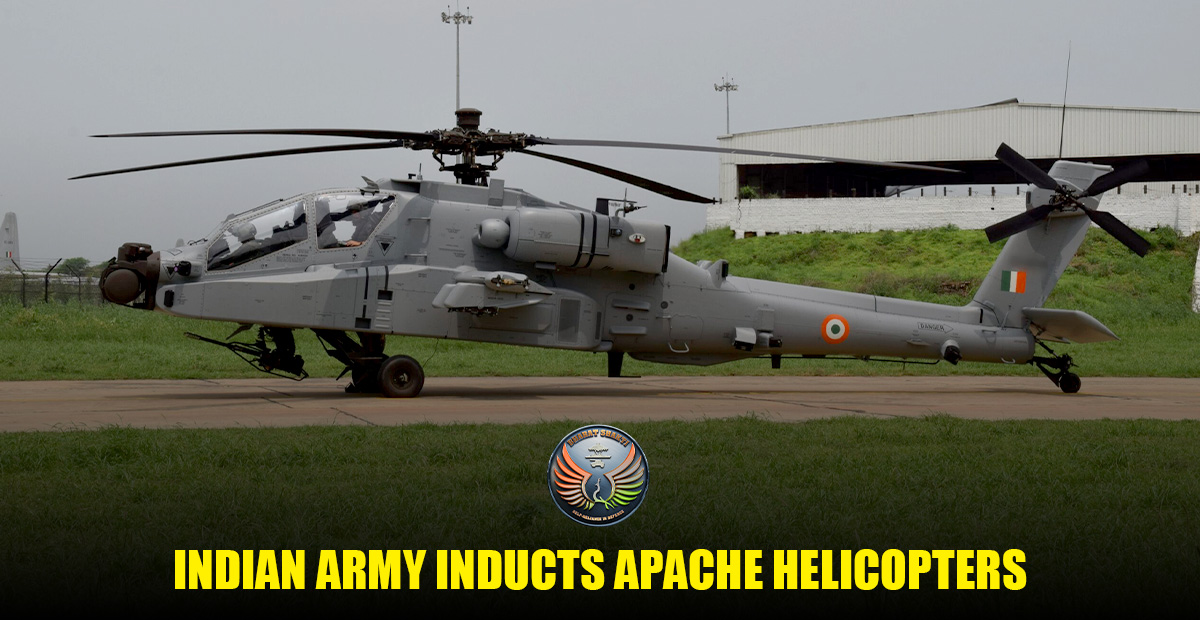
In a boost to the Army Aviation Corps, the first three AH-64E Apache attack helicopters were inducted on July 22, with the remaining three delivered in December. The helicopters – long considered a critical force multiplier – mark the culmination of a long-pending Army aviation modernisation plan.
New Battlefield Structures Rolled Out
The Army said 2025 also saw the visible fielding of new tactical organisations, intended to reshape frontline combat capability for future conflict.
These include:
- Bhairav Battalions – light commando formations
- Ashni Platoons – drone-enabled ISR and precision-strike units
- Shaktibaan Regiments and Divyastra Batteries – formations centred on unmanned systems and loitering munitions
A capability demonstration in Rajasthan on October 24 showcased the integrated employment of these new units alongside emerging technologies. Open reporting indicated plans to operationalise 25 Bhairav battalions on an accelerated timeline, with Ashni Platoons rolled out across infantry formations.
Indigenisation and Unmanned Systems Surge
The Army reported that 91% of ammunition currently in use is now indigenised, reflecting steady progress under Atmanirbhar Bharat.
It also confirmed a major expansion in unmanned systems, including:
- Around 3,000 Remotely Piloted Aircraft (RPAs)
- 150 tethered drones
- swarm drones
- logistics drones for high-altitude operations
- kamikaze (loitering) drones
The Defence Acquisition Council decisions of December 29, 2025, reflected an apparent tilt toward unmanned systems, counter-UAS capabilities, and precision fires, aligning with lessons from modern conflicts and India’s own operational experience.
Other approvals included MALE RPAs for tri-service surveillance and strike roles, and, on August 5, the Acceptance of Necessity for thermal-imager-based Driver Night Sights for BMPs, enabling safer night manoeuvres for armoured units.
Focus on Digitisation and Faster Battlefield Decisions
The Army said 2025 also marked significant progress in operational digitisation, with edge data centres established to accelerate “data-to-decision” cycles closer to the tactical battlefield.
In-house software systems were rolled out to support both operations and welfare functions, including Equipment Helpline and the Sainik Yatri Mitra App, signalling a drive toward streamlined logistics and soldier-support services.
‘From Adoption to Integration’
The Army described 2024–25 as years of technology absorption, saying the emphasis had shifted from simply acquiring systems to embedding them into force structures, doctrines and training.
With Operation Sindoor demonstrating deterrence in action, officials said the capability milestones achieved through 2025 – from deep-strike accuracy to unmanned warfare – underline a broader transformation of the Indian Army toward faster, technology-enabled, joint-force operations aimed at countering future threats.
Team BharatShakti