



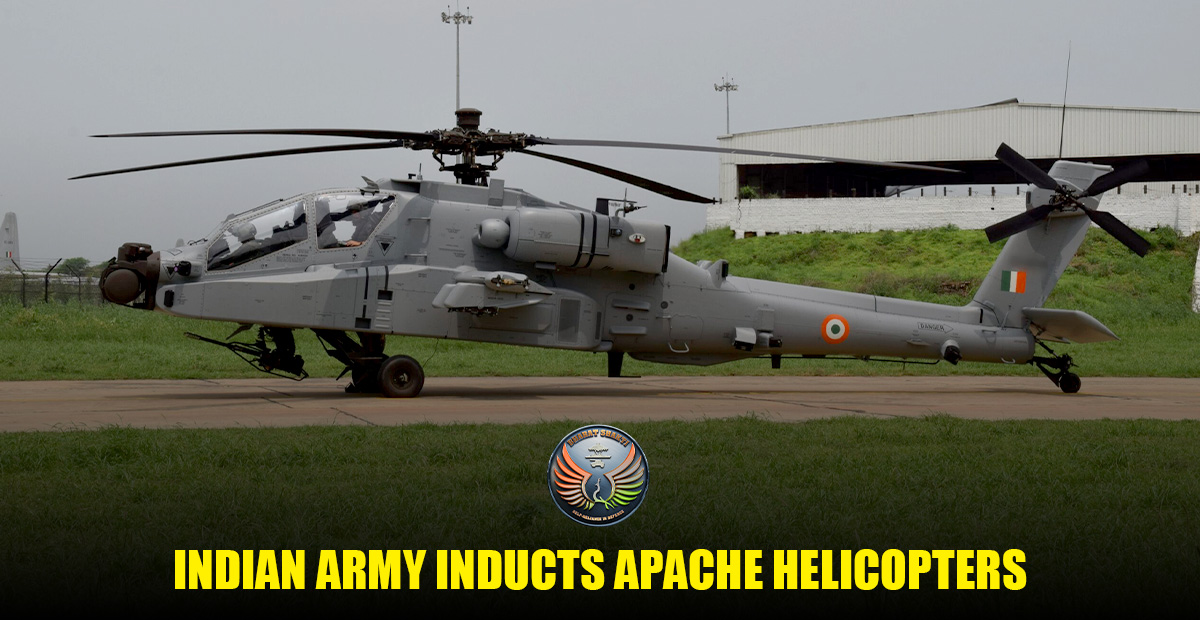
The long wait is finally over. After more than 15 months of delays, the Indian Army is set to induct its first batch of Boeing AH-64E Apache attack helicopters, marking a major step forward in modernising its battlefield capabilities. The first three of six helicopters will be officially handed over on July 22 and are scheduled for deployment at Jodhpur, near the Pakistan border.
This induction comes under a $600 million deal signed with the United States in 2020. The helicopters, widely regarded as among the most advanced combat platforms in the world, will form part of the newly raised 451 Army Aviation Squadron under the Western Command.
Why the Apache Matters
The Apache AH-64E is a battle-tested, multi-role attack helicopter equipped with advanced sensors, precision-guided munitions, and a powerful 30mm chain gun. It is capable of operating in all weather conditions and has seen extensive use in modern conflicts, including Iraq and Afghanistan.
For the Indian Army, the Apache provides a critical edge in high-threat environments, especially in desert and plains sectors where armoured threats are prominent.
“These helicopters are built for high-intensity warfare,” said a senior officer in the Army Aviation Corps. “Their combination of mobility, firepower, and survivability is unmatched in our current inventory.”
Delays and Diplomatic Push
Initially, the helicopters were expected to arrive between May and June 2024. However, production issues, logistical constraints, and supply chain disruptions in the U.S. caused repeated delays. The matter reportedly drew high-level attention, with Defence Minister Rajnath Singh raising the issue during a recent call with U.S. Secretary of Defence Pete Hegseth.
Both sides reaffirmed their commitment to accelerating defence deliveries and strengthening defence-industrial cooperation, according to a U.S. Department of Defence statement.
With the first three Apache now en route, the remaining three are expected to follow later this year.
Jodhpur: Strategic Location
The Apaches will be based at Nagtalao, Jodhpur, an area of strategic importance near the India-Pakistan border. Their presence is expected to significantly bolster the Army’s rapid-response capability in the western sector, especially in light of recent operational developments under Operation Sindoor.
The helicopters will not only support ground forces during combat operations but also provide a crucial deterrent in areas vulnerable to mechanised incursions.
Complementing Indigenous Platforms
The Army has already inducted the HAL-developed Light Combat Helicopter (LCH) “Prachand,” optimised for high-altitude operations in regions like Ladakh. The Apache, on the other hand, is designed for intense strike missions at lower altitudes and in flat terrains.
“The LCH and Apache serve complementary roles,” a senior official explained. “While Prachand gives us an edge in mountainous terrain, the Apache brings unmatched capabilities to desert and plains warfare.”
The Army Aviation Corps currently operates three aviation brigades—in Misamari (East), Leh (North), and Jodhpur (West)—each tailored to their respective operational theatres.
Strengthening the Aviation Corps
Ahead of the Apache delivery, Indian Army pilots and technicians underwent extensive training in the United States under Boeing’s program. The helicopters were initially assembled at the Tata-Boeing facility in Hyderabad before being sent to the U.S. for final integration and testing.
Besides the Apache and LCH, the Army’s rotary-wing fleet includes the Rudra (an armed variant of the HAL Dhruv), Cheetah, and Chetak helicopters for reconnaissance and evacuation, as well as Mi-17s for transport. Unmanned systems, such as the Heron and Searcher, are also deployed for surveillance operations.
Looking ahead, discussions are ongoing to procure an additional 11 Apache helicopters, expanding the original requirement to 50. In parallel, the Defence Acquisition Council has approved the procurement of 156 more LCHs for both the Army and the Air Force.
A Tactical Shift
With an increased focus on mobility, speed, and precision strikes, the Army is restructuring its combat doctrine around technology-driven platforms.
As tensions continue along multiple borders, the addition of the Apache helicopters offers a timely enhancement to India’s deterrence posture, ensuring that the Army can respond quickly, decisively, and with overwhelming force when required.
Team BharatShakti