



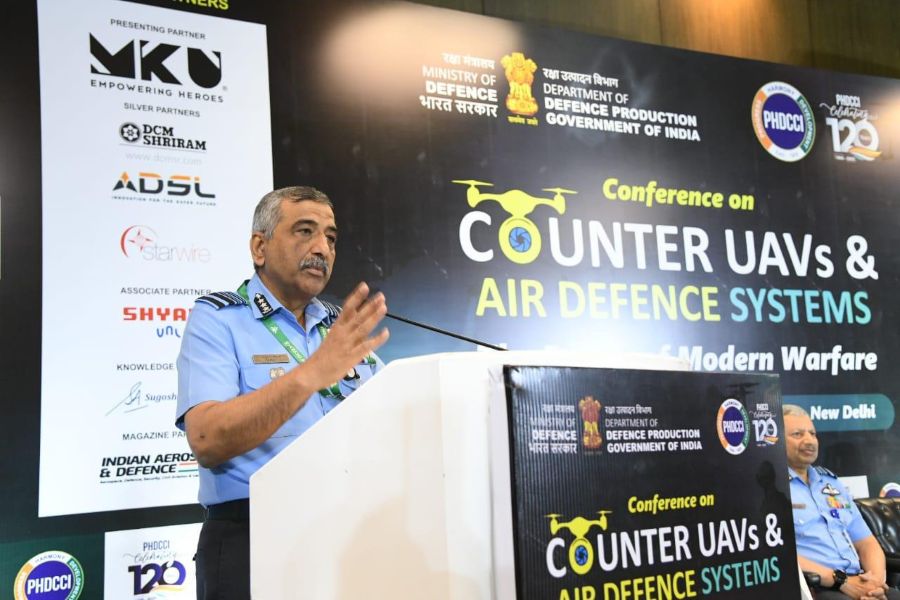
As unmanned aerial vehicles (UAVs) redefine the nature of warfare worldwide, India’s military leadership has signalled the need for a rapid transformation of its air defence doctrine to counter an increasingly drone-dominated battlefield. This message was conveyed forcefully at a high-level conference on “Counter UAVs & Air Defence Systems: The Future of Modern Warfare,” hosted by the PHD Chamber of Commerce and Industry (PHDCCI) in New Delhi.
Air Marshal Ashutosh Dixit, CISC at HQ IDS, delivered the keynote, warning that drones have shifted from being tactical tools to strategic disruptors. He cautioned that swarms of hundreds of UAVs could overwhelm traditional air defence systems, making it imperative for India to adopt a layered defence matrix that combines electronic warfare, kinetic interceptors, directed-energy weapons, and advanced long-range detection radars.
“Drone warfare is not a distant scenario; it is a current operational reality,” he stressed, urging a doctrinal shift to integrate counter-drone strategies into India’s core warfighting policies.
Air Marshal Rakesh Sinha, Deputy Chief of Integrated Defence Staff (OPS), underlined the disruptive impact of low-cost drones, which can be easily weaponised and deployed to devastating effect. To counter this asymmetry, he called for embedding AI-driven threat detection, sensor fusion, and machine learning into India’s air defence command-and-control systems.
He noted that without real-time, automated decision support, conventional human-led responses may prove inadequate against massed and fast-moving drone attacks.
The event drew over 200 senior representatives from the Armed Forces, Ministry of Defence, industry leaders, and academia, underscoring the urgency of preparing India’s security architecture for drone warfare threats across both borders and urban centres.
Neeraj Gupta, MD of MKU Ltd., highlighted that the global UAV market is projected to cross USD 50 billion by 2030, creating both challenges and opportunities. He urged agile procurement policies, rapid R&D, and robust testing ecosystems to match the 12–18-month innovation cycles of drone technology.
Gupta proposed a National Roadmap for Counter-UAV Self-Reliance, arguing that with targeted policy backing, Indian defence manufacturers could transition from importers to exporters of drone defence systems.
Col. K. V. Kuber, Director for Aerospace & Defence at Ernst & Young LLP, emphasised that Indian startups have already developed more than 40 indigenous counter-drone prototypes. But he warned that the next leap must focus on scalability, standardisation, and operational deployment.
Citing the success of Operation Sindoor – where rogue drones were neutralised in coordinated missions – he called for institutionalising a TPCR (Technology, Policy, Collaboration, Rapid Response) framework to future-proof India’s defences.
Speakers collectively warned that drone warfare evolves faster than conventional procurement cycles. Future conflicts, they agreed, will punish delay and fragmented responses. The resounding message is that India’s counter-drone policy must be accelerated, integrated, and forward-looking, or risk being overtaken by adversaries already investing heavily in UAV swarms and autonomous strike systems.
Team BharatShakti


