



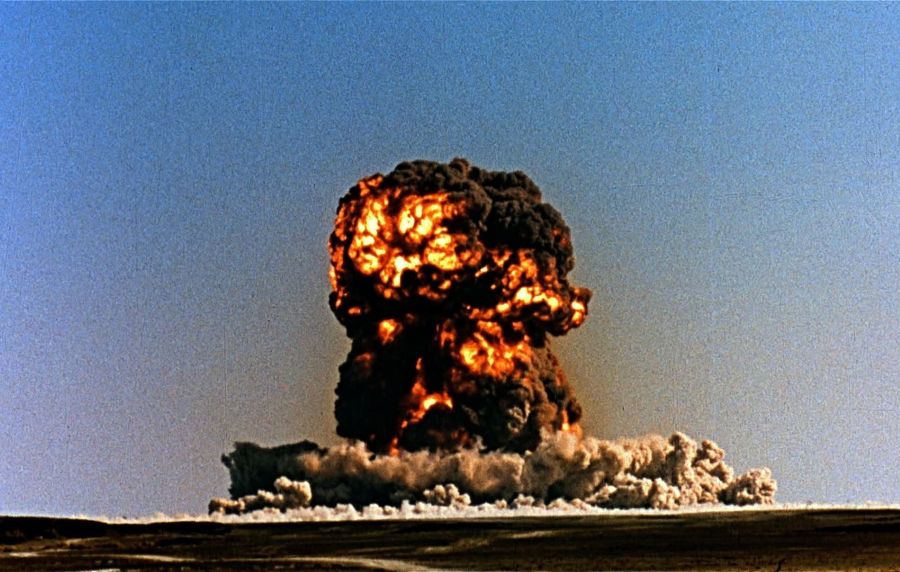
As China’s nuclear arsenal surpasses 600 warheads this year and Beijing continues to withhold ratification of the Comprehensive Nuclear-Test-Ban Treaty (CTBT), the scars left by decades of testing at Lop Nur in Xinjiang once again come into focus.
The region, long on the periphery of China’s development narrative, paid a steep price for the country’s nuclear rise, one built on secrecy, control, and sacrifice. By contrast, India’s nuclear policy, shaped by public debate, limited scope, and doctrinal clarity, presents a contrasting model of how a regional power can pursue deterrence without abandoning transparency or restraint.
A Tale of Two Programmes
China’s nuclear journey began on 16 October 1964 with its first atomic test at Lop Nur. Over the next 32 years, the country conducted 45 to 47 nuclear tests at the site, including both atmospheric and underground explosions. These trials were key to the development of both fission and thermonuclear weapons, helping Beijing secure its place among the world’s nuclear powers. However, this progress came at a heavy cost, borne mainly by the residents of Xinjiang, primarily Uyghur and Kazakh communities.
India’s nuclear path, while secretive in its early stages, took a more limited and doctrinally guided route. With tests in 1974 and 1998, followed by the clear articulation of a “minimum credible deterrence” policy and a declared no-first-use stance, India has kept its programme tightly focused on deterrence rather than coercion. Civilian oversight and public accountability have played a key role in shaping its nuclear posture.
Lop Nur: Remote, Controlled, and Costly
The choice of Lop Nur for China’s nuclear testing was strategic, remote, sparsely populated, and tightly controlled by the People’s Liberation Army (PLA). Yet this remoteness masked a deeper reality: the area was home to ethnic minorities who were either displaced or exposed to health and environmental hazards with little say or protection. Over time, large swathes of eastern Xinjiang were brought under military administration, reinforcing Beijing’s broader project of control over the region.
The PLA was not just a military force executing weapons development; it became a governance actor in Xinjiang. Nuclear testing was part of a wider pattern of securitisation that would, decades later, shape policies of mass surveillance, re-education camps, and demographic controls.
A Legacy Without Acknowledgement
From 1964 to 1996, China conducted 22 atmospheric and 22 underground detonations. The most notable was the thermonuclear test of 17 June 1967, just three years after China’s first fission bomb, showcasing a speed of development that outpaced even Cold War rivals.
Yet, Beijing has never released full data on the environmental or human toll. Independent reports suggest that radioactive fallout from atmospheric tests affected not only Xinjiang but also regions across Central Asia. Dust storms may have carried isotopes beyond national borders, but internal studies remain classified, and casualty figures are unknown.
Unlike the U.S. or post-Soviet Kazakhstan, where declassified records and compensation programmes have addressed past testing, China has kept a tight lid on the Lop Nur legacy. Despite signing the CTBT in 1996, China has not ratified it, preserving ambiguity over future testing while avoiding the legal constraints of full commitment.
India: Limited Tests, Clear Doctrine
Conducted under high secrecy, the 1974 and 1998 tests were followed by public disclosures and strategic clarity. India outlined a no-first-use policy, focused on maintaining a credible but minimal deterrent. The absence of repeated testing, combined with democratic oversight and parliamentary debate, has defined India’s nuclear stance as defensive and restrained.
While India does not disclose full details of its arsenal, estimates suggest a much smaller stockpile than China’s. The emphasis remains on survivability, second-strike capability, and avoiding arms races, core tenets that shape India’s posture to this day.
Nuclear Power and Political Control
China’s nuclear weapons have served more than just deterrent purposes. Integrated into the PLA’s broader strategic toolkit, they support both external signalling and internal control. In this sense, nuclear weapons have helped Beijing reinforce claims over territory, project technological strength, and govern peripheral regions like Xinjiang through militarisation.
India’s doctrine, by contrast, avoids integrating nuclear power with political coercion. Civil-military relations are governed by clear lines of civilian control, and nuclear weapons remain outside the realm of conventional military operations or domestic enforcement.
The Unseen Costs of Power
China’s rise as a nuclear power has been accompanied by prestige but little accountability. The development of its arsenal brought recognition, but at the cost of transparency, institutional safeguards, and regional trust. The fact that victims of nuclear fallout in Xinjiang remain unnamed, uncompensated, and largely forgotten reflects a deeper pattern of governance prioritising state goals over individual rights.
India, too, has faced scrutiny over its nuclear decisions, especially in 1998, but the difference lies in its willingness to articulate and limit its ambitions through public policy and doctrinal statements.
Two Paths in a Nuclear Asia
As the Asian strategic environment evolves, China and India offer two distinct models of nuclear development. One is rooted in centralised control, secrecy, and expansion. The other is grounded in democratic oversight, restraint, and minimalism.
The history of Lop Nur is not just a chapter in the Cold War nuclear race; it is a window into how power is exercised, who bears the cost, and what legacies are left behind. As China modernises its nuclear arsenal, including new delivery platforms and warhead designs, the unresolved story of Xinjiang casts a long shadow.
India’s model may not be perfect, but it provides a counterpoint: that nuclear power, when bounded by policy and accountability, need not come at the expense of public trust or human dignity.
Huma Siddiqui


