



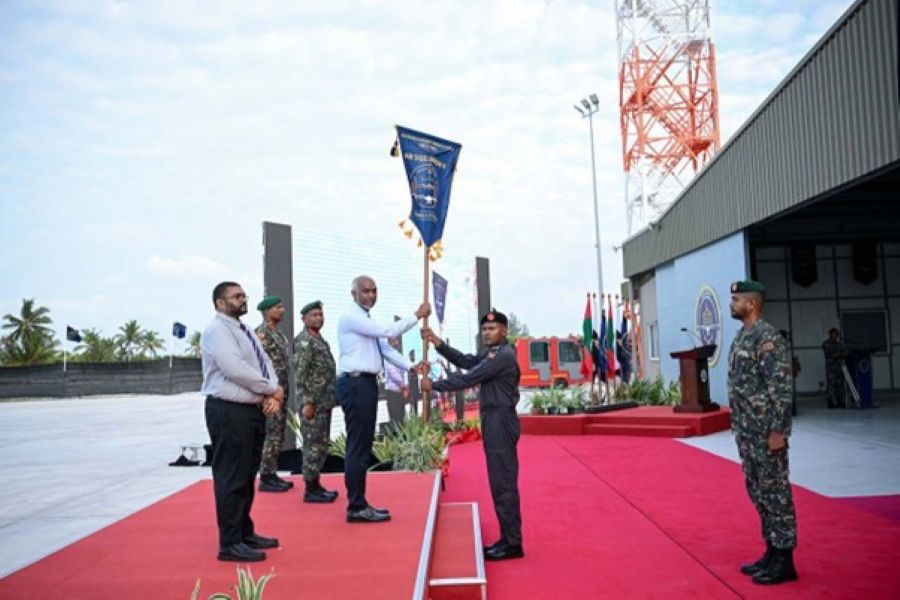
The Maldives will acquire its first military aircraft next year, President Mohamed Muizzu announced on Wednesday while inaugurating the Maldives National Defence Force (MNDF)’s first dedicated air station at Addu City, the country’s southernmost atoll.
The Gan Air Station, commissioned under the newly constituted MNDF Air Corps, marks a significant expansion of the island nation’s defence infrastructure and air surveillance capability. The state-run Public Service Media (PSM News) described the event as a “landmark moment” that formalises a key component of the national defence strategy.
“The Maldivian army has made progress in all areas,” President Muizzu said at the inauguration, according to local portal Adhadhu. “Hopefully, this coming year will be more progressive. We have already decided to get military aircraft for the Air Corps,” he added, without offering further details.
Expanding the Air Corps and Surveillance Mandate
The commissioning follows a Presidential Decree issued on November 3, which directed the MNDF Air Corps to establish and operationalise the air station to support airspace surveillance, Exclusive Economic Zone (EEZ) monitoring, and the execution of operational missions. The Decree also mandates 24-hour continuous airspace surveillance over the Maldivian EEZ.
The Air Corps itself was formally constituted earlier this year, on March 15, 2024, under a separate Presidential Decree. Muizzu had previously inaugurated the MNDF’s unmanned aerial vehicle (UAV) service at Maafaru International Airport last year, signalling his administration’s focus on enhancing indigenous surveillance capabilities.
“With the commissioning of the Gan Air Station, all military air operations necessary to maintain the security of Maldivian airspace have now been fully launched,” PSM News reported.
Rising Defence Expenditure and Turkish Partnership
The Maldives’ proposed state budget for 2026 allocates MVR 2.8 billion (around USD 180 million) for defence, equivalent to roughly four per cent of total government spending, Adhadhu reported. The government has not publicly detailed the defence outlay, citing “national security reasons.”
The largest known military acquisition under Muizzu’s administration so far is a USD 37 million (MVR 570 million) deal with Turkey for six armed drones, reflecting a notable diversification of defence partnerships. The 2026 budget also allocates MVR 99 million for the private insurance of the UAV fleet.
The increased engagement with Turkish defence firms follows Muizzu’s broader push to build what he describes as a more “self-reliant and sovereign” defence posture, distinct from the Maldives’ previous dependence on external military assistance — particularly from India, which had stationed defence personnel to operate aircraft gifted for humanitarian and surveillance roles.
Since Muizzu assumed office in late 2023, his administration has sought to reduce the Indian military footprint in the archipelago, leading to the gradual withdrawal of Indian personnel earlier this year. The establishment of an operational air station and the upcoming acquisition of aircraft are seen as part of efforts to fill the domestic capability gap.
First Operational Success for Air Corps Drones
In a related development, PSM News reported that the MNDF recently intercepted a foreign vessel operating illegally in Maldivian waters, an operation guided by one of the Air Corps’ drones. The Coast Guard Special Boat Squadron executed the interception, though no further details were disclosed.
According to PSM News, the MNDF’s new armoured UAVs can fly for up to 20 hours at speeds of 220 km/h and carry out search and rescue operations at night, offering a substantial enhancement over earlier surveillance capabilities that relied solely on Coast Guard patrol vessels.
Defence analysts in the region view these developments as evidence of a strategic realignment in Malé’s defence policy, with the Muizzu administration balancing national security ambitions and political messaging of autonomy, even as it seeks new security partnerships beyond its traditional sphere.
Team BharatShakti


