


At the Army War College on Tuesday, some of the nation’s top military commanders reflected on the hard lessons of Operation Sindoor while mapping the contours of future warfare at Ran Samwad 2025, a tri-service seminar focused on technology, jointness, and transformation in warfighting.
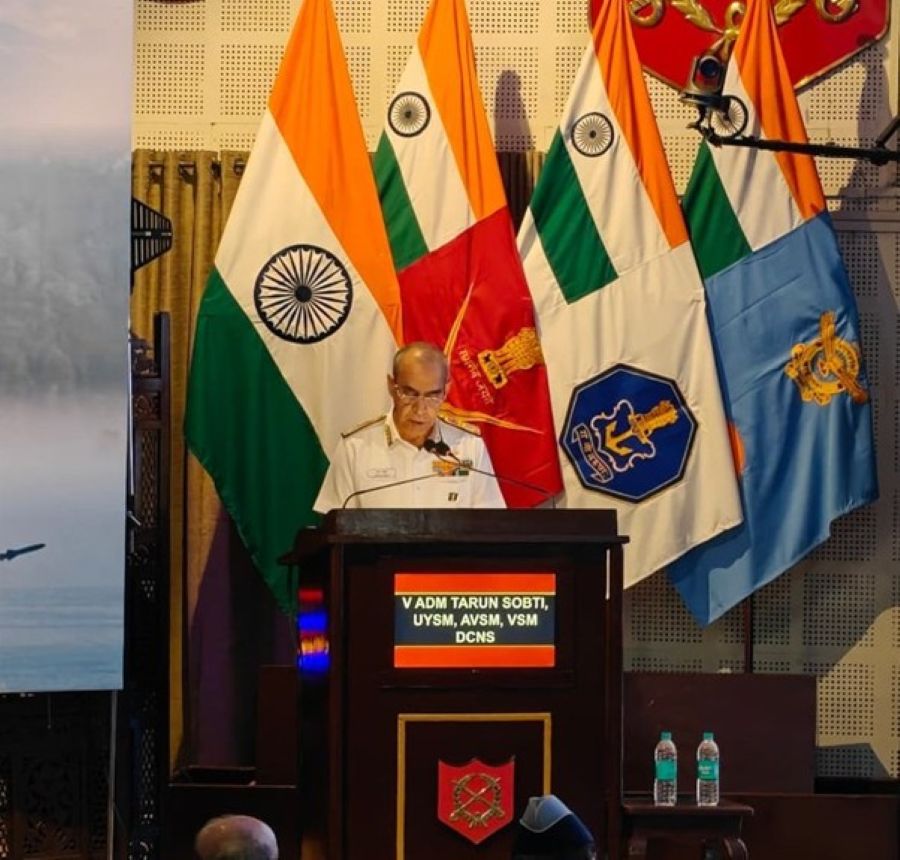
Vice Admiral Tarun Shobti, Deputy Chief of Naval Staff, described how the Navy’s readiness and rapid mobilisation during Operation Sindoor translated into speed, precision and deterrence while speaking to media at the sidelines of the ongoing event in Mhow.
“Many lessons have been learned – not just by the Navy, but across the armed forces,” he noted. “Several corrective measures are already in place, and others are being fast-tracked.” He underlined that the larger discussion now is about looking beyond the operation: “We are examining the wider impact of technology on warfare as seen in recent conflicts, and how we should envision and prepare for future war.”
Air Marshal Nagesh Kapoor, Air Officer Commanding-in-Chief of the South Western Air Command, emphasised self-reliance as a defining takeaway as his command played a crucial role during the operation.
“The big lesson is indigenisation. We cannot afford supply-chain vulnerabilities. This time we demonstrated the use of indigenous weapons – and in the future, we must innovate and build at home to avoid such issues,” he said.
Lt Gen A. Sengupta, General Officer Commanding-in-Chief, Central Command, highlighted the emerging threat from drones.
“During Operation Sindoor, we faced a large number of hostile drones. We must strengthen counter-drone measures while simultaneously developing our own aerial and autonomous capabilities to target enemy networks. Ran Samwad is a vital platform for such discussions,” he stressed.
On the information domain, Lt Gen Vipul Shinghal, Deputy Chief of Integrated Defence Staff (Doctrine, Organisation & Training) and seminar organiser, underlined the media’s central role in cognitive warfare.
“The armed forces can create the story, but it must be told from the right perspective. That is where media partnership is crucial. By inviting the media in large numbers to Ran Samwad, we are taking a correct step in that direction,” he said.
A Forward Deterrent Posture: Navy Might
Vice Admiral Shobti detailed how peacetime preparedness fed directly into wartime readiness. The Navy’s biennial theatre-level exercise TROPEX, which concluded earlier this year, had already placed forces in a state of high readiness when the Pahalgam attack triggered a crisis.
“Within 96 hours, every operational ship topped up ammunition, submarines were loaded, and we sailed out,” he recalled.
A key highlight was the embarkation of 15 MiG-29K fighters on India’s newest carrier, INS Vikrant, marking a powerful demonstration of sea-based deterrence.
“Our aim was clear – to maintain a forward deterrent posture so that the adversary Navy could not threaten our coastline, our trade routes, or our economic lifelines,” he said. “This posture proved decisive. We bottled up the Pakistani Navy near their coast, denied them freedom of manoeuvre, and maintained control of the seas.”
Setting the Stage for Future War
Over two days, Ran Samwad (August 26–27) is deliberated on joint doctrines, technological adaptation, and capability roadmaps. Defence Minister Rajnath Singh is scheduled to deliver the plenary address on the final day, while Chief of Defence Staff Gen Anil Chauhan opened the proceedings on Tuesday.
By blending lived operational experience with forward-looking debates on technology and jointness, Ran Samwad is being positioned as a crucible for shaping India’s next-generation warfighting strategies on the lines of the Shangri-La Dialogue – Asia’s foremost defence and security summit.
Ravi Shankar, Mhow

Dr Ravi Shankar has over two decades of experience in communications, print journalism, electronic media, documentary film making and new media.
He makes regular appearances on national television news channels as a commentator and analyst on current and political affairs. Apart from being an acknowledged Journalist, he has been a passionate newsroom manager bringing a wide range of journalistic experience from past associations with India’s leading media conglomerates (Times of India group and India Today group) and had led global news-gathering operations at world’s biggest multimedia news agency- ANI-Reuters. He has covered Parliament extensively over the past several years. Widely traveled, he has covered several summits as part of media delegation accompanying the Indian President, Vice President, Prime Minister, External Affairs Minister and Finance Minister across Asia, Africa and Europe.