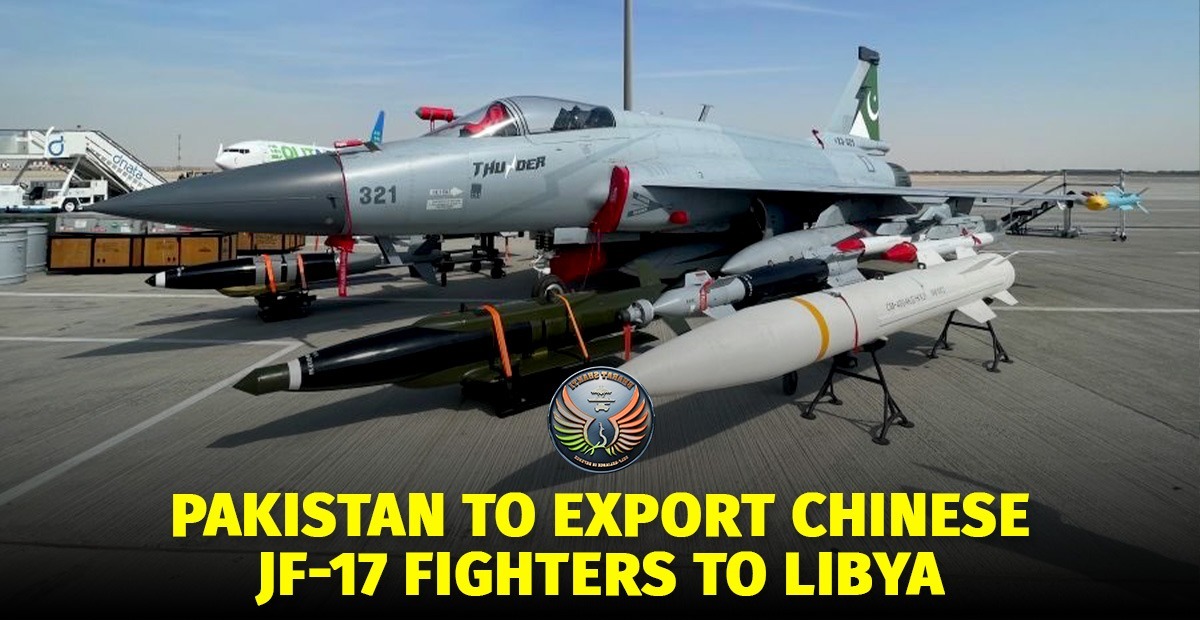
Pakistan has struck an arms deal worth more than $4 billion with the Libyan National Army (LNA), one of Islamabad’s largest-ever defence export agreements, despite a longstanding United Nations arms embargo on the North African country, Reuters reported, citing Pakistani officials.
The agreement was finalised following a meeting last week in Benghazi between Pakistan’s Army Chief, Field Marshal Asim Munir, and Saddam Khalifa Haftar, the LNA’s Deputy Commander-in-Chief, four Pakistani officials told Reuters. The officials, all involved in defence matters, spoke on condition of anonymity due to the sensitivity of the deal.
Pakistan’s foreign ministry, defence ministry and military did not respond to requests for comment, the report said.
According to a copy of the agreement seen by Reuters before it was finalised, the deal includes the sale of 16 JF-17 multi-role fighter jets, jointly developed by Pakistan and China, and 12 Super Mushak trainer aircraft used for basic pilot instruction. One official confirmed the accuracy of the list, while another said the equipment detailed in the list formed part of the final agreement, but exact quantities could still change.
One official said the package covers equipment for land, sea and air forces, to be delivered over two-and-a-half years. Two officials valued the deal at more than $4 billion, while two others put the figure closer to $4.6 billion.
The LNA’s official media outlet said on Sunday, Reuters reported, that it had entered into a defence cooperation pact with Pakistan encompassing arms sales, joint training and military manufacturing, without providing financial or technical details.
“We announce the launch of a new phase of strategic military cooperation with Pakistan,” Haftar said in remarks broadcast by Al-Hadath television.
Authorities in Benghazi did not immediately respond to requests for comment.
Libya has remained deeply divided since a 2011 NATO-backed uprising that toppled longtime ruler Muammar Gaddafi. The U.N.-recognised Government of National Unity (GNU), led by Prime Minister Abdulhamid Dbeibah, controls much of western Libya, while Haftar’s LNA dominates the east and south, including key oilfields, and does not recognise the authority of the Tripoli-based administration.
U.N. Arms Embargo Concerns
Libya has been under a U.N. arms embargo since 2011, requiring prior approval for all transfers of weapons and military equipment. A U.N. panel of experts said in a December 2024 report that the embargo remained “ineffective,” noting that foreign states were increasingly open about providing training and military assistance to forces on both sides of Libya’s conflict.
It remains unclear whether Pakistan or the LNA sought exemptions from the embargo. Three Pakistani officials told Reuters the agreement did not violate U.N. restrictions. One said Pakistan was not alone in engaging with Libyan actors, another noted that Haftar is not personally sanctioned. A third pointed to improving relations between eastern Libyan authorities and Western governments amid rising fuel exports.
Pakistan Pushes Defence Exports
Islamabad has been seeking to expand defence exports, leveraging decades of counter-insurgency experience and a growing domestic defence industry that covers aircraft manufacturing, armoured vehicles, munitions, and naval construction.
Pakistan has actively marketed the JF-17 as a lower-cost alternative to Western fighter jets, offering bundled packages that include training and maintenance outside traditional Western supply chains.
“Our recent war with India demonstrated our advanced capabilities to the world,” Munir said in remarks aired by Al-Hadath.
Pakistan has also stepped up security cooperation with Gulf partners, signing a Strategic Mutual Defence Agreement with Saudi Arabia in September 2025 and holding senior-level defence talks with Qatar.
The Libya agreement would significantly expand Pakistan’s defence footprint in North Africa, as regional and global powers compete for influence over Libya’s fragmented security institutions and oil-backed economy.
Team BharatShakti