


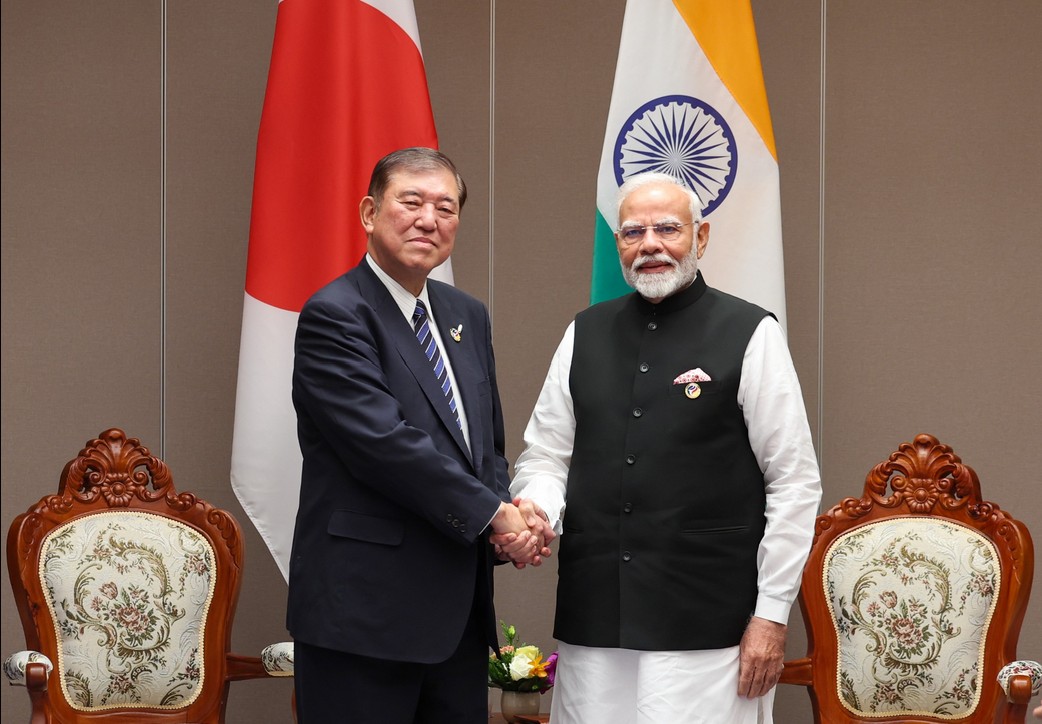
Prime Minister Narendra Modi will embark on a key visit to Japan from August 28-30, 2025, marking an important moment in the deepening of India-Japan relations.
The visit, confirmed by Foreign Secretary Vikram Misri on Tuesday at a special briefing, comes at a critical time in the Indo-Pacific’s evolving strategic landscape. This is expected to reinforce bilateral defence cooperation, co-production initiatives, and regional security dialogue under the QUAD framework.
“This will be PM Modi’s first annual summit with his Japanese counterpart, and his first standalone visit to Japan in nearly seven years,” Misri stated in New Delhi. “The visit will be fully dedicated to the bilateral agenda,” he added.
PM Modi is scheduled to hold the 15th Annual India-Japan Summit with Japanese Prime Minister Shigeru Ishiba on August 29 and 30. This summit, considered the most important bilateral dialogue mechanism, will provide an opportunity to conduct a comprehensive review of the expanding India-Japan Special Strategic and Global Partnership.
Strengthening Defence and Security Collaboration
The defence and security domain are on the agenda. Both countries have steadily elevated their strategic engagement in recent years through joint military exercises, reciprocal logistics agreements, and technology sharing. Notably, Japan’s recent policy shift toward exporting defence equipment, including lethal platforms has opened new doors for collaboration with trusted partners like India.
Referring to the defence cooperation, Foreign Secretary Misri stressed the evolving nature of the partnership: “This has indeed emerged as an important builder of cooperation between the two countries. Earlier, this month the defence minister of both sides were able to review a host of issues, more importantly in defence equipment and technology collaboration, which is an important part of the overall defence and security engagement between the two sides.”
Unicorn Masts system
Among the flagship projects under discussion is the “Unicorn Masts” system—a sophisticated radar antenna cluster developed collaboratively by India’s Bharat Electronics Limited (BEL) and Japanese defence companies. The radar mast, first installed on Japan’s Mogami-class frigates, enhances stealth capabilities and surveillance performance. A Memorandum of Implementation for this landmark initiative was signed in November 2024, making it the first co-development/co-production defence project between the two nations.
According to the foreign secretary, Japan’s ATLA (Acquisition, Technology and Logistics Agency) and India’s DRDO are also engaged in advanced defence R&D across several domains.
“Both agencies are keen on working jointly on projects related to underwater wireless power transmission, UGV/robotics, SiC crystal growth, and anti-drone systems, said sources in the defence and security establishment.
Maritime Security and Indo-Pacific Strategy
Both countries view maritime domain awareness and the freedom of navigation in the Indo-Pacific as top strategic priorities. With China’s expanding naval footprint in the South China Sea and growing regional assertiveness, Tokyo and New Delhi are seeking stronger coordination to ensure peace and stability.
India and Japan have also intensified bilateral and multilateral military drills. Their 2020 agreement on reciprocal logistics support between armed forces continues to facilitate deeper interoperability. A new proposal under discussion includes maintenance cooperation between the Indian Navy and Japan Air Self Defence Force (JASDF).
Foreign Secretary Misri noted, “The Indian Navy and JASDF are also exploring possible cooperation in the area of ship maintenance in India… there are discussions going on a number of other issues between the designated agencies of the two sides.”
High-Tech Collaboration in Aerospace and Submarine Systems
Beyond radar systems, Japan has expressed interest in exporting fighter jets and submarines to India. The Soryu-class submarine, which features cutting-edge lithium-ion battery propulsion, is of particular interest due to its long-endurance, stealth, and quiet operation—making it superior to many of its global counterparts.
Meanwhile, India is independently advancing its Advanced Medium Combat Aircraft (AMCA) project, but both countries are exploring scope for aerospace collaboration, including integration of Indian software with Japanese hardware expertise.
Japan has also reportedly approached India to collaborate on its next-generation fighter jet under the Global Combat Air Programme (GCAP), which currently includes the UK and Italy.
Quad and Regional Strategic Balance
PM Modi’s discussions with Prime Minister Ishiba are expected to include regional security dynamics, especially through the Quadrilateral Security Dialogue (Quad) with the United States and Australia. India is set to host the next Quad summit later this year.
With China’s influence rising, India and Japan are increasingly seen as anchors of a rules-based order in the Indo-Pacific. The two sides are likely to stress freedom of navigation, territorial sovereignty, and enhanced military interoperability during the summit.
Expanding Industrial and Technological Engagement
Beyond defence, industrial cooperation in emerging technologies is on the rise. Indian firm BEL is exploring lithium-ion battery technology with Japan’s Toshiba Corporation, and anti-drone solutions with Jupiter Corporation for Japanese defence needs. These partnerships underline Japan’s growing openness to co-develop and procure advanced systems with India.
Also under negotiation are fabrication facilities for micro motors, cooperative intelligence systems, and other next-gen systems that reflect the increasingly high-tech nature of the bilateral relationship.
A Visit of Strategic Depth
PM Modi’s upcoming visit, his eighth to Japan since 2014, is viewed as a strategically vital engagement amid regional and global flux. It also comes amid shifting dynamics with China and uncertainty in India’s ties with the US.
As Misri said, “The annual summit… drives the agenda of the India-Japan special strategic and global partnership.”