



Despite Pakistan’s humiliating defeat in Operation Sindoor, its military leadership continues to fan anti-India rhetoric. Field Marshal Asim Munir, who frequently hails Kashmiri terrorists as “martyrs,” has escalated tensions over Jammu & Kashmir—even as his government struggles to govern the territory it already occupies: Pakistan-occupied Kashmir (PoJK).
But the real crisis lies within. As Pakistan drowns in debt, it appears to be quietly selling off PoJK’s land and assets, raising alarming questions about transparency, sovereignty, and desperation.
Pakistan’s Economic Tailspin
According to the World Bank, 44.7% of Pakistan’s population now lives in extreme poverty. A toxic mix of misgovernance, mounting debt, decaying infrastructure, and geopolitical adventurism has led the country to the brink of economic collapse.
Pakistan’s federal budget for FY 2025–26 stands at PKR 17.57 trillion, of which a staggering PKR 8.21 trillion (46.7%) is earmarked for debt servicing, with PKR 7.2 trillion allocated to domestic debt alone.
IMF data as of June 2025 shows Pakistan’s outstanding credit at $6.86 billion, with no repayments or new disbursements—a telling sign of a stalled and fragile economic relationship.
Selling PoK: A Hidden Fire Sale?
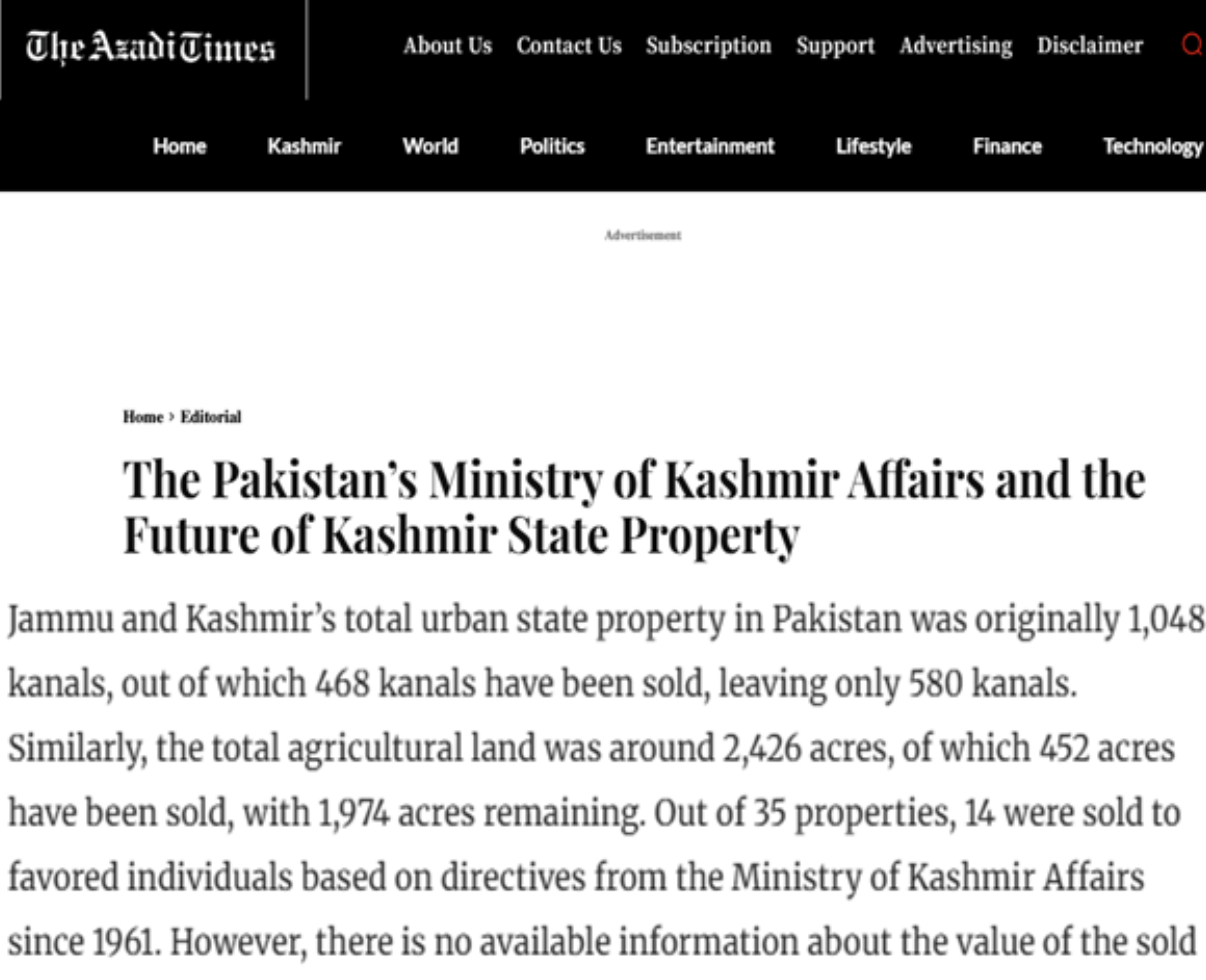
Amid this spiralling debt, Pakistan’s government has begun liquidating PoJK-linked properties—a move raising serious concerns about fiscal priorities and the erosion of local rights. Records from Lahore’s Land Administration Office reveal a deliberate pattern: PoJK assets, many with heritage value, are being sold off—allegedly to repay the national debt.
At least 35 such properties have been sold across Punjab and Khyber Pakhtunkhwa. Worse, 14 of these 35 properties reportedly ended up in the hands of elite insiders, suggesting corruption and crony favouritism. The legal basis for these sales stems from Pakistan’s 1961 PoJK Property Ordinance, originally framed to “maintain” PoJK-linked assets. Over the years, this has mutated into a tool for clandestine land disposal, carried out without local consultation or public disclosure.
Weaponising Kashmir, Abandoning PoJK
Even as Pakistan amplifies its Kashmir narrative, accusing India of aggression, it is simultaneously selling off the very territory it claims to defend. While Munir lends tacit support to terror outfits like Lashkar-e-Taiba, Jaish-e-Mohammed, and Hizbul Mujahideen, the country is liquidating PoJK’s assets—a move that betrays not just fiscal distress but political hypocrisy.
Local voices, including the Jammu and Kashmir Liberation Front (JKLF), have denounced these sales as an assault on PoJK’s autonomy and heritage.
Debt Trap or Terror Financing?
Pakistan’s total debt now stands at over PKR 63 trillion ($224 billion)—three times its annual budget. Nearly half of the 2025–26 budget is dedicated to debt repayment.
Experts warn that:
- These rapid asset sales may be Pakistan’s desperate bid to service debt.
- Proceeds could also be diverted to fund continued proxy operations in Kashmir.
- PoJK’s administration remains uninformed and powerless, further highlighting Islamabad’s top-down, opaque governance.
The Real Crisis: A State Selling Occupied Land
From crown properties to entire villages, Pakistan has gone from occupying PoJK to quietly dismantling it. The duality is stark: professing solidarity with Kashmiris while auctioning their land behind closed doors.
It isn’t just a fiscal manoeuvre—it’s a symptom of a failing state. Whether it’s to repay creditors or finance insurgents, Pakistan’s liquidation of PoJK holdings lays bare the extent of its internal crisis.
The sale of PoJK land is no longer a bureaucratic detail—it’s a geopolitical alarm bell.
It reveals a nation unable to sustain its occupation, hollowed out by debt and destabilised by its own contradictions. Pakistan’s internal unravelling may soon pose greater risks than any external conflict it claims to resist.
Huma Siddiqui