


At Ran Samwad 2026, India’s top military leadership spoke with clarity – and a degree of candour rarely seen in uniform. At Ran Samwad 2026, India’s military leadership did more than outline the future of warfare. It quietly challenged one of the country’s most celebrated strategic narratives: Atmanirbharta in defence.
If one can read between the lines, the message was clear – India may be building weapons at home. But it is not yet sovereign in how it fights.
The keynote by Air Marshal Ashutosh Dixit, Chief of Intergrated Defence Staff (CISC), echoed by HQ IDS India, set the baseline: modern conflicts will begin long before kinetic action – through cyber attacks, space disruptions, information warfare, and economic coercion. The sharper point: Atmanirbharta cannot be reduced to manufacturing weapons. It must translate into sovereignty.
India’s defence ecosystem has made visible strides under Atmanirbhar Bharat – from indigenous platforms to procurement reforms. But at Ran Samwad, he mentioned the uncomfortable gap: India can manufacture ships, drones and artillery. But if our data flows are not sovereign, cyber backbone is externally dependent and AI stack is not indigenous, then India’s warfighting capability is conditionally autonomous at best.
———————————-
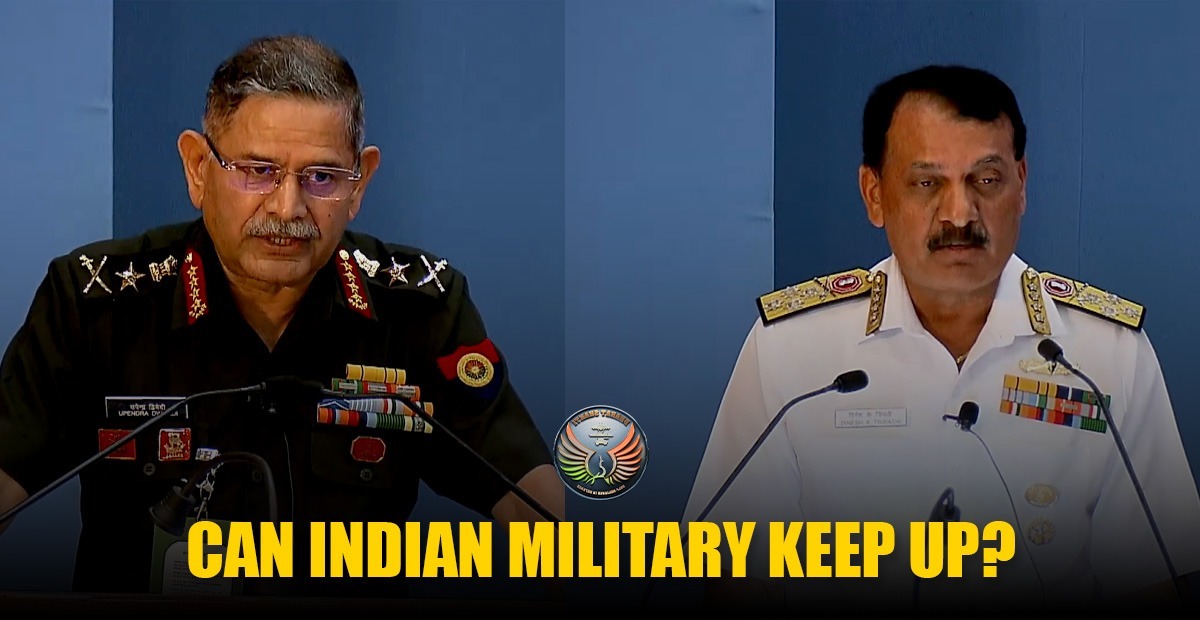
General Upendra Dwivedi, India’s Chief of the Army Staff, went further – and sharper. His articulation of multi-domain operations (MDO) dismantles a comfortable illusion within military thinking: that each service can dominate its own domain and collectively deliver victory.
General Dwivedi’s most important shift is conceptual: the battlefield is no longer geography; it is a system. It is 3-dimensional, layered, and simultaneously kinetic and non-kinetic. In today’s battlefield, he said, ground forces fight physically, cyber operations shape perception, space assets influence targeting and electronic warfare contests the invisible spectrum.
He referred to Operation Sindoor drove home the operational reality – that no single domain delivered victory. But instead, one domain created conditions, another exploited them and a third reinforced the outcome; which is the essence of multi-domain operations (MDO): mutual enablement, not individual dominance.
Perhaps the most actionable part of his remarks is the idea of the 3Is:
- Integration – connects forces
- Informatisation – turns data into awareness
- Intelligentisation – converts awareness into decision advantage
The Army Chief was candid in pointing out that India has not yet arrived. While India is moving from: coordination → jointness → integration, it has not yet reached fusion – where domains dissolve into a seamless operational system.
————————————-
While the Army Chief spoke of transformation, Chief of the Navy Staff Admiral Dinesh Tripathi opened his remarks with a geopolitical reality India can no longer ignore: Tensions in West Asia, disruptions to maritime traffic – these are not distant crises. They are direct strategic pressures.
Reminding the audience that multi-domain operations (MDO) is deeply rooted in Indian strategic thought and exists in India’s own civilisational frameworks, he asserted that India does not need to import strategic thinking – it needs to operationalise its own.
He explained how the game has changed: Today, there is a shift in:
- Speed – that compresses decision-making
- Scale – which expands battlespace complexity
- Simultaneity – which ensures everything happens at once
These are not incremental shifts. They are structural, and together, they create a battlespace where there is no pause, no sequence, and no margin for delay.
He enumerated three levels and three interlinked pillars that are important for MDO to be effective:
- The physical – builds capability – platforms, weapons, networks
- The conceptual – provides coherence – doctrine, strategy, direction
- The human – delivers judgment – decision-making under pressure
In essence: It is not about what we have, but how seamlessly we work together.
The message by all speakers was unmistakable: The character of war has already changed. India is adapting. But the real challenge is to implement the changes with speed.