

India’s geographical positioning offers a distinct advantage in promoting and expanding its maritime outlook. With an almost 11,100 km coastline and proximity to key sea lanes in the Indian Ocean, the Indian subcontinent is geographically poised to be a centre of maritime activity. The coastal regions of peninsular India have a legacy of seafarers engaged in trade and commerce over the centuries. However, for much of India’s contemporary history, ancient maritime history and wisdom have remained ignored and understated. As India is set on the path to becoming a Viksit Bharat by 2047, its maritime outlook will be a key feature of this trajectory.
The Indian Navy, too, has seen significant growth and progress over the past decade. From humanitarian assistance missions in the Western Indian Ocean and joint exercises with partners across the globe, our navy has demonstrated agility, professionalism and a deep sense of purpose. The commissioning of almost 20 new platforms in the last five years and a record seven frontline ships in the year 2025 is indicative of not only the growing confidence of Indian shipbuilding but also the ability of the Indian Navy to absorb technology, train and prepare its personnel to handle the onerous responsibility to operate these platforms.
As this year’s Navy Day passed, it is worth reflecting not just on the ships and the personnel who serve on board, but on the deeper currents shaping our maritime destiny. The Indian Navy continues to make significant progress, but beyond this growth and strategy lie a few questions that warrant answers: Has the nation truly reclaimed its maritime imagination? Are citizens being awakened to the potential that the seas hold for civilisation? The right maritime strategy is not just about building state-of-the-art warships, developing new ports with increased capacities, enhancing the shipbuilding industry’s capabilities, but also about awakening the maritime consciousness of the citizens, learning about maritime heritage, and that’s an area which has proven to be a challenge for our country.
The Forgotten Legacy
India’s maritime history and tradition are not a peripheral idea, but they are central to our civilisational strength. From the engineering marvels of the dockyards at Lothal to the naval expeditions of the Cholas, our ancestors understood the sea as a space of opportunity, diplomacy and power. Several of our ancient texts speak about our ancient maritime history, be it Kautilya’s Arthashastra, which spoke of the Navadhyaksha (the superintendent of ships), and laid out principles of port governance and maritime trade, to the Chola merchant guilds, who ensured that maritime trade and culture exchanges went hand in hand with the Southeast Asian Countries. The Marakkar resistance to Portuguese, French, and Dutch trading powers, and the coastal fortresses built and maintained by Kanhoji Angre to protect the coast, all point to a civilisational grasp of a very robust maritime culture that existed in the subcontinent.
Yet, somewhere along the way, as a civilisation, we lost our maritime outlook, turned inland, and focused on the land borders. Land-based invasions, colonial disruptions, and post-independence priorities blinded our maritime outlook. It may not have been deliberate, but it was incidental to the events and happenings of the time. The result? A meek surrender to the colonial powers, which were primarily sea-based. The colonial seafarers’ ability to gain a foothold in the Indian subcontinent is directly attributable to this strategic miscalculation. Even after independence, our preoccupation with the land borders has led to a strategic calculus that often overlooks the sea. It is a strategic miscalculation, acknowledged by many and has far-reaching consequences.
Resetting Compass
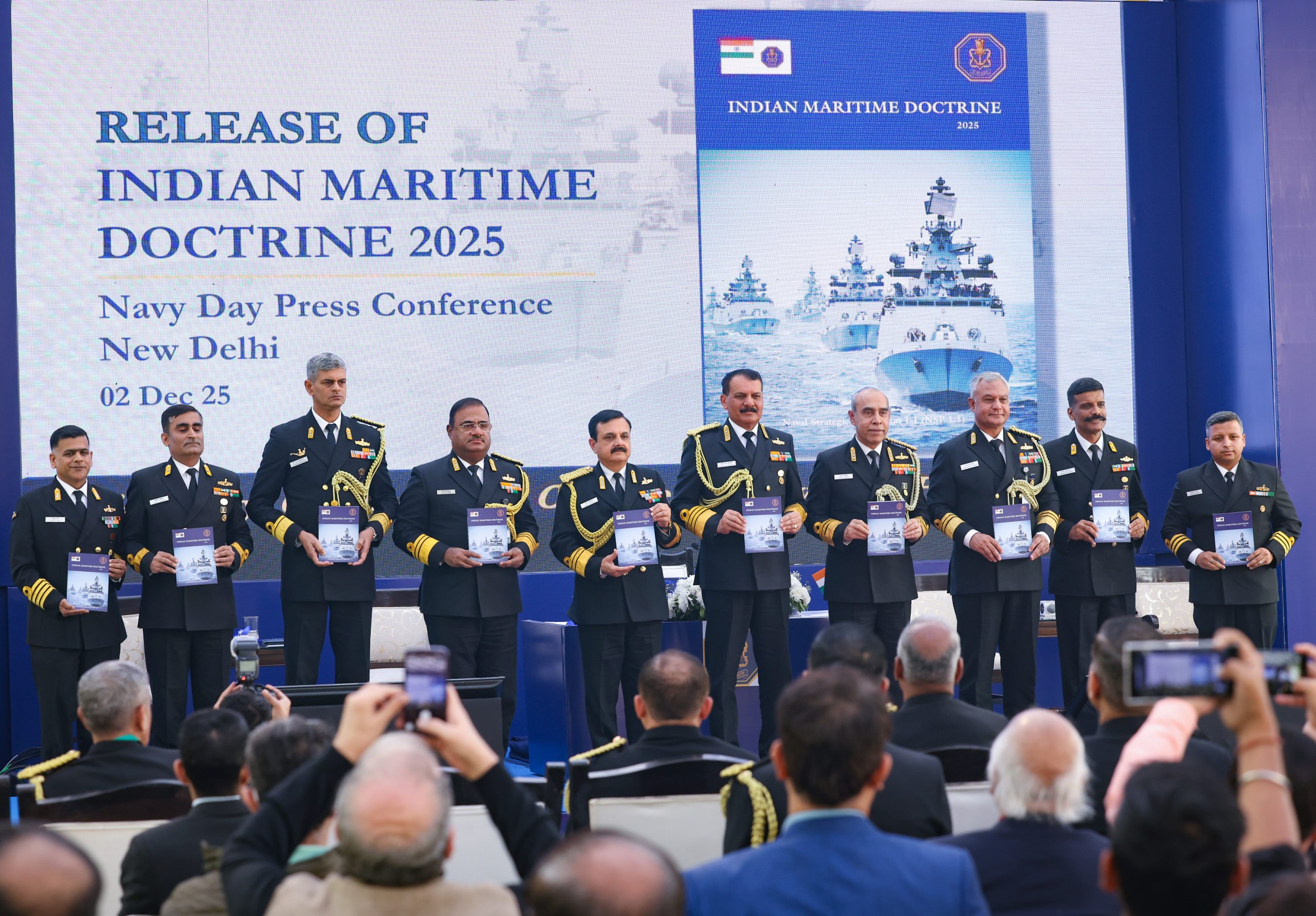
Today, the Indian Navy is not just a guarantor of peace and stability in the IOR – it has the added onerous responsibility of reviving the maritime consciousness of a nation. Examples of the most recent initiatives, including the Maritime Information Sharing Workshop at Gurugram and the Indo-Pacific Regional Dialogue at New Delhi, indicate the Navy’s commitment to the cause and its engagement with policy and decision-makers. To connect with the public at large, extensive effort is being made to organise events like the International or Presidential Fleet Review, the Op Demo on Navy Day, and the THINKQ quiz for younger generations to enhance awareness, all steps in the right direction.
But this must be matched by a broader societal awakening and a more nuanced, long-term policy-based approach to maritime strategy. We need to mainstream maritime thinking across our schools, educational institutions, policies, and public discourse. The youth must learn not just about battles on land, but about the voyages that shaped civilisations. Policymakers must see ports not just as infrastructure but also as instruments of influence, and, most importantly, families of naval personnel must be celebrated not just for their sacrifice but also for their role in anchoring India’s maritime resurgence.
What Lies on the Horizon
As we look to 2026 and beyond, several imperatives stand out for the Indian Navy. The Indian Navy must play a leading role in awakening the nation’s maritime consciousness. The commissioning of INS Tamal – the Indian Navy’s last ship built outside India- has signalled a change and transferred the onerous responsibility of shipbuilding for the Navy to the Indian shipbuilding sector. They now need to be reoriented through focused effort and investment, supported by robust policy guidance and a framework, to meet the heightened expectations. Indian ports must evolve into smart, secure, and strategic hubs of trade and commerce, break free from the shackles of inefficiency and bureaucracy, and exploit the advantages of geography. Be it Vizinjam or Galathia Bay, each has its strategic significance that needs to be harnessed.
A maritime doctrine rooted in ‘Samavāya’—the inseparable link—between India and the Indian Ocean—can guide long-term partnerships and civilizational outreach. Maritime strategy must be rooted in civilizational consciousness, strategic storytelling, and long-term national commitment—not just in rhetoric. This Navy Day, as we honour those who serve at sea, let us also take a pledge to revive and honour the legacy they sail upon. Let us reawaken India’s maritime consciousness—not as nostalgia, but as necessity. It is time India sails forward, guided by its past, anchored in its geography, and propelled by its strategic will.
Capt P Ratheesh (Author is serving officer of the Indian Navy)
Capt P Ratheesh was commissioned in the Indian Navy in Jul 2003. He is a Dornier Pilot and Qualified Flying Instructor with over 4500 hours of flying experience. The officer has commanded INS Kuthar and INS Nashak, as well as the Maritime Reconnaissance Squadron INAS 311, on the Eastern Seaboard.