


The trajectory of India–UK defence cooperation has entered a new phase marked by technology-driven collaboration and industrial co-development. As the United Kingdom’s Carrier Strike Group (CSG), led by HMS Prince of Wales, arrived in Mumbai this week on its Indo-Pacific deployment, Rolls-Royce announced its readiness to partner with the Indian Navy on the design and deployment of the nation’s first electric-powered warship. This move underscores the convergence of the two nations’ strategic and industrial priorities.
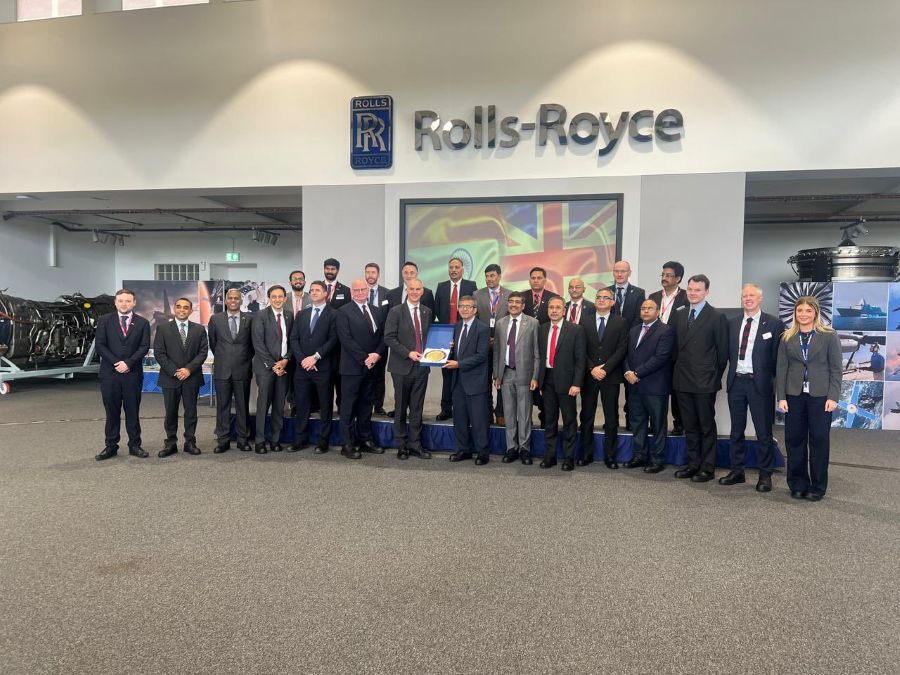
The announcement follows a series of high-level engagements aimed at deepening bilateral defence collaboration. In April 2025, India’s Defence Secretary Rajesh Kumar Singh visited the Rolls-Royce facility in Bristol, UK, to review the company’s advanced capabilities in aero engines, marine propulsion systems, and next-generation energy technologies. The visit formed part of the broader framework of the India–UK Comprehensive Strategic Partnership and reflected India’s intent to leverage UK expertise in key propulsion domains.
Aligning with India’s Electric and Hybrid Propulsion Vision
“Rolls-Royce is well-positioned to support India’s naval modernisation with its proven expertise in integrated hybrid-electric and full-electric propulsion systems,” said Abhishek Singh, Senior Vice President, Defence (India and Southeast Asia), Rolls-Royce.
The company’s MT30 marine gas turbine, currently powering the UK’s Queen Elizabeth-class aircraft carriers, has been recognised globally for its exceptional power density and reliability. According to Singh, the MT30, alongside emerging electric and hybrid propulsion technologies, provides a strong foundation for India’s future surface combatant designs.
“With our extensive experience supporting advanced naval operators worldwide, we are ready to collaborate with the Indian Navy to deliver next-generation propulsion solutions that align with India’s self-reliance and sustainability goals,” he added.
The focus on electric propulsion aligns with India’s broader objective of reducing emissions, enhancing endurance, and achieving operational efficiency in future naval platforms.
Strengthening Maritime Engagement and Industrial Linkages
The arrival of HMS Prince of Wales in Mumbai, powered by two Rolls-Royce MT30 turbines generating a combined output of over 70 MW, provided a live demonstration of advanced UK naval engineering to Indian defence stakeholders.
“This visit showcases the scale and sophistication of the UK’s maritime power systems,” said Alex Zino, Executive Vice President, Business Development and Future Programmes (UK and International), Rolls-Royce. “We are committed to deepening collaboration with India across naval and aerospace propulsion domains.”
The Royal Navy’s engagement under the Carrier Strike Group has been positioned as a platform for defence industrial exchange, enabling Indian decision-makers to assess operationally proven technologies.
Expanding Aerospace Collaboration: Engine Co-Development for AMCA
Beyond naval propulsion, Rolls-Royce remains a key contender in India’s ongoing discussions to co-develop a new-generation fighter jet engine for the Advanced Medium Combat Aircraft (AMCA) programme. The proposed collaboration, which includes provisions for complete transfer of technology (ToT) and intellectual property rights (IPR), represents a major step toward India’s long-term goal of building a sovereign aero-engine design and manufacturing ecosystem.
Senior officials from India’s Ministry of Defence and Rolls-Royce have engaged in multiple rounds of dialogue to align the proposal with the Defence Industrial Roadmap announced during UK Prime Minister Keir Starmer’s just concluded visit to India this week.
During that visit, both governments signed new defence agreements valued at over £600 million, including a £350 million contract for Lightweight Multirole Missiles for the Indian Army and a £250 million framework for joint development of electric-powered naval engines. Rolls-Royce’s offer to partner on India’s first electric warship was presented in this context.
MRO Expansion and Industrial Synergies
Complementing these initiatives, Rolls-Royce has confirmed that it is exploring the establishment of a Maintenance, Repair and Overhaul (MRO) facility in India for the AE2100 engines powering the Indian Air Force’s C-130J Super Hercules fleet. The proposed facility would strengthen lifecycle support for critical assets while aligning with India’s Aatmanirbhar Bharat objectives in defence maintenance and sustainment.
“With our strong legacy in India, we are focused on developing in-country capabilities that advance the bilateral framework for industrial collaboration,” Singh said. “This next phase is about co-development, innovation, and capacity-building grounded in trust, talent, and technology.”
Rolls-Royce also plans to double its sourcing from India within the next five years, expanding its supplier base for high-value components and systems across both defence and civil aerospace sectors.
Strategic Outlook: From Vendor to Co-Developer
The recent engagements, including the Defence Secretary’s visit to Bristol, the signing of new bilateral defence agreements, and Rolls-Royce’s multi-domain expansion in India, reflect a systemic transition from a vendor-recipient model to a co-development partnership.
By integrating Indian industry and R&D institutions into the propulsion ecosystem, Rolls-Royce’s “grand design” for India envisions a distributed capability architecture in which design, manufacturing, and lifecycle support are progressively indigenised.
From advanced fighter engines to electric warships, the UK’s technology base and India’s industrial momentum together provide a platform for creating joint intellectual property, shared production facilities, and enduring operational advantages.
As both nations move to operationalise the Defence Industrial Roadmap and the Comprehensive Economic and Trade Agreement (CETA), Rolls-Royce’s initiatives are emerging as central pillars of a mutually reinforcing defence partnership—one that ties strategic cooperation directly to industrial capability-building and technological self-reliance.
In essence, the Rolls-Royce partnership embodies the evolving architecture of India–UK defence relations, shifting focus from transactional acquisitions to long-term co-development of propulsion technologies that will define the next generation of India’s air and naval platforms.
Ravi Shankar

Dr Ravi Shankar has over two decades of experience in communications, print journalism, electronic media, documentary film making and new media.
He makes regular appearances on national television news channels as a commentator and analyst on current and political affairs. Apart from being an acknowledged Journalist, he has been a passionate newsroom manager bringing a wide range of journalistic experience from past associations with India’s leading media conglomerates (Times of India group and India Today group) and had led global news-gathering operations at world’s biggest multimedia news agency- ANI-Reuters. He has covered Parliament extensively over the past several years. Widely traveled, he has covered several summits as part of media delegation accompanying the Indian President, Vice President, Prime Minister, External Affairs Minister and Finance Minister across Asia, Africa and Europe.