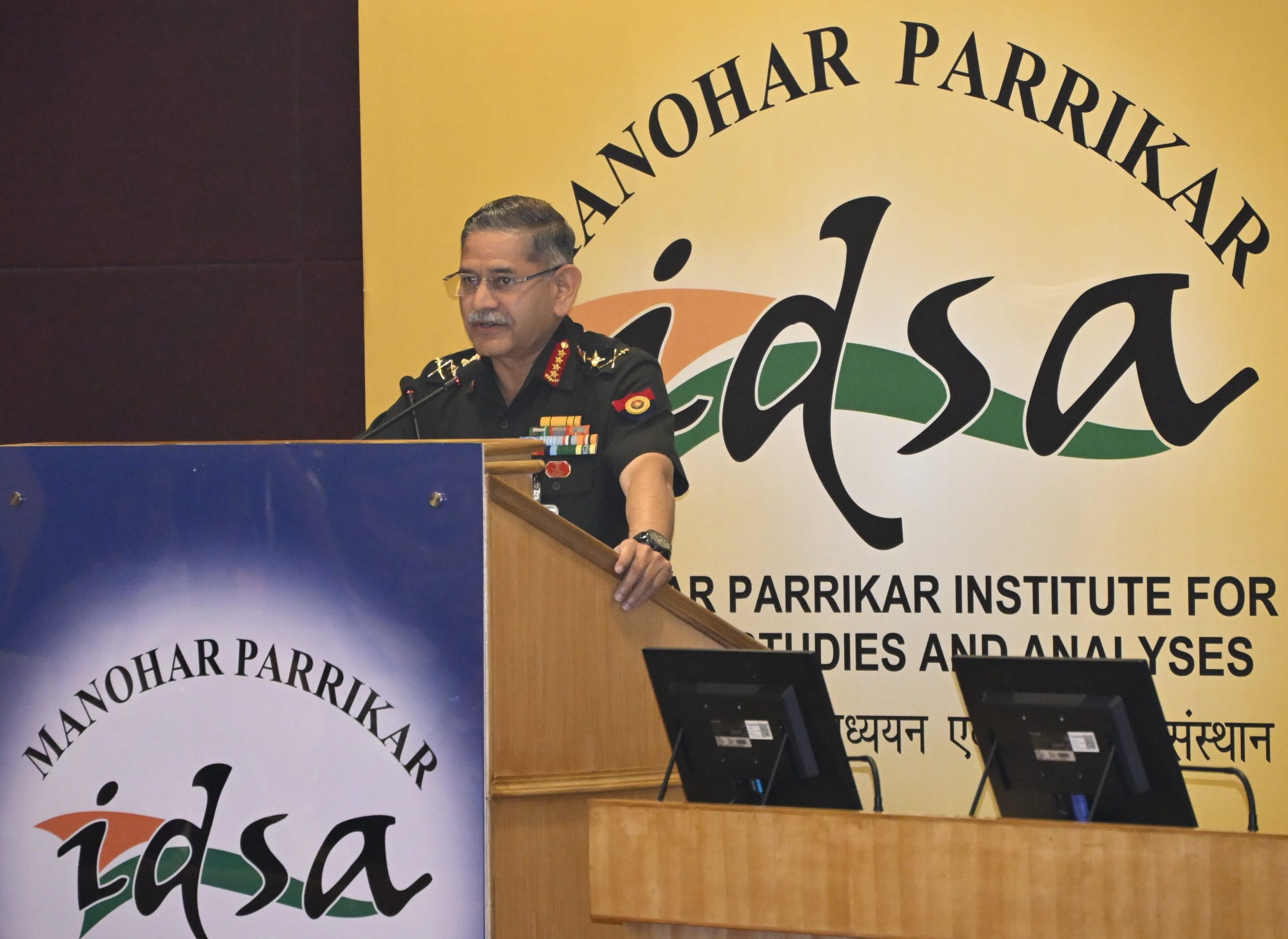
The second edition of the Delhi Defence Dialogue concluded today at the Manohar Parrikar Institute for Defence Studies and Analyses (MP-IDSA), with a strong focus on how emerging technologies can transform India’s defence capabilities.
Technology as a Force Multiplier, not a Replacement
In his special address on “Modernisation of the Indian Army and the Role of New-Age Technology,” Chief of Army Staff Gen Upendra Dwivedi underlined that while technology is reshaping modern warfare, human leadership and geography remain decisive.
He observed that more than 50 conflicts across the world today highlight an “era of jostling and competition,” with the Ukraine conflict serving as a real-time testbed for drones, jamming systems, and precision weapons.
Dwivedi said the Indian Army is undergoing a decade of transformation, guided by the five pillars that integrate manpower with advanced technologies. He introduced the Army’s “5Ps Action Plan”: Procedures, Processes, Patents, People, and Partnerships — aimed at accelerating innovation through close collaboration among academia, industry, and government.
Highlighting the importance of balance, he stated that “land will remain the currency of victory for India. Our strength will always lie in our soldiers, amplified by AI, not replaced by it.” He also identified the three Ds: Democratisation, Diffusion, and Disruption, as defining factors in the evolution of modern warfare.
DRDO Pushes for Technology Leadership
Delivering another special address, Samir V. Kamat, Chairman of the Defence Research and Development Organisation (DRDO), said that India is moving from being a technology adopter to becoming a technology leader. He described the shift from a unipolar to a multipolar world order as an opportunity for India to assert itself as a key innovation hub in the global defence landscape.
Kamat highlighted that over 90 per cent of defence orders in 2024 were for indigenously developed systems, marking a sharp reversal from past import-heavy trends. He proposed increasing defence R&D spending from 5.5 to 10 per cent of the total defence budget over the next five years to support indigenous innovation and private sector participation.
He also outlined several reforms within DRDO, including the adoption of a dual Development-cum-Production Partner (DCPP) model, the expansion of the Technology Development Fund (TDF) to support MSMEs and start-ups, and the establishment of 15 Centres of Excellence in leading academic institutions.
To nurture young scientific talent, the DRDO has established five Young Scientist Laboratories, each headed by a director under the age of 35, focusing on frontier areas such as quantum computing, AI, and manned–unmanned teaming. “R&D must be viewed as an investment in national security, not merely an expenditure,” Kamat said.
Industry, Start-Ups, and the Atmanirbhar Mission
In another address, Sanjeev Kumar, Secretary, Department of Defence Production, stressed that India’s pursuit of Atmanirbharta (self-reliance) must be powered by innovation, cross-sector collaboration, and a clear doctrine to integrate industry and innovators. “Our defence capability will depend on how effectively we combine technology, leadership, and collective national effort,” he noted.
Experts emphasised the importance of civil–military integration, streamlined procurement, and a robust innovation pipeline to accelerate the adoption of new-age technologies.
Team BharatShakti