


The ongoing 2026 conflict between the United States, Israel, and Iran—dubbed “Operation Epic Fury”—has defied initial expectations of a swift Iranian collapse.
Having absorbed thousands of precision strikes, Iran has successfully leveraged its “Mosaic Defence” strategy, decentralising its military into 31 autonomous regional commands and burying its formidable missile arsenal in hardened, subterranean “missile cities”.
As the conflict enters its third week, the centre of gravity has firmly shifted away from direct territorial bombardment and toward the maritime chokepoints of West Asia, specifically the Strait of Hormuz.
The war has devolved into a brutal test of economic stamina, pre-logistical resilience, and military attrition. Both sides face a strategic paralysis where decisive military victories risk catastrophic global economic fallout.
Based on the current operational tempo, geopolitical landscape, and economic realities, here is a comprehensive analysis of the top three most probable strategic options left for Iran and the US/Israel coalition.
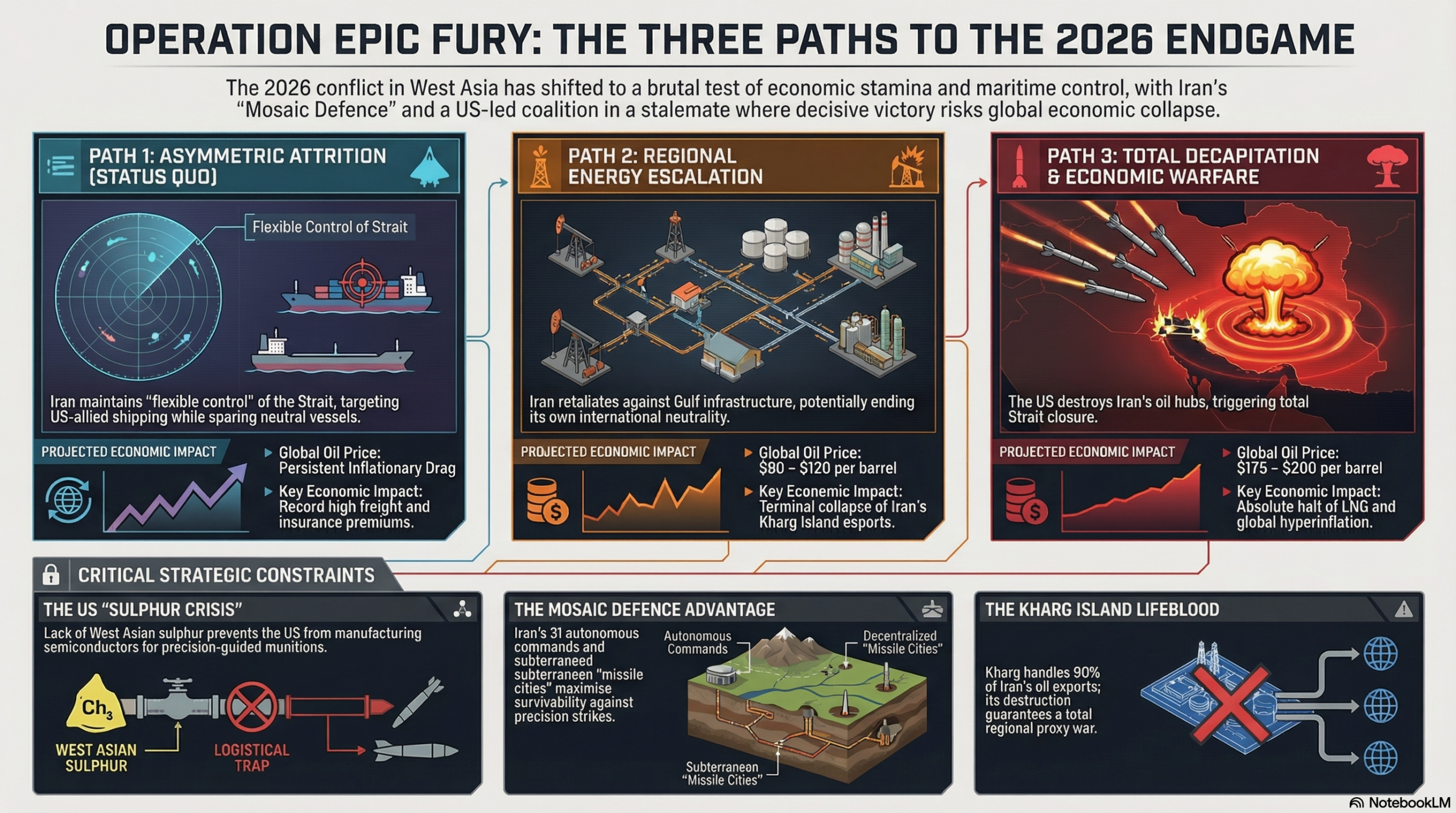
Option 1: Sustained “Flexible Control” and Asymmetric Attrition (The Status Quo)
The most probable immediate trajectory is the continuation of the current strategic stalemate.
In this scenario, Iran sustains a modern iteration of the 1980s “Tanker War,” applying a doctrine of “flexible control” over the Strait of Hormuz without initiating a total blockade. Iran maintains its “two-tiered shipping system,” permitting safe passage for vessels from friendly or neutral nations like China, India, Pakistan, and Turkey, while deliberately targeting or harassing ships associated with the US and its allies.
In response, the US and Israel focus on containment, organising international maritime escorts (Operation Sentinel), deploying sentry ships, and tactically degrading Iran’s launch sites while deliberately sparing Iran’s vital civilian oil infrastructure on Kharg Island.
Military Pros and Cons: For Iran, this option plays directly to its asymmetric strengths, masking its glaring conventional weaknesses, such as an outdated air force and antiquated air-defence networks like the Mersad system. By utilising swarms of cheap, expendable loitering munitions (like the Shahed-136) and fast-attack craft, Iran forces the US and Israel to expend interceptor missiles that cost millions of dollars, creating a highly favourable cost-exchange ratio.
Furthermore, Iran’s forces remain dispersed and camouflaged within the Mosaic Defence framework, maximising survivability. However, a prolonged campaign guarantees the slow, continued degradation of Iran’s military infrastructure, as technologically superior Western aircraft steadily pick off exposed radar sites and missile launchers.
For the US and Israel, the primary military advantage is containment; this option prevents the conflict from spiralling into an uncontrollable, multi-front regional war and avoids triggering the full activation of Iran’s “Axis of Resistance” proxies, such as Hezbollah and the Houthis.
The major military disadvantage is that a war of attrition is exactly what Iran’s strategy is designed to endure. Maintaining a massive, indefinite deployment of naval destroyers, aircraft carriers, and Patriot batteries drains billions of dollars and undermines Washington’s strategic pivot to the Pacific.
Furthermore, the US military faces a severe “pre-logistical” crisis: the US defence industrial base is caught in a “byproduct trap” because it lacks the sulfuric acid necessary to process copper, nickel, cobalt, and the ultra-high-purity silicon wafers needed for advanced semiconductors and precision-guided munitions.
Because 50 percent of the global seaborne sulfur trade is choked behind the Strait of Hormuz, the US physical ability to manufacture new missiles and replenish its combat arsenal is strictly capped, limiting its long-term combat endurance.
Economic Pros and Cons: This approach effectively converts the military conflict into a global economic hostage situation. For Iran, keeping the Strait marginally open allows it to preserve its vital oil export revenues, primarily through sales to China.
However, the calibrated disruption still harms Iran’s domestic economy, which relies on the Strait for the import of food, medicine, and non-oil consumer goods.
For the US and global markets, restraint prevents the worst-case scenario of a total oil crash. Strategic releases of 400 million barrels from the International Energy Agency (IEA) and the US Strategic Petroleum Reserve (SPR) can help stabilise the market, keeping oil below catastrophic levels and shielding the US domestic economy from deep recession.
However, the ongoing disruption still imposes severe costs. Freight rates and insurance premiums have soared to record highs, and the rerouting of global supply chains creates a persistent inflationary drag. Sulfur prices alone have surged by 25 percent since the war began, squeezing modern industrial power globally.
Political and Social Impact: Politically, the US preserves its international alliances by showing restraint. However, President Trump’s domestic efforts to lower costs and secure political stability ahead of the 2026 midterm elections are heavily hindered by chronically high energy prices and inflation.
In Iran, the regime’s political and security structures have held firm despite significant civilian casualties, including the tragic deaths of 165 schoolgirls in initial bombardments. Socially, global populations will bear the brunt of inflation, while Iranian citizens face a slow, grinding deterioration of living standards.
Option 2: Escalatory Strikes on Regional Energy Infrastructure (The Gulf Target Option)
Following recent US and Israeli strikes on Iran’s South Pars gas field, a highly probable escalation involves Iran acting on its explicit threats to retaliate against major energy infrastructure in neighbouring Gulf states. This option would see Iran launching massive, sophisticated cruise missile (Ya-Ali, Hoveyzeh, Soumar) and stealth drone (Shahed-171, Saegheh-2) swarms against high-value targets such as Qatar’s Ras Laffan refinery, Saudi Arabia’s Abqaiq stabilization facility or Jubail complex, and the UAE’s Al Hosn gas field or Fujairah port.
Military Pros and Cons: For Iran, successfully penetrating advanced US and allied air defences to destroy critical stabilization plants or refineries would prove that the US military cannot adequately defend its regional partners. This would fundamentally undermine the American security umbrella in West Asia and demonstrate the lethal accuracy and reach of Iran’s diverse missile forces.
The primary military disadvantage for Iran is that this highly provocative move would instantly unite the region against Tehran. Unprovoked Iranian attacks on civilian infrastructure and non-combatant nations would eliminate any remaining regional neutrality.
Militarily, this isolation would likely prompt Gulf states to abandon their caution and openly allow the US to use their bases and airspace for direct, devastating strikes against Iran, massively expanding the operational theatre and the volume of firepower directed at the Iranian regime.
Economic Pros and Cons: This option represents the “nuclear option” for energy markets short of closing the Strait. A successful attack on major Gulf infrastructure would result in millions of barrels of oil going offline. For instance, severe damage to the Abqaiq facility and Fujairah port could result in a prolonged, multi-year loss of 5.5 million barrels per day. This would ignite an immediate global panic, spiking Brent crude prices to between $90 and $120 per barrel. The ensuing inflationary pain would ravage the US and global economies.
However, the economic blowback on Iran would be terminal. If Iran destroys its neighbours’ oil infrastructure, the US and its allies will lose all incentive to spare Iran’s primary economic lifeline: Kharg Island. Kharg Island handles approximately 90 percent of Iranian oil exports.
To date, the US has only struck military installations on the island to prevent a global energy crash. If Iran escalates to this level, the US will almost certainly obliterate Kharg’s oil export terminals, leaving the Iranian regime entirely cash-strapped and facing absolute internal economic collapse.
Political and Social Impact: Politically, this move would result in total international isolation for Iran. Unprovoked attacks have already led the UN Security Council to condemn Iran with a record 135 co-sponsors, and former partners like Qatar and the UAE have turned against the regime. Such an escalation could fast-track the expansion of the Abraham Accords, fundamentally realigning West Asian geopolitics against Iran.
Socially, the destruction of infrastructure could impact power grids and desalination plants in the Gulf, causing humanitarian distress. Globally, skyrocketing energy costs would induce social unrest, while the Iranian populace would face the devastating realities of a totally bankrupted state.
Option 3: Full Decapitation and Total Economic Warfare (The Kharg Island / Regime Collapse Option)
Frustrated by a prolonged stalemate, ammunition depletion, and the ineffectiveness of limited strikes, the US military could advise the President to establish absolute “escalation dominance”.
This option entails a massive, weeks-long aerial and naval campaign designed to systematically eradicate Iran’s naval capabilities, submarine fleets, mine depots, nuclear facilities, and command-and-control hubs. Most crucially, it includes the complete and intentional destruction of Iran’s oil export infrastructure on Kharg Island, plunging the regime into total economic warfare.
Military Pros and Cons: This option allows the US to decisively degrade Iran’s physical ability to wage conventional and asymmetric warfare. By systematically destroying the “missile cities” and launch infrastructure, the US would force a systemic collapse of Iran’s offensive capacity, unequivocally demonstrating US military supremacy and permanently resolving the threat of Iran’s nuclear and ballistic missile programmes.
The military consequences, however, would be catastrophic. Backed into a corner and facing existential destruction, the Iranian regime would lose all incentive for restraint and unleash its entire arsenal.
This guarantees the absolute closure of the Strait of Hormuz. Iran would aggressively deploy its Kilo-class and midget submarines to lay widespread minefields and launch suicide swarms against any vessel in the region.
Furthermore, Iran would immediately and fully activate all regional proxies. Hezbollah would likely be directed to overwhelm Israel’s Iron Dome with saturation rocket attacks, while the Houthis would completely shut down the Red Sea. The US would be forced into a highly destructive, multi-front war spanning the entire West Asia. It would take the US Navy months simply to clear the Q-routes of mines, during which no commercial or military logistics vessels could safely transit.
Economic Pros and Cons: From a purely strategic long-term perspective, removing the Iranian regime’s ability to fund itself via oil exports could precipitate the total collapse of the government, theoretically bringing absolute stability to the region in the ensuing years.
The short-term economic devastation, however, would be globally catastrophic. The total closure of the Strait of Hormuz—which handles 20 percent of the world’s oil and liquefied natural gas—combined with the destruction of Kharg Island and surrounding Gulf infrastructure, would immediately remove up to 24.8 million barrels of oil per day from the global market.
Even with full, coordinated releases from international strategic petroleum reserves, the shock would be unparalleled. Brent crude prices would instantly spike to between $175 and $200 per barrel. This price shock would completely halt the transit of liquefied natural gas (LNG), break global supply chains, and trigger a severe global recession characterised by hyperinflation across the West and Asia.
Political and Social Impact: Politically, executing this option removes all leverage the US currently holds over Iran. A multi-front war would severely strain US alliances, particularly if global partners blame Washington for the resulting economic depression. Asian economies—namely China, Japan, South Korea, and India, which rely heavily on Gulf oil—would face severe industrial contraction. Socially, the fallout would be immense. The Iranian population would face a severe humanitarian catastrophe, societal collapse, and massive casualties.
Globally, hyperinflation and broken supply chains would lead to widespread social unrest, job losses, and political upheaval, heavily penalising incumbent governments worldwide.
The End Game
Ultimately, the 2026 conflict has devolved into a brutal waiting game heavily defined by geography, industrial chemistry, and economic endurance.
Iran operates under the belief that it does not need to win a conventional military victory; it only needs to endure the bombardment while imposing sufficient economic pain through disrupted oil shipments and strangled critical mineral supply chains until the US and Israel lose the political appetite for war.
The US “pre-logistical” sulfur crisis demonstrates that modern military readiness is tethered to upstream commercial supply chains that are highly vulnerable to asymmetric maritime disruption.
Conversely, the US and Israel must carefully weigh the slow, grinding costs of containment and ammunition depletion (Option 1) against the risks of regional escalation (Option 2) or the catastrophic global economic fallout that would undoubtedly accompany a definitive, decapitating strike against the Iranian state (Option 3).
For now, the global economy hangs in the balance, trapped between a slow war of attrition and the terrifying prospect of total economic warfare.

In a career spanning three decades and counting, I’ve been the foreign editor of The Telegraph, Outlook Magazine and the New Indian Express. I helped set up rediff.com’s editorial operations in San Jose and New York, helmed sify.com, and was the founder editor of India.com. My work has featured in national and international publications like the Al Jazeera Centre for Studies, Global Times and Ashahi Shimbun. My one constant over all these years, however, has been the attempt to understand rising India’s place in the world.
I can rustle up a mean salad, my oil-less pepper chicken is to die for, and it just takes some beer and rhythm and blues to rock my soul.