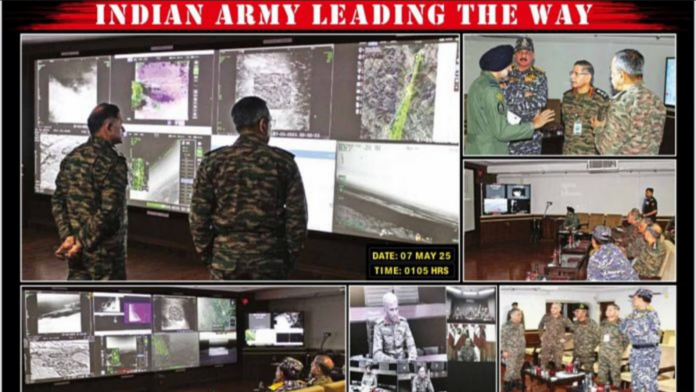
The Indian Army is not just embracing Artificial Intelligence (AI), it is shaping it to meet operational needs through indigenous innovation, massive data integration, and tight alignment with national defence goals.
In an interaction with the media, Lt Gen Rajiv Kumar Sahni, Director General of Electronics and Mechanical Engineers (DG EME), revealed how over 26 years of historical data have been harnessed to train mission-critical AI models that were operationalised during Operation Sindoor, delivering unmatched accuracy in combat environments.
“We are not experimenting with AI anymore, we are deploying it,” said Lt Gen Sahni. “We have integrated over 26 years of classified and real-world operational data into our AI applications. It gives us not only a deep historical context but also predictive power to respond faster and more accurately than ever before.”
AI in Action: Operation Sindoor and the 99.4% Accuracy Benchmark
During Operation Sindoor, AI systems developed in-house by the Army played a decisive role. The Electronic Intelligence Collation & Analysis System (ECAS) was upgraded in real-time to scan frequency emissions, match them with historical emitter databases, and accurately locate their origin.
“This system gave us 99.4% accuracy in threat identification and location,” Lt Gen Sahni noted. “When an emitter activates near the border, we can trace it back to where and when it has appeared over the past two decades, understand its signature, and anticipate its pattern. That level of fidelity is unmatched.”
Other applications included:
- TRINETRA, offering a unified operational picture via Project SANJAY, enabling seamless coordination across units.
- AI-enhanced weather forecasting and threat prediction models, integrated with data from the IMD and Ministry of Earth Sciences, for long-range vector planning.
- Battlefield Surveillance System (BSS) and sensor-shooter integration, ensuring rapid, AI-guided targeting using both optical and thermal sensors.
Responding to another question, he said that these systems ensured near-zero delay between detection, decision, and engagement, shortening the kill chain dramatically.
Comparison with China and Pakistan: Capability, Not Hype
On comparisons with China and Pakistan in the AI domain, Lt Gen Sahni was candid.
“We are fully aware of how China is leveraging AI and big data. There are reports of their real-time feeds being shared with Pakistan. But I want to assure the nation, we are not lagging behind,” he said.
He further explained that the Indian Army is building sovereign models, not reliant on foreign datasets or external platforms. It avoids risks such as data poisoning, which is often a vulnerability in open-source or externally developed AI systems.
“Our models are built with our data, by our own developers, trained using Indian conditions — from terrain to threat matrix. There is no foreign bias, and that’s a strategic advantage,” he added.
From Commanders to the Frontline
He described how AI has now become integral at the tactical level. Commanders at the forward edge are utilising AI-based change detection systems, ISR (Intelligence, Surveillance, and Reconnaissance) tools, and AI-enabled decision support systems to interpret large data feeds in real-time.
“Earlier, it took hours to analyse and act on intelligence. Today, AI tools can provide commanders with a review of what has changed in the last two hours, three hours, or less, whether it be force concentrations, terrain changes, or movement. That’s battlefield dominance,” he said.
AI-Driven Modernisation
The Army’s tech integration is driven by six key Lines of Effort, including infrastructure development, AI weaponisation, human resource skilling, and governance. These initiatives align with national efforts such as Digital India, IndiaAI Mission, and Atmanirbhar Bharat.
Major initiatives include:
- Army AI Research and Incubation Centre (AARIC) in Bengaluru
- A forthcoming Unified AI Platform, integrating intelligence, logistics, and operational functions on a secure framework
- Defence AI Hub, jointly established with ArtPark–IISc, to manage AI project portfolios, ethics, and testing
The Army is also developing domain-specific military language models, including patented small language models (SLMs) and a dedicated Large Language Model (LLM) that will support mission-critical operations securely.
“We are working on a military LLM of our own, trained entirely in-house. These models are not only for data interpretation, but also for enabling edge computing, smart decision-making, and mission continuity, even in disrupted environments,” said Sahni.
AI at the Tactical Edge
Looking ahead, the Indian Army is preparing to bring AI even closer to the battlefield, including autonomous systems, predictive logistics, AI-supported cyber defence, and real-time change detection via satellite feeds.
He also highlighted how the Army is moving toward closed-loop sensor-to-shooter networks, supported by edge-deployed AI that enables rapid decision-making in dynamic combat situations — with human-in-the-loop control remaining a core principle.
“We are building AI for war, not for a showcase. It is being developed, tested, deployed and constantly refined in our own operational environment, for our own needs. That’s how we stay future-ready,” he said.
Huma Siddiqui