


The world is witnessing geopolitical, geoeconomic, and strategic churn like never before. In just seven months, U.S. President Donald Trump’s irrational, unreasonable, and ego-driven overreach on trade and tariffs has disrupted global stability and, in the process, driven a wedge into 25 years of deepening Indo-US strategic ties.
While India, like much of the world, has been preoccupied with the fallout of this disruption, its immediate eastern neighbourhood — particularly Bangladesh and Myanmar — has been sliding into instability. This deterioration has serious implications for India’s Act East policy, its neighbourhood first approach, and the stability of the entire North-East.
Bangladesh
It has been a year since Sheikh Hasina was ousted and replaced by an interim government headed by Professor Mohammad Yunus. In that time, Dhaka has reversed 15 years of positive ties with India, embarking on a course marked by provocations and policy shifts that undermine bilateral goodwill. Yunus’s remark in China that North-East India is landlocked and that Bangladesh is the “guardian to the ocean” was both uncalled for and strategically loaded — especially coming from Beijing, a country with a history of aiding insurgent groups in India’s North-East.
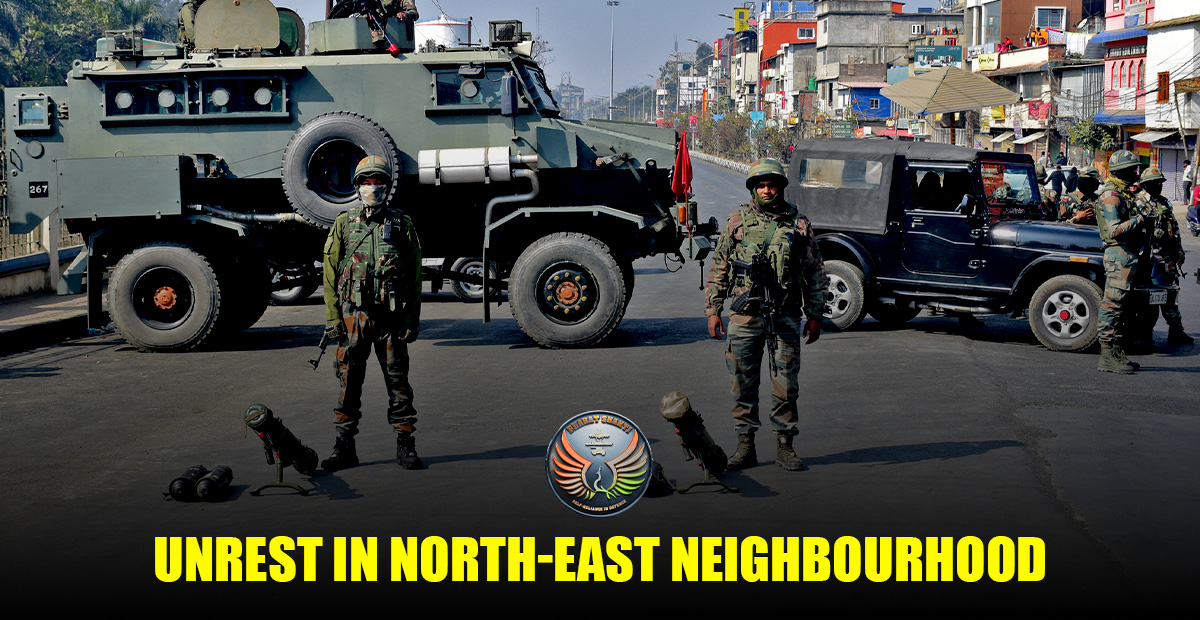
The Yunus administration’s closer ties with China and Pakistan, coupled with anti-India rhetoric, risk encouraging the revival of insurgency in the North-East. While violence in Manipur has subsided, disturbances persist, and reports of drone strikes against ULFA(I) camps add to the uncertainty.
Street protests and mob violence that helped topple Hasina remain a fixture. The situation is exacerbated by the lifting of bans on Jamaat-e-Islami and its student wing, Chatra Shibir — groups once outlawed under Hasina. Religious hardliners, emboldened by this political rehabilitation, continue to harass minorities, journalists, and activists.
The twenty-eight point July Declaration read out by Yunus on 5 August 2025 chronicles decades of Bangladesh’s political history but conspicuously omits India’s role in the 1971 Liberation War. This omission, along with other measures erasing Sheikh Mujibur Rahman’s legacy, points to a deliberate recasting of national history.
Of particular concern to India are remarks about the Siliguri Corridor’s vulnerability, hints about reviving the Lalmonirhat airfield in Rangpur province, and a senior Yunus aide’s claim over parts of West Bengal and the North-East. These are not casual statements; they cross red lines for New Delhi.
While Yunus has announced election dates, there is a high likelihood of delays, with the interim leadership citing the need to complete reforms before polls. Such a course risks prolonging political instability, unrest, and violence.
Myanmar
Four and a half years after Senior General Min Aung Hlaing seized power, Myanmar remains mired in conflict. The junta controls only 40–45% of the country, while rebel forces and ethnic armed organisations (EAOs) hold about 42%. Fighting in the Chin State and Sagaing region, both bordering India, has reached unprecedented levels.
The Arakan Army controls 14 of 17 cities in Rakhine State and the entire 271 km Myanmar-Bangladesh border. Parts of Chin State under its control include the route of the ₹2,900-crore Kaladan Multi-Modal Transit-Transport Project, making it vulnerable to disruption.
Instability in Chin State, unrest in Bangladesh’s Chittagong Hill Tracts, and tensions in Manipur have together fuelled Kuki-Chin-Zo nationalism — a development that serves neither India nor its neighbours. Drug trafficking, weapons smuggling, and militant movements across the Indo-Myanmar border threaten North-East India’s political and socio-economic stability, with increased seizures and arrests reported by the Assam Rifles in Mizoram, Manipur, and Nagaland.
The violence in Chin State has also driven close to 35,000 refugees into Mizoram, straining state resources. Adding another layer to the situation is a surge in American and British missionary activity in Mizoram, publicly acknowledged by the state’s chief minister.
China
China’s imprint is evident in both Bangladesh and Myanmar. In Bangladesh, Beijing is accelerating Belt and Road Initiative (BRI) projects, providing infrastructure funding, financial aid, and expanding defence engagement — developments with direct security implications for India’s North-East.
In Myanmar, Beijing is pushing ahead with the China-Myanmar Economic Corridor (CMEC), arming ethnic armed organisations, and ensuring delays in India’s infrastructure projects. Strategic rivalry extends to evolving connectivity dynamics in Myanmar and Thailand, where India and China compete to shape economic and security outcomes.
Recommendations
Bangladesh
India should continue exercising strategic and diplomatic restraint, maintaining economic aid, infrastructure support, mutual trade, goods movement facilitation, and electricity distribution projects under its neighbourhood first policy. These should not be held hostage to the current dispensation in Dhaka. Elections followed by a new government are likely to see a reset in ties; geography will ultimately dictate relations. Despite the recent anti-India hysteria and atrocities against minorities, cultural linkages — such as the celebration of Durga Puja in October last year — remain resilient.
Myanmar
India’s outreach to Myanmar during the COVID-19 pandemic, including vaccine diplomacy and earthquake relief in March this year, has been well received. Across stakeholders — the junta, EAOs, and the People’s Defence Forces (PDF) — there is greater trust in India’s goodwill than in China’s predatory diplomacy. Recent efforts to revive cultural connections, particularly Buddhism, have found favour. India should build on these, consider sending peace missions to engage all stakeholders, and increase financial and humanitarian aid to the war-ravaged country.
Lt Gen Pradeep C Nair (Retd)