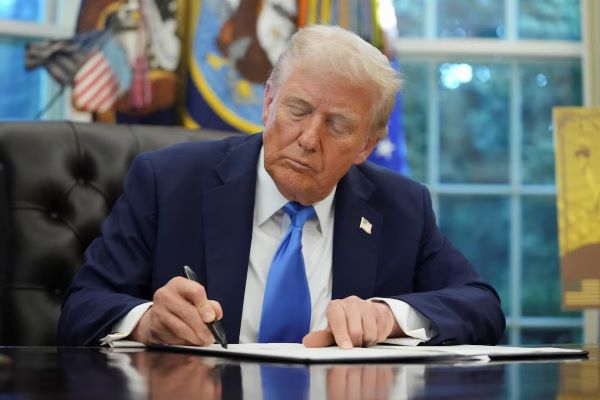
US President Donald Trump’s call to raise America’s military budget to an unprecedented US$1.5 trillion has triggered warnings of a renewed global arms race and aims to blunt China’s influence.
In a social media post on Wednesday, Trump said the United States should sharply increase defence spending in the 2027 financial year to confront what he described as “very troubled and dangerous times”, arguing the move was necessary to counter China’s expanding global military footprint.
“This will allow us to build the ‘Dream Military’ that we have long been entitled to,” Trump wrote, claiming the expansion would keep the US “safe and secure, regardless of foe”.
If approved, the proposal would represent the largest-ever increase in US defence spending, roughly 50 per cent higher than current levels. Washington is expected to spend close to US$1 trillion on defence this year, including a US$900 billion military budget passed by Congress in December and an additional US$150 billion approved under last year’s One Big Beautiful Bill Act.
Security experts warned the proposal could prompt Beijing to accelerate its own military modernisation, particularly as the technological gap between the two powers narrows and tensions over Taiwan persist.
“Beyond the higher defence budget, this is about prioritising production and innovation to sustain US deterrence,” one analyst said, adding the move would give China “greater urgency” to boost its defence outlays.
Although China’s military spending has grown steadily, its share of GDP has remained relatively stable. Analysts said that the balance could change if Washington follows through, further widening China’s defence spending advantage over other Indo-Pacific states.
Beijing could also respond asymmetrically, including by tightening export controls on critical minerals vital to US defence manufacturing. This move could slow American production in the short term but accelerate allied efforts to build alternative supply chains.
Trump’s plan comes in the wake of recent strikes on Iranian nuclear facilities and operations in Venezuela. The latest doctrine, the National Security Strategy, makes clear that it aims to deny rival powers like China and Russia the ability to establish strategic footholds near the American hemisphere.
Trump has repeatedly cited China’s presence in the Panama Canal and the Arctic as security threats, most recently justifying potential US action against Greenland by claiming the island was “covered with Russian and Chinese ships”.
China has expanded Arctic activities through its “Polar Silk Road” initiative and deepening military cooperation with Russia.
Chinese military analysts dismissed the US$1.5 trillion target as unrealistic. “If Trump truly proceeds, other countries will increase military budgets in kind, triggering a new arms race,” said an expert.
Others questioned whether the US economy could sustain such an expansion amid rising borrowing costs and the knock-on effects of tariffs on American importers.
Experts noted that Beijing has historically avoided matching US defence spending dollar-for-dollar, citing China’s view that Soviet attempts at parity with Washington hastened the USSR’s collapse.
“China cannot parallel such a massive American defence budget,” one analyst said, “but it may rethink how and where it allocates resources, particularly in the Asia-Pacific.”
Trump has announced a series of ambitious procurement programmes, including a proposed Golden Dome missile defence shield, the F-47 sixth-generation fighter, and a new
“Trump-class” battleship, all of which would require sustained funding increases.
China, meanwhile, has unveiled two sixth-generation fighter projects, expanded its intercontinental ballistic missile force, and debuted new ICBM variants during its Victory Day parade last September.
It is interesting to note that Trump’s plan, whether it becomes policy or remains political signalling, analysts argue, has already sharpened strategic calculations on both sides, raising the risk of intensifying military competition at a time of fragile global stability.
Ravi Shankar

Dr Ravi Shankar has over two decades of experience in communications, print journalism, electronic media, documentary film making and new media.
He makes regular appearances on national television news channels as a commentator and analyst on current and political affairs. Apart from being an acknowledged Journalist, he has been a passionate newsroom manager bringing a wide range of journalistic experience from past associations with India’s leading media conglomerates (Times of India group and India Today group) and had led global news-gathering operations at world’s biggest multimedia news agency- ANI-Reuters. He has covered Parliament extensively over the past several years. Widely traveled, he has covered several summits as part of media delegation accompanying the Indian President, Vice President, Prime Minister, External Affairs Minister and Finance Minister across Asia, Africa and Europe.