



A fresh warning from Washington has put Pakistan’s missile programme under renewed international scrutiny, triggering a swift and pointed rebuttal from Islamabad and reopening familiar fault lines in South Asia’s strategic landscape.
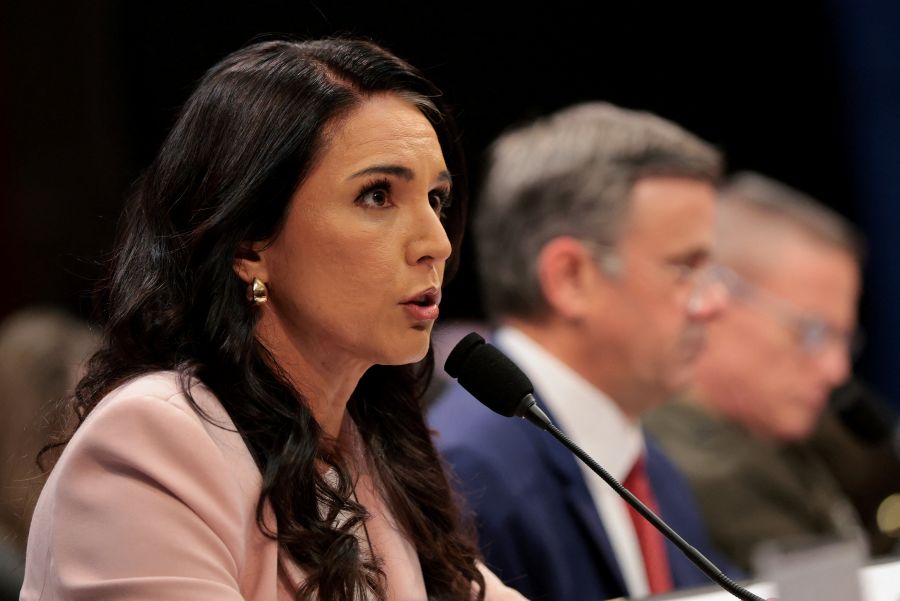
Releasing the Annual Threat Assessment Of The U.S. Intelligence Community on March 18, 2026, U.S. Director of National Intelligence Tulsi Gabbard told lawmakers that China and Pakistan are working on advanced missile capabilities that could potentially bring parts of the United States within range.
The assessment forms part of a broader U.S. intelligence review examining emerging threats to the American homeland, with a particular focus on long-range strike capabilities being developed by multiple countries.
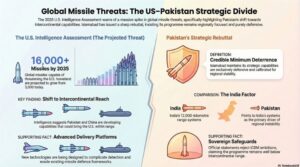
The assessment paints a sobering picture of the evolving global missile landscape. The report warns that the number of missiles capable of threatening the U.S. homeland could grow dramatically—from more than 3,000 today to over 16,000 by 2035.
Within that broader assessment, Pakistan is listed alongside China, Russia, North Korea, and Iran as countries developing an array of missile delivery systems—both nuclear and conventional—that could potentially strike the United States. The emphasis is not limited to intercontinental ballistic missiles but extends to a wider range of technologies, including advanced delivery platforms that may complicate detection and defence.
The suggestion that Pakistan’s missile programme could evolve toward intercontinental reach marks a notable shift in tone. Historically, Pakistan’s strategic capabilities have been viewed as regionally focused, primarily aimed at maintaining deterrence against India.
However, U.S. intelligence appears to be signalling concern that technological advancements—potentially aided by Chinese cooperation—could alter that equation over time.
Islamabad responded quickly and emphatically.
In an official statement issued on March 19, Pakistan’s Ministry of Foreign Affairs rejected what it described as “categorically” incorrect assertions about its missile ambitions. The spokesperson, Tahir Andrabi, said Pakistan’s strategic capabilities are “exclusively defensive in nature,” rooted in the doctrine of credible minimum deterrence.
The statement stressed that Pakistan’s missile programme “remains well below intercontinental range” and is designed solely to safeguard national sovereignty and maintain stability in South Asia. It also turned the spotlight toward India, arguing that New Delhi’s development of missile systems with ranges exceeding 12,000 kilometres reflects a trajectory that goes beyond regional deterrence and raises broader concerns.
Pakistan’s response underscores a familiar pattern in South Asian strategic discourse, where each side frames its capabilities as defensive while portraying the other’s as destabilising. The explicit comparison with India is particularly significant, suggesting Islamabad is keen to ensure that any scrutiny of its own programme is balanced by attention to India’s expanding arsenal.
For policymakers in Washington, the concern is less about immediate capability and more about trajectory. Intelligence assessments often focus on what adversaries could achieve over the next decade, rather than what they can do today. In that sense, Pakistan’s inclusion reflects apprehension about future developments, particularly in the context of deepening China-Pakistan strategic ties.
China’s role is a critical variable in this equation. Beijing’s long-standing defence cooperation with Islamabad has historically included assistance in areas such as missile technology and nuclear infrastructure. While the extent and nature of current collaboration remain closely guarded, U.S. intelligence appears to be factoring in the possibility that such partnerships could accelerate Pakistan’s technological progress.
Islamabad, however, has sought to push back against any implication that its programme is evolving beyond its stated doctrine. By emphasising “credible minimum deterrence,” Pakistan is reiterating a long-held policy that its nuclear and missile capabilities are calibrated to deter India, not to project power globally.
The broader intelligence assessment also underscores a range of interconnected security concerns that go beyond missiles and nuclear deterrence, reflecting the multi-layered nature of current global threats.
Presenting the report, Gabbard pointed to progress in tackling one such challenge—the illicit flow of fentanyl precursor chemicals into North America—while cautioning that the crisis remains far from contained. Efforts to coordinate with China and India, she indicated, are showing signs of improvement, but the continued toll of fentanyl-related deaths each year in the United States underscores the scale of the challenge.
The report also reflects a familiar political claim from U.S. President Donald Trump, stating that his intervention contributed to de-escalating recent tensions between India and Pakistan.
At the same time, the intelligence assessment offers a more measured view, noting that neither country appears to be seeking a return to open conflict. However, it cautions that underlying conditions remain volatile, particularly with the continued risk that terrorist actors could act as catalysts for future crises.
Beyond South Asia, the review highlights the evolving global landscape of weapons of mass destruction. It identifies China, North Korea, Pakistan, and Russia as countries actively expanding their capabilities, alongside efforts to develop more diverse and sophisticated delivery systems. Such advancements, the report notes, could lower the threshold for use, complicate detection, and potentially challenge existing U.S. missile defence frameworks.
India is also referenced as developing new and longer-range nuclear delivery systems, though it is not placed in the same category of threat to the U.S. homeland as the other countries mentioned. The distinction reflects Washington’s differentiated assessment of capabilities and intent, even as technological advancements continue across multiple regions.
At a broader geopolitical level, the report identifies China, Russia, Iran, and North Korea as states that increasingly view the United States as a strategic competitor—and in some cases, a direct adversary. These countries, it notes, perceive U.S. policies as a challenge to their interests and are seeking to counter American influence through a mix of diplomatic, economic, and military measures.
China has pushed back against such characterisations, urging Washington to avoid amplifying what it described as exaggerated threat narratives and calling on the United States to stop “hyping” the idea of China as a global security risk.
Adding another dimension to the assessment, the report also touches on transnational challenges such as narcotics trafficking. A separate element highlighted by the Deccan Chronicle identifies India as part of global narcotics supply chains—an observation that, while distinct from the missile issue, reflects the wide scope of the intelligence review and the interconnected nature of modern security threats.
Key additional concerns flagged in the assessment include:
- A projected sharp rise in missile threats to the U.S. homeland, with numbers expected to exceed 16,000 by 2035.
- Continued development of advanced delivery systems designed to evade detection and missile defence mechanisms.
- Persistent missile and nuclear advancements by North Korea and Iran despite international scrutiny.
- The risk posed by non-state actors, including terrorist groups, in triggering regional crises.
- The growing complexity of transnational threats such as narcotics networks and illicit supply chains.
- For India, the mention in the narcotics context is unlikely to carry the same strategic weight as the missile-related concerns surrounding Pakistan. However, it illustrates how comprehensive intelligence assessments increasingly blend traditional security threats with non-traditional challenges.
In the case of Pakistan, the immediate diplomatic fallout appears contained but significant. Islamabad’s statement emphasises its commitment to “constructive engagement” with the United States, grounded in mutual respect and factual accuracy, even as it firmly rejects the U.S. assessment.
For Washington, raising concerns about missile proliferation is consistent with longstanding policy priorities aimed at monitoring and limiting threats to the homeland. Publicly articulating such assessments serves both as a warning and as a means of shaping international security discourse.
Yet, such assertions also carry risks. In regions like South Asia, where strategic sensitivities remain high, external assessments can be perceived as amplifying tensions or reinforcing rivalries. Pakistan’s decision to highlight India’s missile capabilities in its response underscores how quickly such debates can broaden.
Ultimately, the episode reflects a complex interplay of intelligence, diplomacy, and perception. The U.S. assessment points to long-term concerns about the evolution of missile technologies and expanding threats, while Pakistan’s response reiterates its position that its programme remains limited, defensive, and regionally focused.
As missile technologies advance and geopolitical rivalries persist, such exchanges are likely to become more frequent—and more consequential. For now, the latest war of words between Washington and Islamabad serves as a reminder that even incremental shifts in strategic assessments can reverberate widely, shaping narratives and influencing policy far beyond their immediate context.

In a career spanning three decades and counting, I’ve been the foreign editor of The Telegraph, Outlook Magazine and the New Indian Express. I helped set up rediff.com’s editorial operations in San Jose and New York, helmed sify.com, and was the founder editor of India.com. My work has featured in national and international publications like the Al Jazeera Centre for Studies, Global Times and Ashahi Shimbun. My one constant over all these years, however, has been the attempt to understand rising India’s place in the world.
I can rustle up a mean salad, my oil-less pepper chicken is to die for, and it just takes some beer and rhythm and blues to rock my soul.


