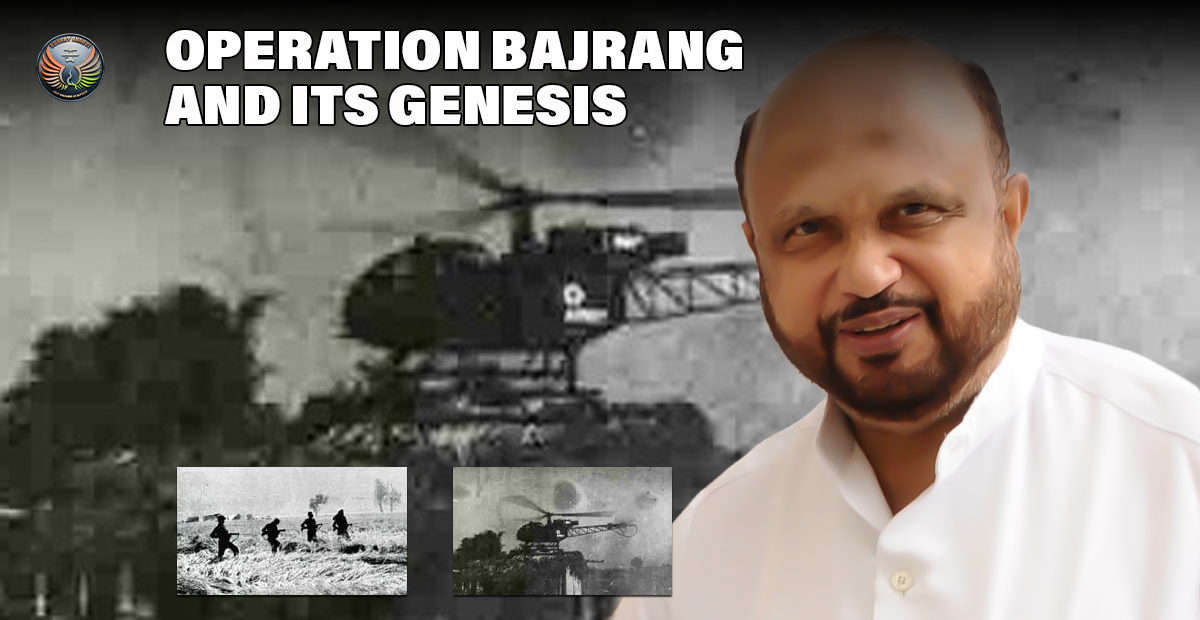
At midnight on this date 35 years ago, the Indian Army launched Operation Bajrang to flush out and decimate the United Liberation Front of Asom (ULFA). Simultaneously, Assam’s first regional party government (Asom Gana Parishad), led by Prafulla Kumar Mahanta, was dismissed less than a month ahead of completing its five-year tenure, and President’s Rule was imposed. Operation Bajrang didn’t succeed to the extent it was meant to but its follow up, Operation Rhino that began in September 1991, did. It was exhilarating to be a small part of this long forgotten phase in north-east India’s recent history. As a 28-year old Executive Editor of North East Times, I and my younger team were able to scoop stories, give a run to old, established publications and be prominent contributors to the discourse around insurgency and counter-insurgency in the region.
Here’s an expert from my book ‘The Hot Brew’ that was first published in 1998:
India’s second experiment with a non-Congress government was coming unstuck. V.P. Singh was ousted from power after he failed to manage the contradiction of surviving on the support of the right-wing BJP and the leftists at the same time. He was replaced with the original “Young Turk” Chandra Shekhar who, with barely 50 MPs at his disposal, became Prime Minister after Rajiv Gandhi’s Congress propped him up.
In Assam another phase of trouble was about to begin. Doom Dooma India Ltd is perhaps the most unlikely name for a tea company. Part of the consumer giant Hindustan Lever, Doom Dooma owns seven gardens, all of them located in upper Assam. Along with other big companies, Doom Dooma was also approached by ULFA for money. Its management refused to entertain the demand. As visits and threats by the “boys” increased, word reached London, the headquarters of Unilever plc, Hindustan Lever’s parent company.
This is where the countdown to the fall of the first AGP ministry began. Reports from Assam were pouring in daily into Bombay (where Hindustan Lever is headquartered) and London about the state government’s growing inability to combat the ULFA. Worried over the fate of its employees located in Assam, Unilever then pulled strings as only a trans-national corporation can. It got the British minister for economic affairs to speak to India’s then High Commissioner in London Kuldip Nayar who, in turn, got in touch with Delhi about the problem.
Meanwhile, an old-boys network was also put into operation. Madan Prasad Bezbaruah, an IAS officer of Assam cadre, was posted as the Economic Affairs Minister in the Indian High Commission, London at that time. Till a year before that, he was Assam’s Home commissioner. Bezbaruah, when told of the threat, called up Haren Das, the mild-mannered Chief Secretary, known for his expertise in economic affairs. Das promised to look into the matter. Bezbaruah’s call had come late on November 4. Immediately, Das asked DGP Kharkwal whether he was aware of such a threat. The DGP checked up from Tinsukia but no one had any information about it. So when Bezbaruah called up again, Das told him there was nothing to worry about. Next day, Das went up to Chief Minister Mahanta and apprised him of the conversation that he had with Bezbaruah. Not satisfied with all these efforts, Unilever apparently contemplated a mercenary-type operation, much in the style made famous by Frederick Forsyth in his novels like Dogs of War, to take care of ULFA. This little known fact was revealed to me by tea baron Hemen Barooah when we got talking about his “escape” to London following threats from the ULFA. When Barooah was in London sometime in October that year, he was met by Tom Brazier, the man in-charge of tea operations worldwide for Unilever. They discussed a lot of things. One of the possibilities Brazer apparently asked about was whether a mercenary force could be deployed against ULFA.
Barooah told him: “Fortunately, India is a far bigger and civilized country than many South American nations where these kind of actions must be taking place”.
Fast running out of options, Unilever then decided to take a drastic step: it opted to pull out of Assam. Again the decision was easier to make than implement.
The company could not trust anyone in Assam. So, a high-level diplomatic initiative was launched. It fell upon operatives of India’s external intelligence agency, the Research & Analysis Wing (R&AW) to mount a rescue mission to get the Doom Dooma executives and their families out of Assam. In an operation reminiscent of an Alistair McLean thriller, R&AW sleuths got the 60-odd people, including women and children, airlifted from upper Assam to Guwahati’s Borjhar airport on November 6, 1990. From there, they took scheduled Indian Airlines flights going out to Delhi and Calcutta.
So many things could have gone wrong during the course of the evacuation. ULFA could have got wind of the plan. The Assam government could have played spoilsport for having been kept in the dark. Surprisingly, none of this happened. Instead, it was left to a month-old English daily, The North-east Times, of which I was the founding executive editor, to break the story. It was a big boost for the fledgling publication. At the same time, it was egg on the face of the AGP government. Not only was it caught unawares, it was not even informed by the Centre about the operation. It was clearly a vote of no-confidence against Mahanta’s government. From then on, it was just a matter of time before the denouement came. But Act I, Part II was yet to come.
Although Doom Dooma’s withdrawal was certainly a big setback for Mahanta, what finally went against his government was the fact that Doom Dooma’s sister concerns, Brooke Bond India and Lipton India, pulled out of the Guwahati Tea Auction Centre, bringing it to a complete halt.
In Guwahati, Governor D.D. Thakur, who had been given an additional temporary charge of the neighbouring Arunachal Pradesh too, flew to Itanagar to take oath as that state’s Governor. There, 400 km away from the prying eyes of the Guwahati media, Thakur received an unusual visitor Lt. Gen. K.S. Brar.
Brar, the main protagonist of Operation Blue Star against Sikh separatists in Amritsar’s Golden Temple in 1984, could sense that he had another delicate job coming up in the very near future as he shook hands with Thakur. As Eastern Army Commander, based in the historical Fort Williams, Calcutta, Brar had been privy to the disturbing reports about the growth of the ULFA in the Brahmaputra valley. But just how serious it was dawned on him only after meeting Thakur. “You will have to come in anytime now,” Thakur said in his opening remarks to Brar. The Governor, who had already sent a detailed report to the Centre, was told by Delhi that he should be ready for any contingency.
Brar was given an extensive briefing by the Governor. There was little in the details that Brar or his Tezpur-based Corps Commander Lt. Gen Ajai Singh did not already know. But coming as it did from the Governor himself, both the officers realised that the army will have to be involved in a crackdown which would not be long in coming. As they left to prepare for the inevitable involvement of the troops, and Thakur flew back to Guwahati, the Centre had already made up its mind. Thakur sent one final report, stating that the ULFA had a free run of the countryside and thus there was no alternative but to dismiss the AGP government. That did it.
Everyone in Assam was now talking about the inevitability of a crackdown by the Centre. Those were very uncertain times. In Delhi, the Union Cabinet was in a meeting to discuss the Assam situation. It was November 26. Hiteswar Saikia, who had left the safe environs of the Aizawl Raj Bhawan in April that year to once again take charge of the Assam Congress, was camping in Delhi, apprising Rajiv Gandhi about the breakdown of law and order in Assam.
Although the Cabinet that day refrained from taking a formal decision, someone in Delhi tipped off an officer in the Assam government that a drastic action was in the offing against the AGP ministry. Naturally worried, Mahanta decided to rush to Delhi in a last-minute attempt to salvage his government. He had very few friends left. Goswami, law minister under V.P. Singh, was no longer in power. Instead, it was Rajiv Gandhi’s Congress which was calling the shots in the capital. Before leaving for Delhi, Mahanta, in one of his last orders as Chief minister, suspended Haren Das from service for his ‘impropriety’ in writing to the Union Commerce ministry over the tea auction stalemate. Little did Mahanta know that on his return, he would not even remain an MLA.
Das received his suspension order around 6 pm on November 26. Although not unexpected, the action was certainly unjustified. A typical bureaucrat, who went strictly by rules and code of conduct, Das decided to sit tight and refused to be drawn into any controversy.
As winter set in, Assam was hurtling towards a new phase in its recent history. Next day, November 27, Das had just finished lunch when he got a call from P.P. Verma, then Secretary to Governor D.D. Thakur. Verma said Thakur wanted him (Das) to come over to Raj Bhawan. “My first reaction was to decline the invitation. Since I was already under suspension, it would have looked improper for me to go and meet the Governor,” the former Chief Secretary remembers. But Thakur would not listen. He told Verma to send a Raj Bhawan car to fetch Das. When Das reached the Raj Bhawan, Thakur was relaxing on the lawns in the mild winter sun. His opening remark to Das was: “From this moment on, you are the Chief Secretary.” “My first reaction was to say: You don’t have the power,” Das recalls. “I will have the powers soon,” the Governor replied. “That’s when it dawned on me on what was about to happen,” Das says.
Then Thakur revealed what he had in mind. “This government is going to be dismissed tonight. I want you to be ready to take over as Chief Secretary when that happens. Get prepared accordingly. If you want a couple of others to be brought in on this, do it, but do it with utmost secrecy and then come to me,” Das was told. Returning home, Das kept the monumental news to himself until 10 pm when he telephoned T.L. Baruah, who had just returned from office. Das asked him to come over to his residence to discuss something important. Das also called S.K. Tewary, who was on posting to Tezpur as Commissioner, Northern Assam division following his removal as Commissioner, Personnel, a few days earlier. Unlike Baruah, Tewary had to be cajoled and persuaded to make that trip to Das’ home in Guwahati’s Zoo-Narengi Road area.
After both of them arrived, a sombre looking Das simply said: “We have been called by the Governor to the Raj Bhawan.” Baruah’s instincts, sharp as ever, told him something big was about to happen. As they drove up the hill to the Raj Bhawan—all three officials strangely quiet—they could feel the cold breeze blowing from the silently flowing Brahmaputra.
Governor Thakur called the trio to his comfortable drawing room instead of his office chamber and there, under the chandeliers, the three bureaucrats were told about the plan of action. “Delhi has decided to dismiss the present government,” Thakur announced. “A military crackdown is to be launched simultaneously,” he added. Tewary was to become Secretary, general administration and secretariat administration departments besides being reinstated as Secretary, Personnel. He was asked to prepare the order for Das’s reinstatement in the Raj Bhawan itself and wait for the Governor’s signature. Baruah was told to be ready for a more active role as a key man liaising between the Army and the civil administration in his capacity as a Home Secretary.
After preliminary instructions, the group settled down to wait for the order to arrive from Delhi. Shortly before midnight a BSF plane carrying IGP EM Rammohan, an Assam cadre IPS officer (who was then with the BSF), an important functionary from the Intelligence Bureau, and DGP Kharkwal landed at Borjhar. They drove straight to the Raj Bhawan. The team was carrying the order proclaiming the imposition of President’s Rule in Assam, signed by President R. Venkataraman. Kharkwal’s arrival was a chance happening since he simply happened to be in Delhi on some other official work.
Armed with the necessary papers, Thakur set his plan in action. It was past 2 am. Everyone went home to catch a few hours of sleep. At 6 am on November 28, Das went to the Janata Bhawan and took charge as Chief Secretary. His suspension lasted exactly 24 hours. The first thing Das did was to seal the offices of the ministers.
Some 600 km away, an army unit was silently marching towards the Lakhipathar forest to raid ULFA’s general headquarters. As Assam woke up to a cold winter morning on November 28, Operation Bajrang was already under way for six hours. In Delhi, Mahanta came to know of Chandra Shekhar’s decision too late.
(To access the full book visit:https://nitinagokhale.com/product/the-hot-brew-by-nitin-a-gokhale/)

Author, thought leader and one of South Asia's leading strategic analysts, Nitin A. Gokhale has forty years of rich and varied experience behind him as a conflict reporter, Editor, author and now a media entrepreneur who owns and curates two important digital platforms, BharatShakti.in and StratNewsGlobal.com focusing on national security, strategic affairs and foreign policy matters.
At the beginning of his long and distinguished career, Gokhale has lived and reported from India’s North-east for 23 years, writing and analysing various insurgencies in the region, been on the ground at Kargil in the summer of 1999 during the India-Pakistan war, and also brought live reports from Sri Lanka’s Eelam War IV between 2006-2009.
Author of over a dozen books on wars, insurgencies and conflicts, Gokhale relocated to Delhi in 2006, was Security and Strategic Affairs Editor at NDTV, a leading Indian broadcaster for nine years, before launching in 2015 his own digital properties.
An alumni of the Asia-Pacific Centre for Security Studies in Hawaii, Gokhale now writes, lectures and analyses security and strategic matters in Indo-Pacific and travels regularly to US, Europe, South and South-East Asia to speak at various international seminars and conferences.
Gokhale also teaches at India’s Defence Services Staff College (DSSC), the three war colleges, India's National Defence College, College of Defence Management and the intelligence schools of both the R&AW and Intelligence Bureau.
He tweets at @nitingokhale