


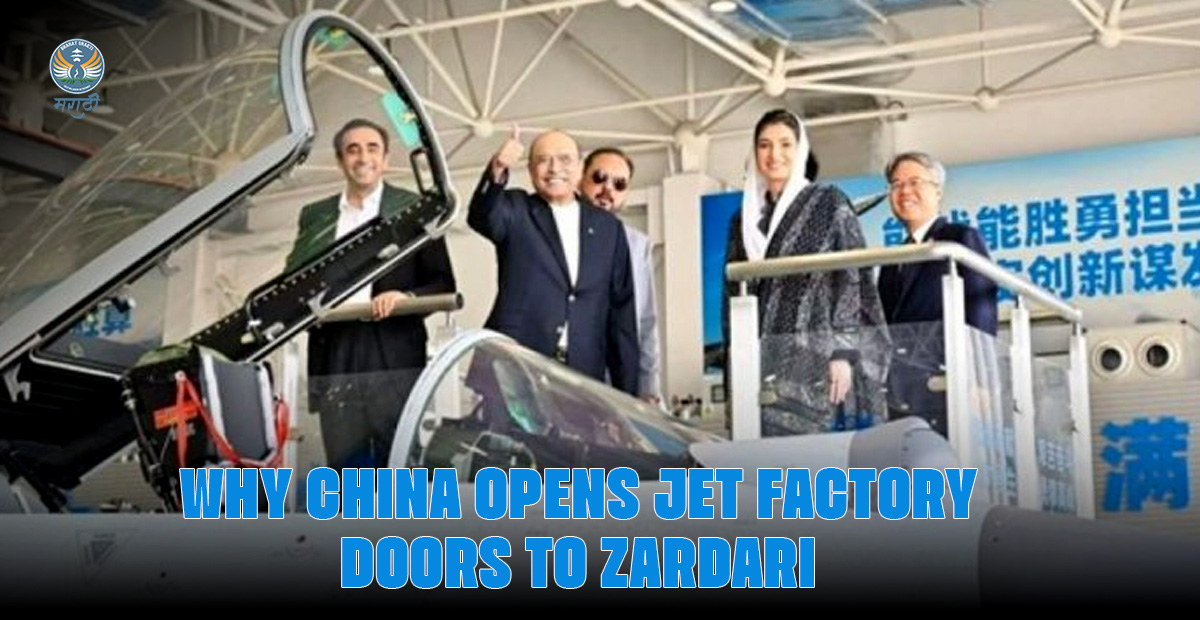
Pakistani President Asif Ali Zardari’s rare visit to the Chengdu aircraft production facility of the Aviation Industry Corporation of China (AVIC) on September 14 marks a symbolic deepening of the China–Pakistan defence partnership at a time when South Asia’s airpower equation is undergoing rapid change. Zardari became the first foreign head of state to be granted access to AVIC’s most sensitive military aviation complex – home of the J-10C and J-20 stealth fighters – underscoring the privileged status of Islamabad in Beijing’s strategic calculus.
The optics of the visit are significant. Pakistan is today almost entirely dependent on China for its advanced military hardware, with 81% of its imports sourced from Beijing between 2020 and 2024, according to SIPRI data. The Pakistan Air Force (PAF) currently operates 36 J-10Cs and 161 JF-17s – both designed and produced by AVIC – and is eyeing a possible acquisition of the fifth-generation J-35 stealth fighter. In May’s four-day confrontation over Kashmir, Islamabad claimed that J-10Cs downed Indian jets, including Rafale, marking the type’s first combat kills. While New Delhi acknowledged combat losses, it withheld details, leaving an information vacuum that Beijing and Islamabad have filled to their narrative advantage.
Zardari’s Chengdu tour also reflects Pakistan’s long-term trajectory: its indigenous aerospace development is subsumed under China’s military-industrial umbrella. The joint JF-17 programme already symbolises this dependence, and with the J-10C, J-35 and drones on offer, Pakistan is effectively tethered to a single supplier. In contrast, India has diversified its defence relationships to avoid such dependency.
While, New Delhi is finalising plans to acquire 114 Rafale multirole fighters from France and an additional half-a-dozen squadrons of Russia’s Su-57 fifth-generation stealth fighters, alongside the indigenous Tejas Mk2 and Advanced Medium Combat Aircraft (AMCA) programmes. This mix of Western and Russian technology, coupled with domestic design, positions India to field a more balanced and superior force structure across both western and northern fronts.
For India, the stakes are clear. Facing a collusive China-Pakistan threat, the Indian Air Force (IAF) is shaping for long-term air superiority through diversification, stealth capability, and sustained production. Pakistan, by contrast, is doubling down on its role as China’s proxy airpower client, gaining access to frontline jets but locking itself into Beijing’s strategic orbit.
Zardari’s unprecedented visit to Chengdu may boost morale in Pakistan and send a message of solidarity, but it also reveals the asymmetry in defence partnerships: Pakistan has only one source of advanced combat aircraft, while India is sourcing across multiple poles of the global aerospace industry. In the coming decade, this structural difference could prove decisive in the balance of airpower across South Asia.
Ravi Shankar

Dr Ravi Shankar has over two decades of experience in communications, print journalism, electronic media, documentary film making and new media.
He makes regular appearances on national television news channels as a commentator and analyst on current and political affairs. Apart from being an acknowledged Journalist, he has been a passionate newsroom manager bringing a wide range of journalistic experience from past associations with India’s leading media conglomerates (Times of India group and India Today group) and had led global news-gathering operations at world’s biggest multimedia news agency- ANI-Reuters. He has covered Parliament extensively over the past several years. Widely traveled, he has covered several summits as part of media delegation accompanying the Indian President, Vice President, Prime Minister, External Affairs Minister and Finance Minister across Asia, Africa and Europe.