



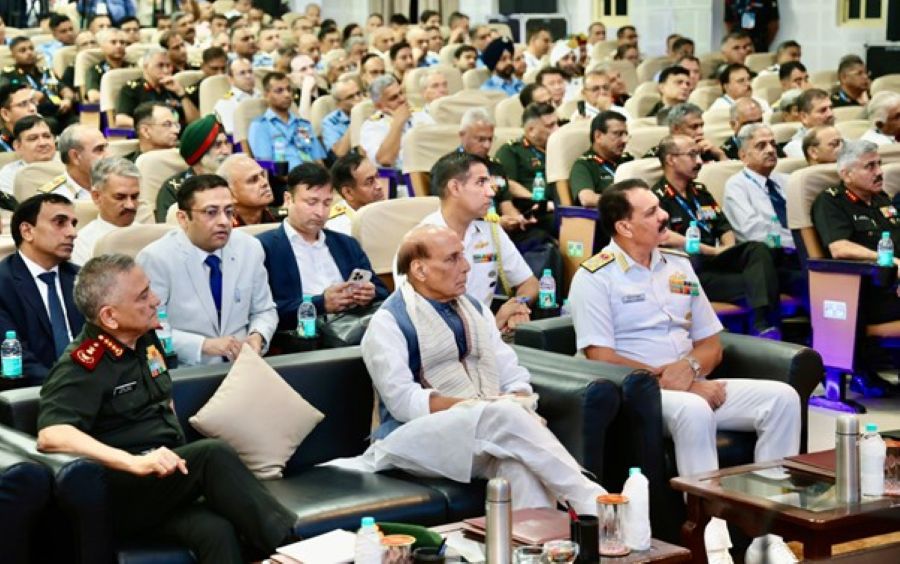
By all accounts, the Indian military’s first of its kind tri-services seminar, interestingly titled “Ran Samwad” (battlefield dialogue), held at Mhow earlier this week (26-27 August) turned out to be an event to remember, mainly because of a clear dissonance evident in the thought process of the top brass, particularly with respect to the process of creating joint theatre commands.
The conference, conceptualised by Chief of the Defence Staff, General Anil Chauhan, was focused on war, warfare and warfighting, but at the end of it, all the attention was grabbed by differing perceptions of theaterisation publicly expressed by Chief of Air Staff Air Chief Marshal AP Singh and Chief of Naval Staff Admiral Dinesh K. Tripathi in the presence of the CDS.
Singh made it clear that the Air Force prefers central joint planning and coordination to ensure integration and jointness, rather than multiple joint commands, reigniting a debate on what model India should adopt to improve combat efficiency and effectiveness.
Singh was reiterating a long-held conviction in the IAF that theaterisation models, which exist in other countries such as the US and China, were not feasible in the Indian context. India must evolve its own structure, he asserted, cautioning against any hasty rollout of fresh arrangements.
“Any structural change that does not lengthen the OODA (Observe, Orient, Decide, Act) loop is beneficial. But sudden disruption is not ideal. What we need is a joint planning and coordination centre in the national capital to anchor integration,” he suggested.
Admiral Tripathi, on his part, stated that the Navy is committed to integrating its command and control, communications, and combat capabilities with those of the Army and the Air Force to align with the theaterisation goal.
In his concluding remarks, Gen Chauhan acknowledged dissonance in views amongst the three services. “So, if you have sensed some kind of dissonance, let me assure you that we will resolve it in the best interest of the nation,” Gen Chauhan said.
In the wake of this development, the lingering question returns to the public debate: how committed are the Indian Armed Forces to theaterisation after Operation Sindoor? The answer appears as elusive as ever.
Also Read: Military Brass Mulling Over Structure Of Theatre Commands
Getting Back to the Drawing Board
There is no gainsaying that it has become imperative for the Indian Armed Forces and the Indian defence establishment to look at viable, workable solutions to efficiently address the full spectrum of threats and challenges, including Humanitarian Assistance and Disaster Relief (HADR) requirements, on a large scale. It calls for exploring the viability of the concept of theatre commands from the unique Indian perspective in keeping with the role and organisational ethos of the Indian Armed Forces. A brief survey of the background of defence reforms relevant to this debate would be in order before exploring the issues impinging on the model of integration.
Major military powers across the world have steadily integrated their militaries to enhance efficiency and rationalise defence spending. In the United States, which maintains the largest military organisation in the world, the institution of the Joint Chiefs of Staff has been in place since 1947. However, in 1986, following efforts of Congressmen Goldwater and Nichols, who were concerned about defence reforms, new legislation (named after them) was passed to ensure closer integration of the US military, leading to the evolution of the present structure based on Unified Commands.
In the UK, the Chief of Defence Staff was designated as the professional head of the armed forces and the Principal Adviser to the government, following the 1998 Strategic Defence Review.
In Canada, the integration of the Canadian Defence Forces was achieved between 1964 and 1967 by former Defence Minister Paul Hellyer, who brought together the necessary political will, legislative backing, institutional wherewithal, and acquiescence of the armed forces to usher in reforms that were initially controversial.
In Australia, the Theatre Command concept was introduced in 1997 with the establishment of HQ Australian Theatre (HQ AST) under the Chief of Defence Force. The aim was to separate the Australian political strategic level from warfighting, discontinue the ad hoc approach to coordination and control of operations, institute unity of command at the operational level, and provide a standing capability for planning campaigns, operations, and other activities.
In Russia, four Strategic Commands were established in 2010 by a Presidential decree, with the appropriate allocation of resources from the three Services and independent arms directly under the Centre, namely missile, space, and airborne forces.
The Chinese model also appears to have evolved along similar lines, with the reorganisation of the seven Military Regions under a regional commander, who controls the allocated resources of the three Services and the Logistics and Armament departments for operations.
Also Read: India’s Rocky Roads to Establish Theatre Commands
As India is an Indo-Pacific democracy, to evaluate a suitable model that is better suited to the Indian context, it would be in order to take a closer look at the US and Australian approaches to Theatre Commands, which have endured and evolved over time, with exposure to operations both at home and overseas.
The U.S. Regional Combatant Commands have geographical areas of responsibility, operating under a single commander who oversees two or more Services. They provide strategic direction of all U.S. military operations within their designated AOR. The five regional unified commands are U.S. Atlantic Command, Central Command, European Command, Indo-Pacific Command and Southern Command.
Additionally, the U.S. has functional commands, including U.S. Space Command, Special Operations Command, and Strategic Command. For Special Operations, a Joint Special Operations Task Force (JSOTF) is formed to plan, rehearse, and execute operations regardless of their geographical location.
The term ‘theatre of operations’ is defined in the American field manuals as land and sea masses to be invaded or defended, including areas necessary for administrative activities incident to the military operations. In the Western concept, the European Theatre of Operations was used to refer to all military activity in Europe, whilst the Pacific Theatre of Operations was related to the Pacific Ocean.
Hence, the inherent meaning of Theatre of Operations relates to large contiguous land or sea areas where synergised operations take place. In the Australian context, the Headquarters Joint Operations Command (HQJOC), which is the successor organisation to the HQ AST, does not have any forces permanently assigned to it. Appropriate forces are allocated to the Chief of Joint Operations (CJOPS) by the Chief of Defence Force (CDF) for specific operations. The CDF maintains full command over the Australian Defence Forces (ADF).
However, the Service Chiefs command their respective services. When the CDF orders the conduct of an operation or a campaign, he directs the service chiefs to assign appropriate forces at a specified level of capability to CJOPS. Each Service Chief is also the CDF’s principal adviser on matters concerning the role and responsibilities of their service. The CDF chairs the Chiefs of Service Committee, which comprises the Service Chiefs, Vice Chief of the Defence Force, and the CJOPS. HQ JOC houses component commanders along with an adequate number of permanent staff. They provide expert advice to the CJOPS concerning the operational employment of the assigned forces. This organisation is permanently available to the Australian CDF.
The question is: Are these models suitable or applicable to the Indian military? The simple answer is that India needs its own unique arrangement, based on its typical geostrategic environment and the diversity of its challenges. Perhaps some concepts can be borrowed from foreign structures to evolve a unique Indian model.
(Tomorrow: Towards a Unique Indian Model inspired by Global Best Practices)
By Nitin A. Gokhale

Author, thought leader and one of South Asia's leading strategic analysts, Nitin A. Gokhale has forty years of rich and varied experience behind him as a conflict reporter, Editor, author and now a media entrepreneur who owns and curates two important digital platforms, BharatShakti.in and StratNewsGlobal.com focusing on national security, strategic affairs and foreign policy matters.
At the beginning of his long and distinguished career, Gokhale has lived and reported from India’s North-east for 23 years, writing and analysing various insurgencies in the region, been on the ground at Kargil in the summer of 1999 during the India-Pakistan war, and also brought live reports from Sri Lanka’s Eelam War IV between 2006-2009.
Author of over a dozen books on wars, insurgencies and conflicts, Gokhale relocated to Delhi in 2006, was Security and Strategic Affairs Editor at NDTV, a leading Indian broadcaster for nine years, before launching in 2015 his own digital properties.
An alumni of the Asia-Pacific Centre for Security Studies in Hawaii, Gokhale now writes, lectures and analyses security and strategic matters in Indo-Pacific and travels regularly to US, Europe, South and South-East Asia to speak at various international seminars and conferences.
Gokhale also teaches at India’s Defence Services Staff College (DSSC), the three war colleges, India's National Defence College, College of Defence Management and the intelligence schools of both the R&AW and Intelligence Bureau.
He tweets at @nitingokhale