






The success of Operation Sindoor has become the touchstone for India’s future military doctrine. Defence Minister Rajnath Singh on Tuesday said the joint exercise, which fused the capabilities of the Army, Navy and Air Force into a seamless operational picture, proved that jointness is no longer optional – it is a matter of survival in today’s fast-changing security environment.
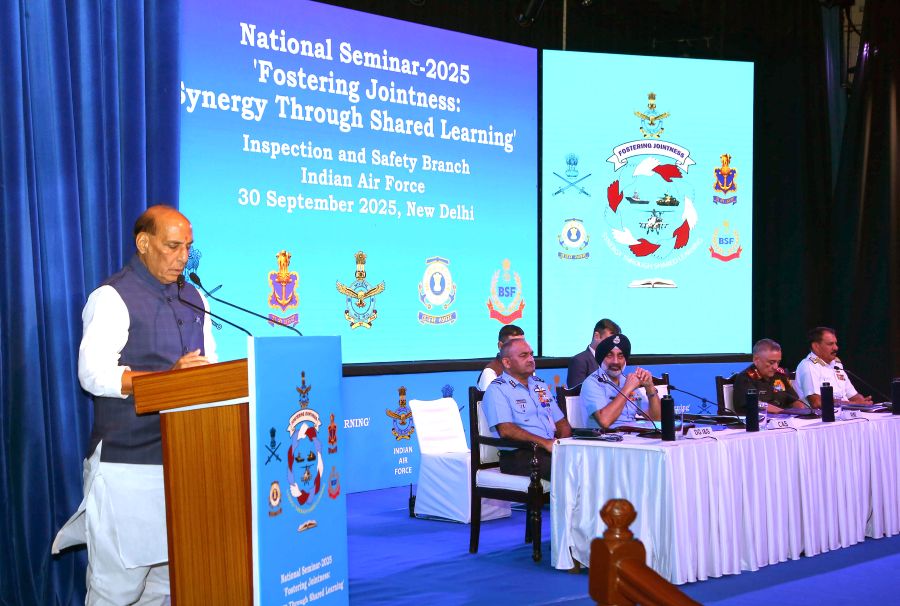
“During Operation Sindoor, the tri-services synergy produced a unified, real-time operational picture. It empowered commanders to take timely decisions, enhanced situational awareness, and reduced the risk of fratricide. It is the living example of jointness delivering decisive results,” Singh told officers at an Indian Air Force seminar in the capital.
Singh highlighted how the IAF’s Integrated Air Command and Control System (IACCS), the Army’s Akashteer, and the Navy’s Trigun systems fused into a single operational backbone during the exercise, creating unprecedented coordination across land, air, and sea.
That success, he argued, must serve as a blueprint for future operations – a benchmark against which all future conflicts will be measured.
A Vision Backed by Policy
Linking the lessons of Sindoor to the government’s broader vision, Singh recalled that Prime Minister Narendra Modi had himself underlined the centrality of jointness at the recent Combined Commanders’ Conference in Kolkata. “Our government’s objective is to further promote integration among the tri-services. It is not just policy – it is a survival imperative,” he said, positioning jointness as the cornerstone of national security and operational effectiveness.
From Silos to Digital Synergy
The Defence Minister stressed that while each service has independently built formidable systems over decades, integration now depends on breaking silos and building shared digital platforms. He praised the Army’s Computerised Inventory Control Group, the IAF’s Integrated Materials Management Online System and the Navy’s Integrated Logistics Management System. He announced that a Tri-Services Logistics Application is under development to bring them together.
“This digital synergy will ensure transparency, accountability and shared visibility of resources. It will optimise stocks and cut out redundant procurement,” Singh explained, adding that technology will be the enabler of integration at both operational and logistical levels.
Changing the Culture, Not Just the Structure
But Singh also acknowledged that achieving jointness cannot be reduced to technology or structural reform alone. It requires a cultural shift within the forces themselves. For too long, he noted, operational knowledge gained by one service remained within its walls. “If the Army developed something, it remained with the Army. If the Navy or Air Force developed something, it stayed within their own walls. This compartmentalisation must give way to collective learning,” he said.
At the same time, Singh warned against uniformity for its own sake. “The cold of the Himalayas is not the same as the heat of the desert. The Navy faces challenges distinct from those of the Army and Air Force. Integration must respect these differences while building trust and interoperability,” he said.
Broadening the Scope of Jointness
Singh emphasised that jointness must expand beyond the three services to include the Indian Coast Guard, the Border Security Force, and even civilian regulators such as the Directorate General of Civil Aviation. He cautioned that in areas such as aviation safety and cyber defence, fragmented standards could create vulnerabilities that adversaries might exploit. “No single service can operate in isolation anymore,” he said.
Ending on a note of resolve, Singh called on military leadership to communicate the value of integration throughout the chain of command and to draw from international best practices, tailoring them to India’s unique geography and culture. “Only when our armed forces operate in unison, in harmony, and in perfect coordination can we counter adversaries across all domains and lead India to new heights of glory. It is the need of the hour, and I am confident we will achieve it,” he concluded.
Team BharatShakti