


The Ministry of Defence has issued a request for information (RFI) for next-generation expendable aerial target drones as the Indian Navy moves to enhance its at-sea training against fast, low-flying threats such as anti-ship missiles and hostile drones.
The proposed system, formally designated Expendable Aerial Target (Next Generation) or EAT (NG), will be used in live-fire exercises to replicate the speed, flight profile and manoeuvres of modern sea-skimming missiles. Unlike reusable drones, these targets are intended to be destroyed during training engagements, providing naval crews with realistic combat scenarios for missile and gun systems.
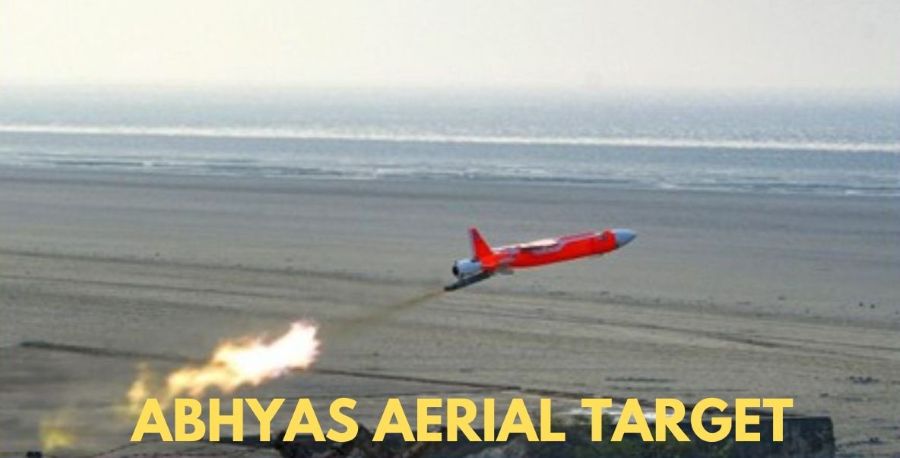
The RFI comes as India’s indigenous target drone programme gathers momentum. The Defence Research and Development Organisation’s high-speed target drone, Abhyas, has already completed developmental and user trials and entered the mass-production phase, marking a key step in expanding domestic capability in this segment.
Demanding performance requirements
According to the RFI, the Navy is seeking a target capable of flying at speeds of at least 300 metres per second at low altitude, roughly Mach 0.87, while sustaining operations for up to 60 minutes. The drone must be able to fly as low as five metres above sea level and achieve a climb rate of at least 20 metres per second.
To realistically simulate modern anti-ship threats, the platform must also execute sustained turns of up to 2G. Remote radio control should extend to 100 kilometres from the ground control station, while the system must also support fully autonomous flight along pre-programmed routes, including mid-course changes in speed and altitude. The ground control station should be capable of managing at least six targets simultaneously.
In the event of a data-link failure, the system must be recoverable in accordance with the user’s programme requirements. The drone is expected to have a low radar cross-section by default, with provisions to increase its radar signature using transponders or corner reflectors when required for training scenarios.
For post-engagement analysis, the target must carry an acoustic miss-distance indicator capable of detecting incoming fire, from 20 mm naval guns to surface-to-air missiles, within a radius of 10 metres.
Operational flexibility is another key requirement. The drone should be launchable from ships or shore facilities using rocket-assisted take-off and must operate in conditions up to sea state 3 and winds of 30 knots. After ditching at sea, it should remain afloat long enough to allow recovery by boat or helicopter. The expected service life of the system is around 15 years.
Push for indigenisation
The RFI also underscores India’s broader push for defence self-reliance. The ministry has asked vendors whether the system can be supplied under the “Buy Indian–IDDM” category, requiring more than 50 per cent indigenous content, or under the “Buy Indian” category with over 60 per cent local content, in line with provisions of the Defence Acquisition Procedure 2020.
Strengthening fleet air defence
The requirement comes at a time when the Navy is expanding its fleet and intensifying operational readiness. Indian warships deploy multiple surface-to-air missile systems, including the Barak-8, which require periodic live-fire validation against realistic aerial targets.
With both of India’s aircraft carriers -INS Vikrant and INS Vikramaditya – in service and naval deployments increasing across the Indian Ocean region, maintaining crew proficiency in countering fast, low-altitude threats has become a priority. The induction of next-generation expendable aerial targets is expected to enhance the realism and frequency of such training significantly.
Ravi Shankar

Dr Ravi Shankar has over two decades of experience in communications, print journalism, electronic media, documentary film making and new media.
He makes regular appearances on national television news channels as a commentator and analyst on current and political affairs. Apart from being an acknowledged Journalist, he has been a passionate newsroom manager bringing a wide range of journalistic experience from past associations with India’s leading media conglomerates (Times of India group and India Today group) and had led global news-gathering operations at world’s biggest multimedia news agency- ANI-Reuters. He has covered Parliament extensively over the past several years. Widely traveled, he has covered several summits as part of media delegation accompanying the Indian President, Vice President, Prime Minister, External Affairs Minister and Finance Minister across Asia, Africa and Europe.