


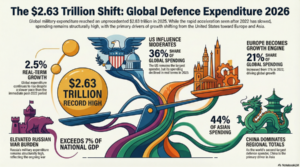
Global defence spending reached $2.63 trillion in 2025, the highest level ever recorded, according to The Military Balance 2026 published by the International Institute for Strategic Studies (IISS).
The increase, amounting to roughly 2.5 per cent in real terms over the previous year, confirms that military expenditure remains structurally elevated even as the pace of growth slows compared with the immediate post-2022 period.
Beneath the headline figure, however, the data reveal significant shifts in where spending growth is concentrated, which states are driving global totals, and how defence burdens are being redistributed across regions.
The IISS assessment shows that global defence expenditure rose from approximately $2.48 trillion in 2024 to $2.63 trillion in 2025, extending a multi-year upward trend triggered by heightened geopolitical tension, prolonged conflict, and renewed focus on deterrence.
While the overall increase is smaller than the sharp surges recorded in the years following Russia’s invasion of Ukraine, the level of spending remains historically high, underscoring the persistence of strategic competition as a defining feature of the current international environment.
A defining feature of the 2025 data is the changing regional composition of global defence spending. The United States remains the single largest military spender, accounting for roughly 36 per cent of total global defence expenditure, but its influence on global growth moderated in 2025.
According to IISS, US defence spending declined in real terms during the year, a shift that had a dampening effect on the overall global growth rate despite rising budgets elsewhere. This moderation contrasts with the US position in earlier years, when American budget increases contributed significantly to global totals.
In contrast, Europe emerged as the principal driver of spending growth. The region’s share of global defence expenditure rose to more than 21 per cent in 2025, up from around 17 per cent in 2022.
This expansion reflects sustained increases across multiple European states as governments respond to a deteriorated security environment, ongoing war on the continent, and commitments to strengthen collective defence.
Germany stands out within this trend, with defence spending rising sharply over successive years, placing it among the world’s top defence spenders and significantly reshaping Europe’s overall contribution to global military expenditure.
Other European countries also recorded notable increases. Belgium, Spain and several Nordic states expanded defence budgets, contributing to a broader regional uplift.
The IISS analysis makes clear that Europe’s rising share is not the result of a single national surge but of broad-based increases across the continent, driven by force modernisation, stockpile replenishment, and efforts to meet alliance benchmarks. While NATO commitments form an important political backdrop, the spending data themselves reflect concrete budgetary decisions already being implemented.
Asia continued to account for a substantial and growing portion of global defence expenditure in 2025. Within the region, China remained the dominant spender, representing approximately 44 per cent of Asian defence spending.
The IISS data show that China’s sustained investment in military capabilities continues to shape regional totals, reinforcing its position as the world’s second-largest defence spender. Other Asian states also increased defence outlays, reflecting a combination of regional security concerns and longer-term military modernisation programmes, though these increases did not match China’s scale.
Russia’s defence spending remained elevated in 2025, both in absolute terms and relative to the size of its economy. Although the rate of increase slowed compared with earlier wartime spikes, Russian military expenditure continued to absorb a high proportion of national output, exceeding 7 per cent of GDP.
The IISS assessment links this level of spending directly to the ongoing demands of the war in Ukraine, including personnel costs, equipment replacement, and sustained operational requirements. Russia’s spending profile illustrates how prolonged conflict can lock states into persistently high defence burdens even when growth rates stabilise.
The Middle East and North Africa also recorded continued defence spending at high levels, shaped by regional instability and active or latent conflicts. While the IISS notes variation across individual states, defence budgets in the region remain significant relative to GDP in several cases, reinforcing the global picture of elevated military expenditure driven by perceived security threats rather than short-term fluctuations.
A key theme running through The Military Balance 2026 is that global defence spending growth is becoming less uniform. While total expenditure continues to rise, the drivers of that growth are increasingly regional rather than global.
The slowdown in US real-terms spending, combined with accelerating European budgets and sustained Asian investment, has altered the balance of contribution to the global total. As a result, changes in regional defence priorities now exert a greater influence on overall trends than during earlier periods dominated by US spending decisions.
The IISS also highlights the distinction between absolute spending levels and defence burdens. Several states with smaller economies devote a higher share of GDP to defence than larger spenders, reflecting the intensity of their security challenges.
In this context, global totals alone do not capture the full strategic significance of defence expenditure patterns. The distribution of spending effort relative to national economic capacity remains uneven, with conflict-affected states bearing disproportionately high burdens.
Importantly, the 2025 data suggest that while defence spending has reached unprecedented levels, the era of rapid, across-the-board acceleration may be giving way to a phase of selective and regionally concentrated growth. The moderation in the global growth rate reflects both fiscal constraints and the stabilisation of emergency wartime spending in some countries, even as others continue to ramp up investment.
This dynamic underscores how global defence expenditure is shaped not only by threat perceptions but also by domestic economic conditions and political choices.
Taken together, the findings of The Military Balance 2026 present a clear picture of a world in which defence spending is structurally high, unevenly distributed, and increasingly driven by regional security dynamics.
The record $2.63 trillion total for 2025 signals that military expenditure has become a fixed feature of the global economic landscape rather than a temporary response to crisis. At the same time, the shifting balance between the United States, Europe, and Asia highlights how responsibility for sustaining global defence spending growth is gradually being redistributed.
By grounding its analysis in detailed budgetary data and consistent methodology, the IISS provides a factual baseline for understanding how states are allocating resources to military power in a period of prolonged strategic tension.
The 2026 edition of The Military Balance makes clear that while the pace of growth has slowed, the scale of global defence spending — and its implications for international security — has never been greater.
Ramananda Sengupta

In a career spanning three decades and counting, I’ve been the foreign editor of The Telegraph, Outlook Magazine and the New Indian Express. I helped set up rediff.com’s editorial operations in San Jose and New York, helmed sify.com, and was the founder editor of India.com. My work has featured in national and international publications like the Al Jazeera Centre for Studies, Global Times and Ashahi Shimbun. My one constant over all these years, however, has been the attempt to understand rising India’s place in the world.
I can rustle up a mean salad, my oil-less pepper chicken is to die for, and it just takes some beer and rhythm and blues to rock my soul.