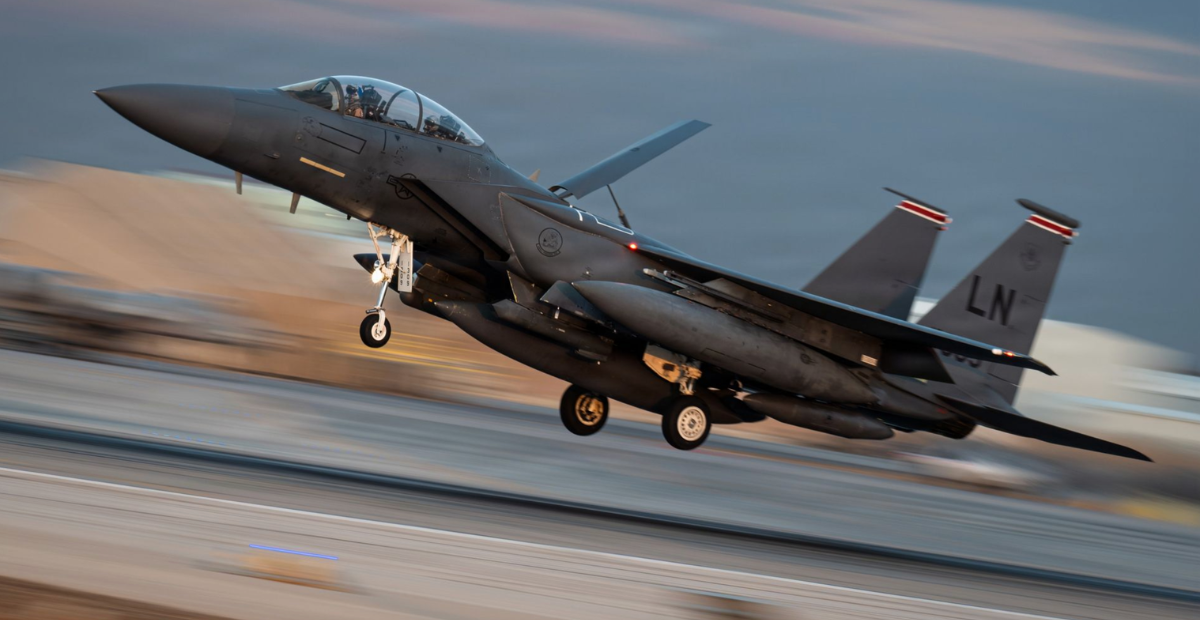
The American F 15E Strike Eagle aircraft is a formidable Macdonald Douglas (now a part of Boeing) machine, which has been a part of the US forces inventory, along with that of a fair number of its allies. Initially meant to be exclusively an air superiority fighter the F 15E Strike Eagle entered service in 1989. It’s been the backbone of USAF and there is hardly the odd one that has ever been shot down till the 3 April, 2026, when one such aircraft was blown up in the Iranian airspace.
The F 15E Strike Eagke has a two-man crew. Both ejected, initiating a race against time for the Iranians and a US special operations mission to find them. While the pilot was soon rescued by the Americans, the other crew, a Weapon Systems Officer (WSO), had drifted away, was injured, and was climbing up the Zagros mountains that reach heights of approximately 7,000ft in that area in Kohgiluyeh and Boyer-Ahmad province. On his dress he wore a typical survival beacon that would, when switched on, send his location to the Americans, providing a safe communication channel.
The injured pilot negotiated his way up the mountains and used the beacon intermittently to ensure Iranians don’t intercept his signals too. The CIA spotted his location, and also ran a deception campaign that conveyed that the WSO had already been rescued and was exfiltrating in a ground convoy. Meanwhile, President Trump gave his go ahead for a rescue operation, ‘at all costs’. Meanwhile, Tehran announced an award of $66,100 to anyone who gets the WSO, a Colonel, alive. The Colonel climbed the heights to be able to transmit clearly, and returned to his hide to avoid the local tribes already searching for him.
So far, the story appears quite cohesive, but the shear size of the rescue force employed and the fact that this force’s activities were closer to Isfahan, rather than the area over which the pilots had ejected poses a few questions.
This was possibly the biggest rescue operation undertaken in terms of resources employed in the post-World War II era. The beacon’s signals were detected by the CIA, were passed to Pentagon. The Americans mustered a huge force for the mission. According to the US President, it involved 155 aircraft, to include four bombers, 64 fighters, 48 tankers, 13 rescue aircraft and more. There were also space, cyber and intelligence resources made available. The question being asked is, was this big a force called for if the task was limited to just rescuing a WSO.
The WSO kept directing the US forces to his location. As the Americans closed in the Special Forces came into play and Navy Seals were dropped to ultimately rescue the F15’s Weapon Systems Officer.
The Americans lost/ destroyed a wide and substantial array of equipment attributable to equipment malfunction, aircraft getting bogged down, security reasons. According to the Iranian Army, the list includes two C 130 transport aircraft, one A 10 Thunderbolt, two Black Hawk helicopters.
Three additional aircraft were flown in to transport US personnel out of Iran. They used a landing strip to fly in and out. Iranian state media reported the downing of an US drone. Apparently, the drone was a Reaper MQ 9. Iranian media also reported that, “a deception and escape mission at an abandoned airport in southern Isfahan… was completely foiled”, but US officials have denied they came under attack.
A few questions are being raised about the operation, especially the fact of such huge resources being fielded by the Americans to retrieve just two pilots. The issue of the pilots ejecting over Kohgiluyeh and Boyer-Ahmad province, while the rescue activities of the Americans was closer to Isfahan, where enriched Uranium is reportedly stored by Iranians, is also raising eyebrows. Doubts are also being expressed about the possibility of an injured WSO climbing to 7,000ft across a mountain range.
Notwithstanding the volley of questions, the mission achieved its publicly stated objective of rescuing both pilots. The operation serves to recall a rescue operation undertaken by the US special forces in 1980 to extricate 53 American diplomats taken hostage by the Iranians. Operation Eagle Claw involved insertion of personnel of Delta Force from a carrier to staging points and finally de-inducting with the Americans. Almost everything went wrong with the operation, right from the beginning. Delta Force was finally forced to withdraw leaving its dead in the deserts.
The execution of such a successful rescue, taking all the chances that such missions inevitably entail, will boost morale of American soldiers, sailors and Airmen, alike. It reinforces what Trump stated and the US military says, “ In the United States Military we leave no American behind.”
The latest, in a scenario that keeps changing by the hour, both the US and Iran have agreed to a ceasefire for two weeks. Strait of Hormuz will also be open. Israel goes with the American decision.
Brig SK Chatterji (Retd)
The officer was commissioned into the Regiment of Artillery after graduating from the Indian Military Academy.
A graduate of the Defence Services Staff College and the Army War College, he commanded a medium artillery regiment in a high-altitude sector and later an artillery brigade in the desert.
He retired as Deputy Director General (Strategic Communication) at Army Headquarters.
A prolific defence commentator, he is the author of Vintage Guns of India' and has co-authored and edited several other books.
His articles on defence and strategic affairs have appeared in leading newspapers and military journals in India and overseas.
Following his retirement from the Army, he served at the apex level of an Indian multinational before becoming the founding editor of BharatShakti, a role he held for over a decade.