






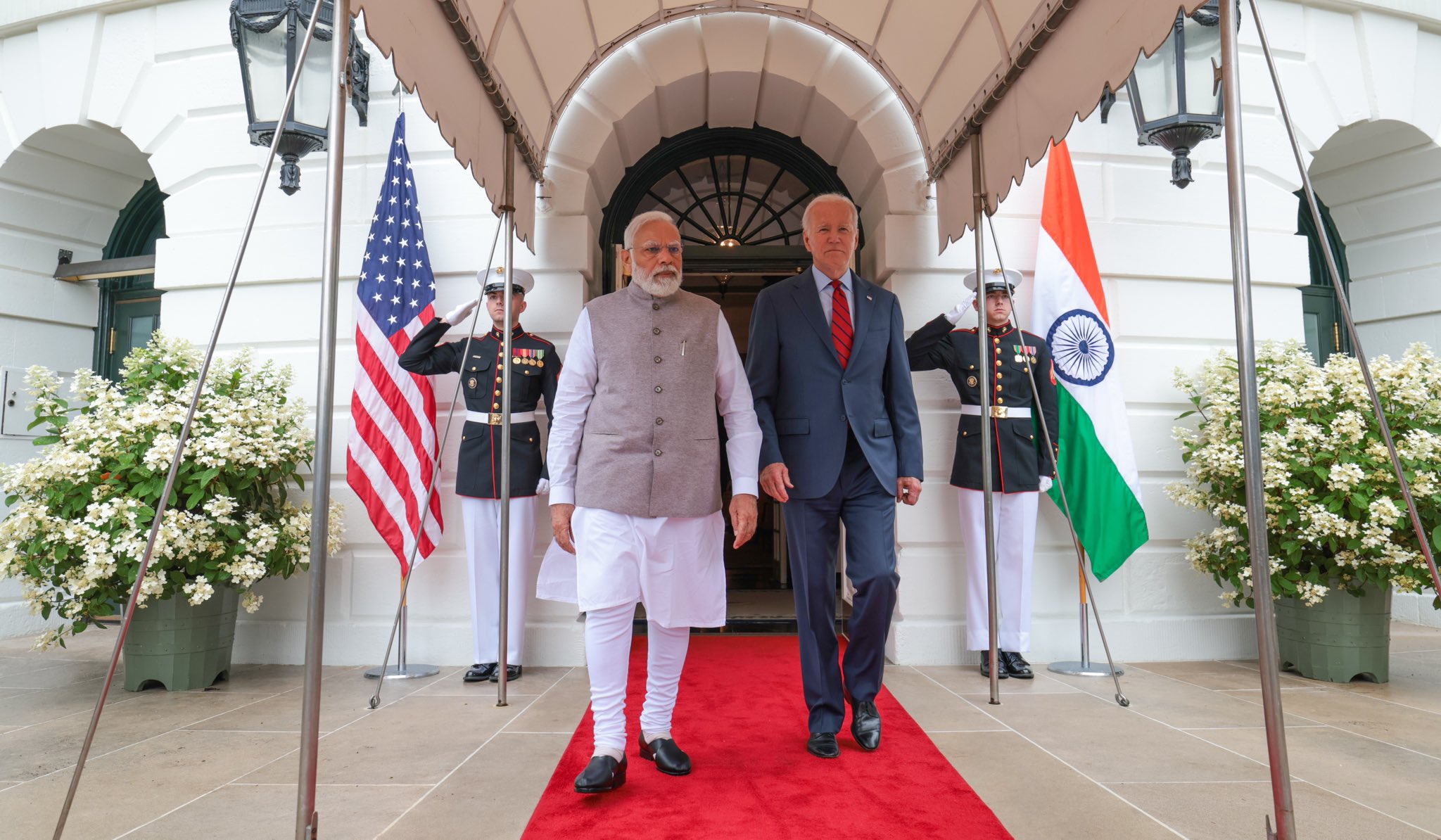
Before concluding his most successful visit to the United States, the Indian Prime Minister Narendra Modi secured several significant agreements relating to defence and cutting-edge technology fields including space, semiconductors, advanced telecommunications, and artificial intelligence. These pacts include plans to procure the most sophisticated armed MQ-9B drones, a “groundbreaking proposal” for joint production of General Electric’s F-414 Jet Engine in India, and a fresh deal on ship repair, the White House announced.
The trip has been has been billed as the catalyst for rolling out new defence collaboration opportunities between the two nations, especially in the realm of advanced technology sharing, even if some details of the initiatives remain scarce.
“The US-India partnership is a cornerstone of a free and open Indo-Pacific, and our deepening bonds show how technological innovation and growing military cooperation between two great powers can be a force for global good,” Pentagon Press Secretary Air Force Brig. Gen. Pat Ryder told reporters on June 22.
The landmark announcement about General Electric’s F-414 jet engine co-production in India was among the most high-profile deals anticipated from Modi’s trip. The White House has officially declared that GE and Hindustan Aeronautics Limited (HAL) have signed a memorandum of understanding (MoU), and Congress has been informed about a manufacturing license agreement.
“This trailblazing initiative to manufacture F-414 engines in India – the first of its kind – will enable greater transfer of US jet engine technology than ever before,” the White House said. The joint statement said that the leaders committed their governments to work collaboratively and expeditiously to support the advancement of this ‘unprecedented co-production and technology transfer proposal’.
In a separate press release, GE stated that the agreement signifies a significant step forward in their commitment to manufacturing 99 engines for the Indian Air Force as part of the Light Combat Aircraft (LCA) Tejas Mk 2 program for the Indian Air Force.
“It puts the company in a strong position to create a family of products in India, including the F-404 engine that currently powers the LCA Mk1 and LCA Mk1A aircraft and GE Aerospace’s selection for the prototype development, testing and certification of the Advanced Medium Combat Aircraft (AMCA) program with our F-414-INS6 engine,” GE said.
The White House said India “intends” to buy armed General Atomics’ MQ-9B HALE UAVs (unmanned aerial vehicles). The MQ-9Bs SeaGuardian, which will be assembled in India, and enhance the ISR capabilities of India’s armed forces across domains. As part of this plan, General Atomics will also establish a Comprehensive Global MRO facility in India to support India’s long-term goals to boost indigenous defence capabilities, according to the statement.
Regarding naval assets and their support structure, the US Navy has concluded a Master Ship Repair Agreement with Larsen and Toubro Shipyard in Kottapuli and is finalising agreements with Mazagon Dock Limited and Goa Shipyard.
“These agreements will allow mid-voyage US Navy ships to undergo service and repair at Indian shipyards, facilitating cost-effective and time-saving sustainment for US military operations across multiple theatres,” the White House said. As envisaged in the Defence Industrial Roadmap, both countries agree to work together to create logistic, repair, and maintenance infrastructure for aircraft and vessels in India.
Ryder said the Pentagon and services would have more details on the plan shortly, but the “aim” is to make India a logistics hub for the US and other regional partners.
“We intend to support India in the creation of logistics, repair, and maintenance infrastructure for aircraft and ships… that is obviously something that will be important as we work together to preserve a free and open Indo-Pacific,” the one-star General added.
The two nations also vowed to strengthen undersea domain awareness cooperation and launched negotiations for a Security of Supply Arrangement and Reciprocal Defence Procurement Arrangement to mitigate defence supply chain disruptions.
In addition to those White House announcements, on June 21, the two countries launched the India-U.S. Defence Acceleration Ecosystem (INDUS-X) to shore up the defence industry cooperation and technology sharing between the two nations. While most of the attention has been around government-to-government relations, INDUS-X is designed to bring the private sector more into the fold and boost tech defence startups in both countries. Indian and American startups will now be able to co-develop and co-produce advanced technologies, including in areas of space and artificial intelligence domains.
The launch is critical because it comes within months of operationalising the US-India Initiative on Critical and Emerging Technologies (iCET) following the agreement between Indian NSA Ajit Doval and his US counterpart Jack Sullivan in January. Several startups from both countries are working in areas of critical technologies.
In his keynote address at the event, Frank Kendall, US Secretary of the Air Force, said the India-US relationship is growing exponentially, and there is enormous potential for startups of both nations to collaborate in deep tech innovations, especially in the Space and Artificial Intelligence (AI) domains.
Technology Partnerships
The ‘Joint Statement’ issued by India and the United States affirmed that “no corner of human enterprise is untouched by the partnership between our two great countries, which spans the seas to the stars”. According to the ‘Fact Sheet’ issued by the White House, the following areas in the digital defence domains between US and India have been agreed on:
Strengthening Semiconductor Supply Chains
With support from the India Semiconductor Mission, Micron Technology will invest more than $800 million toward a new $2.75 billion semiconductor assembly and test facility in India. Applied Materials will build a Semiconductor Centre for Commercialization and Innovation in India to strengthen the two nations’ semiconductor supply chain diversification. And, Lam Research will train 60,000 Indian engineers through its “Semiverse Solution” to accelerate India’s semiconductor education and workforce development goals. This US-India deal on semiconductors will further accelerate India’s efforts to grow its semiconductor manufacturing ecosystem.
New Frontiers in Space: NASA-ISRO Collaboration
India has signed the Artemis Accords, joining 26 other countries committed to peaceful, sustainable, and transparent cooperation that will enable exploration of the Moon, Mars, and beyond. NASA will provide advanced training to Indian Space Research Organization (ISRO) astronauts to launch a joint effort to the International Space Station in 2024. NASA and ISRO are also developing a strategic framework for human spaceflight cooperation by the end of 2023.
Critical Minerals Partnership
India has become the newest partner of the US-led Minerals Security Partnership (MSP) to accelerate the development of diverse and sustainable critical energy minerals supply chains globally. The MSP, which started in June 2022, has 12 other partner countries, plus the European Union. India’s Epsilon Carbon Limited will invest $650 million in a greenfield electric vehicle battery component factory, the largest ever Indian investment in the US electric vehicle battery industry.
Advanced Telecommunications
India and the US have launched public-private Joint Task Forces on developing and deploying Open RAN systems and on advanced telecoms research and development. India’s Bharat 6G and the US Next G Alliance will co-lead this public-private research. This work will reduce costs, increase security, and improve the resiliency of telecommunication networks. Both leaders endorsed an ambitious vision for 6G networks, including standards cooperation, facilitating access to chipsets for system development, and establishing joint research and development projects. They also stressed the need to implement a “Trusted Network/Trusted Sources” bilateral framework.
Quantum, Advanced Computing, and Artificial Intelligence
The two countries have established a Joint Indo-US Quantum Coordination Mechanism to facilitate joint research between the public and private sectors across the two countries. They have also signed an implanting arrangement to support joint research on quantum, Artificial Intelligence (AI), and advanced wireless technologies.
Additionally, both nations signed an implanting arrangement to support further joint research on quantum, Artificial Intelligence (AI), and advanced wireless technologies for commercialisation and encourage public-private collaborations to develop high-performance computing (HPC) facilities in India. the White House Fact Sheet states. President Biden also reiterated his government’s commitment to working with US Congress to lower barriers to US exports of HPC technology and source code to India.
Cutting-edge Research
The US National Science Foundation (NSF) has announced 35 joint research collaborations with India’s Department of Science and Technology (DST) and signed a new cooperative arrangement with India’s Ministry of Electronics and Information Technology on emerging technologies. Furthermore, NSF and India’s Ministry of Electronics and Information Technology will bring fresh funding for joint projects in applied research areas such as semiconductors, next-generation communication, cyber security, sustainability and green technologies and intelligent transportation systems.
Innovation Handshake
To support the U.S.-India Initiative on Critical and Emerging Technology (iCET), the US-India Commercial Dialogue will launch a new “Innovation Handshake” to connect each country’s start-up ecosystems.
The new bilateral agreements illustrate the United States’ efforts to enhance its relationships with strategic allies like India while simultaneously isolating China. India stands to gain advantages from collaborative ventures in research and development and the potential reduction of obstacles to the export of cutting-edge technologies from the United States. Through the Critical and Emerging Technology Initiative (iCET) with India, the United States seizes an additional opportunity to establish a partnership with a nation that aspires to compete with China’s technological advancements. By joining forces, India and the United States bolster their endeavours to counteract China’s swift technological growth, presenting a more formidable united front.

Dr Ravi Shankar has over two decades of experience in communications, print journalism, electronic media, documentary film making and new media.
He makes regular appearances on national television news channels as a commentator and analyst on current and political affairs. Apart from being an acknowledged Journalist, he has been a passionate newsroom manager bringing a wide range of journalistic experience from past associations with India’s leading media conglomerates (Times of India group and India Today group) and had led global news-gathering operations at world’s biggest multimedia news agency- ANI-Reuters. He has covered Parliament extensively over the past several years. Widely traveled, he has covered several summits as part of media delegation accompanying the Indian President, Vice President, Prime Minister, External Affairs Minister and Finance Minister across Asia, Africa and Europe.