



India’s widening fighter-aircraft gap is acquiring a new urgency with Pakistan moving towards a fifth-generation fighter capability, prompting the Indian Air Force to examine how quickly it can add both numbers and advanced combat capability to its fleet.
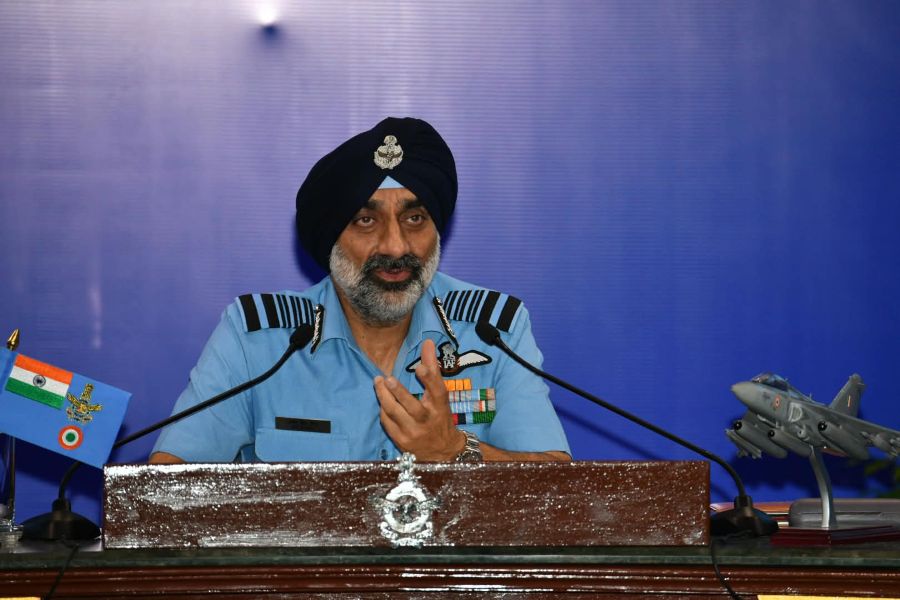
Addressing an annual press conference ahead of 94th Air Force Day, Air Chief Marshal AP Singh has said that if delays persist in India’s Advanced Medium Combat Aircraft (AMCA) programme, the IAF may have to examine alternative fifth-generation fighter options. He also indicated that the long-pending Multi-Role Fighter Aircraft (MRFA) programme could be finalised within the current financial year, if negotiations proceed as planned.
“If there are delays in the AMCA fifth-generation fighter programme, we may have to look at other options,” Air Chief said at his annual press conference ahead of 94th Air Force Day.
The Air Chief’s concern was framed in the context of developments across the western border.
“It’s a matter of cause for worry. We have to fill in the gap, if the other side is getting the 5th generation across, we need to look at some 5th generation,” he said, adding that Russia had offered its Su-57 to India but no decision had been taken.
The remarks underline a twin challenge for the IAF: its fighter fleet is already below the numbers it has sought for sustained combat operations, while the induction of fifth-generation aircraft by a neighbouring air force could create a new capability gap.
36-40 fighters needed every year
Air Chief Marshal said the IAF needs to induct around 36 to 40 fighter aircraft every year to arrest the decline in its combat fleet.
The requirement comes against the backdrop of a fighter fleet that has been shrinking as older platforms are progressively retired, and replacement programmes have faced delays. The IAF’s authorised strength of 42 fighter squadrons remains well above its present operational strength.
The Air Chief stressed that building up aircraft numbers could not be deferred while the country waits for indigenous next-generation platforms.
The AMCA remains India’s principal programme for acquiring a domestically designed fifth-generation fighter. However, its timelines mean that the aircraft will not provide an immediate solution to the IAF’s fighter shortfall.
MRFA deal targeted this financial year
Against this backdrop, the IAF is looking to move ahead with the 114-aircraft MRFA programme, which envisages procurement of Rafale fighters from France under a government-to-government framework.
The government cleared the proposal earlier this year, and negotiations covering price, technology and other contractual issues are under way.
Air Chief Marshal said the deal could be concluded by the end of the current financial year, provided the negotiations proceed as planned.
The MRFA acquisition is significant not only for modernising the fleet but also for arresting the numerical decline in fighter squadrons. The Rafale acquisition would add another advanced multirole fighter type to the IAF while complementing the existing fleet.
However, the MRFA programme and AMCA serve different requirements. While MRFA can address the immediate and medium-term requirement for additional fighter numbers and capability, AMCA is intended to provide India with an indigenous fifth-generation platform in the longer term.
Su-57 option remains open
Russia’s offer of the Su-57 has therefore acquired renewed attention.
Air Chief made it clear that no decision has been taken on the Russian proposal. The IAF, he said, would like to increase the number of aircraft in its inventory.
The Russian proposal would offer a potential fifth-generation capability before AMCA becomes operational, but pursuing such an option would involve a separate set of operational, industrial and strategic considerations. For now, the government’s stated focus remains on the indigenous AMCA programme.
Defence Secretary Rajesh Kumar Singh had also said recently that there was no government decision to pursue a foreign fifth-generation fighter programme.
The Air Chief’s latest comments, however, signal that the IAF is conscious of the capability gap that could emerge if neighbouring countries begin fielding fifth-generation fighters before AMCA enters service.
For the IAF, therefore, the challenge is no longer simply about replacing retiring aircraft. It is about simultaneously restoring fighter numbers, accelerating induction of new platforms and ensuring that the force does not fall behind in the transition to fifth-generation air combat.
Ravi Shankar

Dr Ravi Shankar has over two decades of experience in communications, print journalism, electronic media, documentary film making and new media.
He makes regular appearances on national television news channels as a commentator and analyst on current and political affairs. Apart from being an acknowledged Journalist, he has been a passionate newsroom manager bringing a wide range of journalistic experience from past associations with India’s leading media conglomerates (Times of India group and India Today group) and had led global news-gathering operations at world’s biggest multimedia news agency- ANI-Reuters. He has covered Parliament extensively over the past several years. Widely traveled, he has covered several summits as part of media delegation accompanying the Indian President, Vice President, Prime Minister, External Affairs Minister and Finance Minister across Asia, Africa and Europe.