





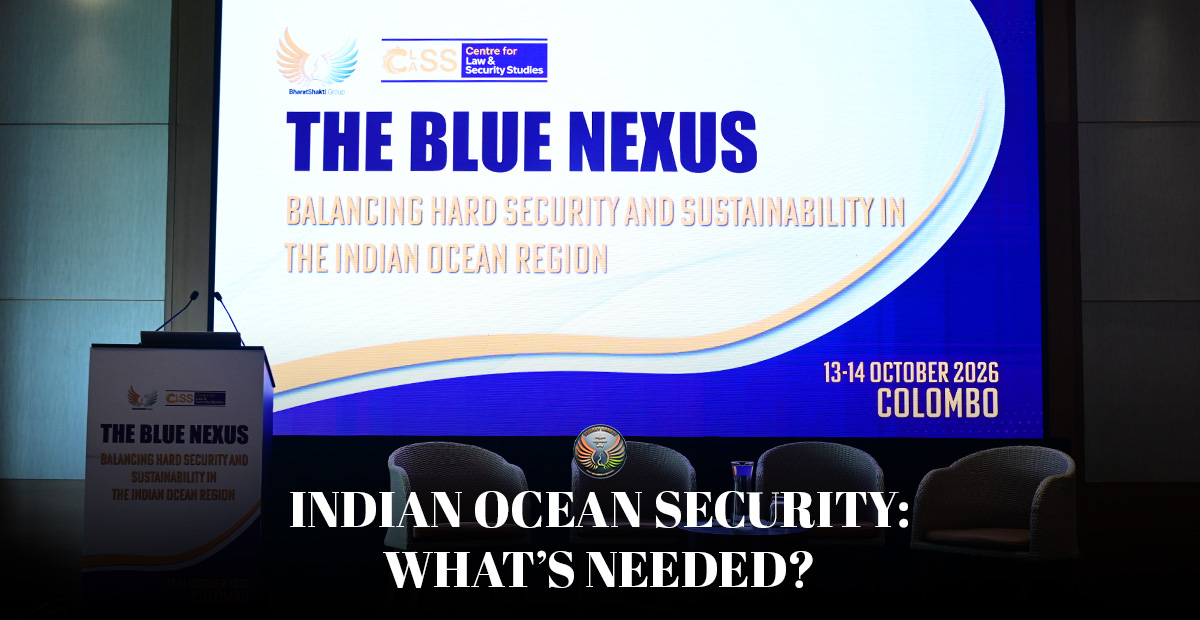
In an era of growing geopolitical competition, grey-zone warfare, vulnerabilities in undersea infrastructure and climate-related challenges are reshaping the Indian Ocean security landscape. That’s why experts advocate stronger regional coordination and a more integrated approach to maritime security. These concerns were discussed at the two-day Blue Nexus conference in Colombo recently.
Organised by the Bharat Shakti Group and Colombo-based Centre for Law and Security Studies (CLASS), the conference brought together security experts, diplomats, academics, industry representatives and researchers. The idea was to examine how Indian Ocean states can safeguard maritime interests while ensuring economic development does not undermine environmental sustainability.
A central theme that emerged was that maritime security can no longer be understood only through conventional naval power. Instead, the region requires an integrated framework connecting national security, economic resilience, technological preparedness and environmental protection.
The inaugural discussion, featuring former Sri Lankan Navy chief Admiral Jayanath Colombage, former Ambassador Prasad Kariyavasam and strategic affairs expert Nitin A. Gokhale, highlighted Sri Lanka’s strategic position along major Indian Ocean shipping routes and the importance of partnerships with India and other Asian countries.
Speakers stressed that Sri Lanka must translate its maritime geography into strategic and economic advantages through practical diplomacy, institutional capacity and a coherent national maritime strategy.
Gokhale ]highlighted the significance of the combined Exclusive Economic Zones of Sri Lanka, India, the Maldives and Indonesia, which cover nearly five million square kilometres and sustain millions of livelihoods. Their security, he argued, is inseparable from the region’s economic and ecological future.
The first knowledge session examined the strategic implications of maritime chokepoints and grey-zone warfare. Former Maldivian Defence Minister Marya Didi argued that shipping routes, ports, undersea cables and energy infrastructure are increasingly exposed to geopolitical competition, transnational crime, illegal fishing and cyber threats.
Discussions involving Indonesian, Bangladeshi and Indian experts highlighted the difficulty of responding to activities that fall below the threshold of conventional conflict. Fishing fleets, survey vessels, shadow shipping, GPS interference and the use of non-state actors can create strategic pressure while complicating attribution. Indonesia’s position was particularly significant, given its responsibility for managing strategically important passages such as the Malacca, Lombok and Makassar straits while balancing freedom of navigation, sovereignty and strategic autonomy.
The second session shifted attention to undersea communication cables and digital infrastructure, increasingly recognised as critical components of national and regional security. Former chief of Indian Navy’s intelligence Rear Admiral Sudarshan Shrikhande (Retd) emphasised that cable disruptions could have substantial regional economic consequences.
The third session examined the relationship between maritime security and the blue economy. Discussions on Colombo, Trincomalee and Hambantota highlighted Sri Lanka’s potential to strengthen its position as a regional shipping, logistics and energy hub. However, participants cautioned against fragmented development and called for complementary port operations.
As a major Indian Ocean stakeholder, India has a direct interest in maintaining freedom of navigation, protecting critical maritime infrastructure, securing trade corridors and strengthening the resilience of smaller island and littoral states. The conference reinforced the importance of regional partnerships that respect strategic autonomy while addressing shared vulnerabilities.