






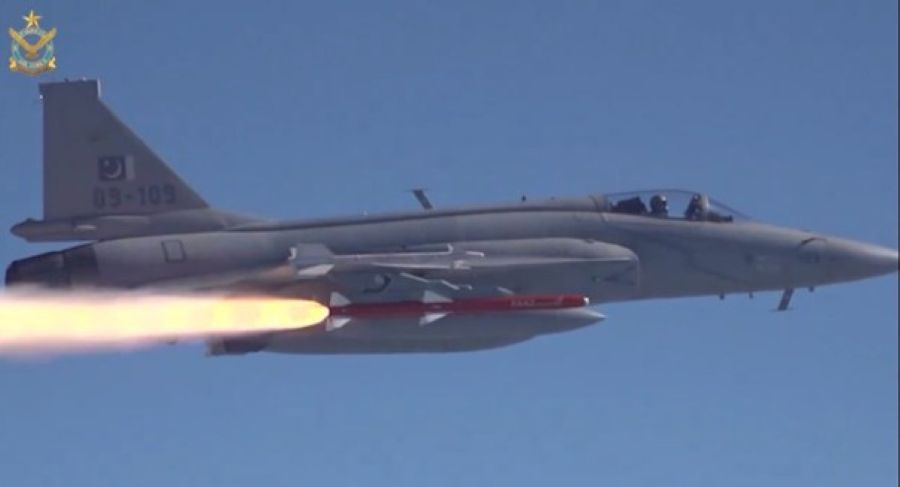
Pakistan has taken an important step towards developing an indigenous air-to-air combat weapons capability with the first flight test of its Fa’az air-to-air missile from a JF-17 Thunder fighter. The test, announced by the Pakistan Air Force on November 3, marks the first publicly acknowledged flight test of an air-to-air missile developed domestically by Pakistan. Beyond the immediate military significance, it represents an attempt to reduce dependence on foreign suppliers and establish a weapons ecosystem around its jointly developed fighter aircraft.
The Pakistan Air Force released video footage showing a JF-17 carrying and subsequently launching the missile. The footage establishes that Fa’az has progressed beyond exhibition models to airborne launch testing. However, the military did not disclose the missile’s performance parameters, the engagement conditions or whether the test involved an actual target interception.
Fa’az: A Missile Family, Not Just a Single Weapon
Developed by Pakistan’s National Engineering and Scientific Commission (NESCOM), through its Air Weapons Complex, and marketed by Global Industrial & Defence Solutions (GIDS), Fa’az was publicly displayed in 2023. The programme encompasses two principal air-to-air configurations – Fa’az-RF, featuring an active radar seeker, and Fa’az-IIR, equipped with an imaging infrared seeker.
The missile shown in the latest footage appears to be the infrared-guided Fa’az-IIR. This distinction matters because infrared guidance offers an alternative to active radar homing, potentially allowing an aircraft to employ a missile without relying on its own radar emissions during the terminal engagement phase.
GIDS has advertised ranges exceeding 100 kilometres for the Fa’az family, with seeker detection ranges reportedly reaching approximately 25 kilometres for the radar-guided variant and 40 kilometres for the infrared version. These remain manufacturer-reported specifications rather than independently validated operational performance.
A claimed missile range of 100 kilometres or more should not be confused with its seeker acquisition range. At such distances, the weapon would need inertial navigation and potentially mid-course guidance updates from the launching aircraft or another source before acquiring its target during the terminal phase. This is particularly relevant to an infrared-guided missile, whose seeker must ultimately detect the target’s thermal signature.
The Chinese Connection: How Indigenous Is Fa’az?
The question of China’s involvement remains central to assessing Fa’az’s technological significance.
Pakistan and China have an extensive defence-industrial relationship. The JF-17 itself was jointly developed, and Pakistan’s air-combat inventory remains heavily dependent on Chinese-origin platforms and weapons.
The possibility of Chinese assistance in Fa’az’s development, particularly in seeker technology or other components, cannot be ruled out. Some analysts have suggested that the missile’s infrared seeker could incorporate Chinese technology. However, this has not been officially confirmed, and Pakistan maintains that Fa’az is indigenous.
Indigenous development does not necessarily mean complete technological self-sufficiency. A missile can be locally designed, assembled and manufactured while incorporating imported components. The real test of Pakistan’s autonomy will be its ability to produce the weapon at scale, maintain its supply chain and undertake subsequent upgrades without excessive external dependence.
Impact on India: Does Fa’az Narrow the Air-to-Air Missile Gap?
For India, Fa’az is worth monitoring, but its first flight test should not be interpreted as an immediate shift in the regional air-combat balance.
1. A Pakistani counterpart to Astra
India has already established a domestic air-to-air missile programme through DRDO’s Astra series. Astra Mk1 is operational with the Indian Air Force, while India has continued testing the missile with indigenous seekers and additional aircraft platforms. In July 2025, DRDO and the IAF successfully tested Astra equipped with an indigenous radio-frequency seeker against aerial targets.
Fa’az therefore gives Pakistan a potential indigenous counterpart to Astra, but not necessarily an equivalent capability today.
The distinction is important – India has demonstrated Astra’s target engagement capability, including successful destruction of aerial targets, whereas the publicly available Fa’az footage establishes a missile launch without disclosing a target interception.
2. Reduced dependence on foreign missile supplies
Perhaps the most consequential implication for India is not the missile’s advertised range but Pakistan’s potential ability to sustain its air-combat inventory independently.
During a prolonged military confrontation, access to foreign weapons, replacement stocks and replenishment schedules can become important constraints. If Fa’az eventually enters serial production, Pakistan could gain greater flexibility in maintaining its missile inventory, subject to production capacity and the availability of imported components.
This would not eliminate Pakistan’s dependence on China, but it could reduce some vulnerabilities associated with foreign procurement.
3. Infrared guidance could complicate air combat
The infrared-guided Fa’az-IIR potentially introduces another engagement option for the PAF alongside radar-guided missiles.
An imaging infrared seeker can offer advantages in certain tactical situations, particularly where emissions control and reduced radar dependence are important. However, long-range infrared engagements require sophisticated target-location information, appropriate launch conditions and effective guidance throughout the missile’s flight.
The mere presence of an infrared seeker does not establish that Fa’az can reliably engage targets at its advertised maximum range.
4. China’s missile advantage remains a separate consideration
Fa’az should not be confused with Pakistan’s existing Chinese-origin beyond-visual-range missile capability.
The PL-15E, deployed with the Chinese-built J-10CE, remains a separate weapon system. Its operational employment during the May 2025 India-Pakistan confrontation highlighted the importance of missile range, aircraft sensors, electronic warfare and networked targeting in modern air combat.
Fa’az does not automatically replace or match that capability. Instead, it could eventually complement Pakistan’s existing Chinese weapons and provide another layer of operational flexibility.
The Larger Strategic Picture
Pakistan’s Fa’az programme is significant because it marks an attempt to move from importing air-to-air weapons towards developing and producing them domestically.
For India, the immediate concern should not be an assumption of technological parity but the possibility that Pakistan is gradually building a more sustainable and diversified air-combat weapons inventory.
The next milestones will be far more revealing than the maiden launch – successful target interceptions, validation of the missile’s guidance system, integration with operational JF-17 variants, serial production and eventual deployment.
Ravi Shankar

Dr Ravi Shankar has over two decades of experience in communications, print journalism, electronic media, documentary film making and new media.
He makes regular appearances on national television news channels as a commentator and analyst on current and political affairs. Apart from being an acknowledged Journalist, he has been a passionate newsroom manager bringing a wide range of journalistic experience from past associations with India’s leading media conglomerates (Times of India group and India Today group) and had led global news-gathering operations at world’s biggest multimedia news agency- ANI-Reuters. He has covered Parliament extensively over the past several years. Widely traveled, he has covered several summits as part of media delegation accompanying the Indian President, Vice President, Prime Minister, External Affairs Minister and Finance Minister across Asia, Africa and Europe.