





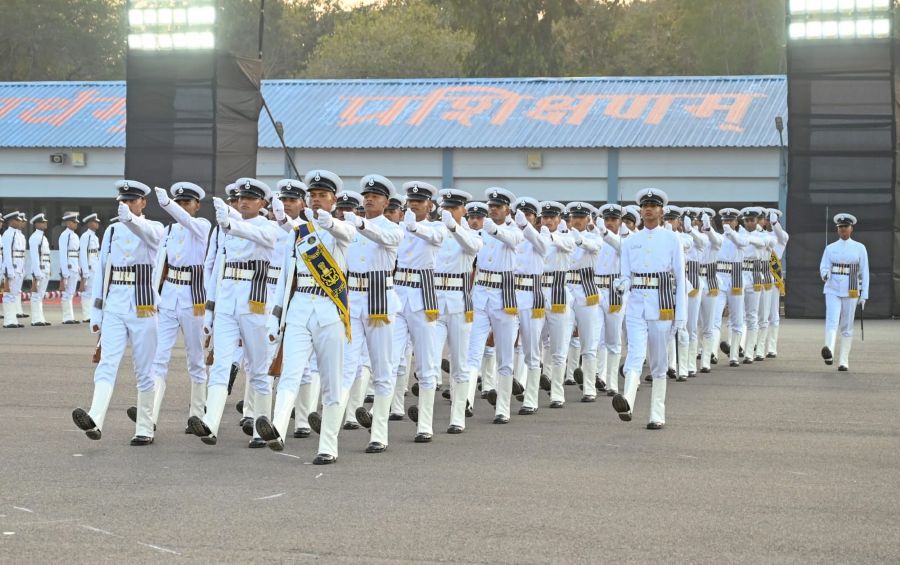
The Indian Navy will witness a significant milestone in its Agnipath journey on November 13, when over 3,300 Agniveers and Indian Coast Guard Naviks will pass out from INS Chilka, marking the largest batch to graduate from the Navy’s premier ab-initio training establishment.
The Passing Out Parade (POP) of the ninth batch of Indian Navy Agniveers and Coast Guard Naviks will be reviewed by Admiral Krishna Swaminathan, Chief of the Naval Staff, who will be the Chief Guest, according to the Navy’s spokesperson, Capt Vivek Madhwal. The event comes at a consequential moment for the Agnipath recruitment model, with the Navy’s first batch of Agniveers approaching the completion of its initial four-year engagement this month.
The passing-out ceremony will coincide with a major policy recalibration of Agnipath, with the Union Cabinet approving a second two-year engagement for Agniveers not selected for regular service after their initial four-year tenure. The revised arrangement gives them another opportunity to compete for regular enrolment, subject to prescribed selection criteria, while retaining the original four-year recruitment framework.
Agnipath enters its first major transition
The 3,300-plus trainees have completed 16 weeks of intensive ab initio training at INS Chilka, which is designed to transform young recruits into disciplined, physically agile, mentally resilient and professionally competent personnel.
The passing-out parade comes as the Armed Forces prepare for the first major transition under the Agnipath scheme, launched in 2022 to reduce the average age of the military and contain the long-term costs associated with salaries, allowances and pensions.
Under the original framework, Agniveers serve for four years, with 25 per cent eligible for retention as regular personnel. The remaining 75 per cent leave with a financial package and other provisions for their subsequent employment.
The latest government decision introduces a second two-year engagement for those not initially selected for regular service. At the end of this extended period, they will have another opportunity to compete for regular enrolment, subject to the prescribed criteria.
The initial four-year tenure and the existing 25 per cent retention provision remain unchanged. The revision, however, creates an additional pathway to continued service, addressing concerns over the limited opportunities for permanent absorption.
The first Navy Agniveer batch is due to complete its four-year tenure this month, followed by the first batches in the Army and the Indian Air Force at the end of next month.
More than three lakh Agniveers are undergoing training or serving across the three services at different stages. The Army accounts for around 2.8 lakh, with approximately 19,000 personnel expected to complete their initial four-year engagement in the coming cycle.
The services had earlier sought a substantial increase in retention after the initial engagement, with several rounds of communication with the Department of Military Affairs on the issue.
Announcing the revision in the capital, Chief of Defence Staff General N S Raja Subramani said the decision followed a sustained assessment of Agniveers’ performance over the past four years and recommendations from the three services.
“When the Agnipath scheme was first introduced, we emphasised that it was not set in stone. We stated that we would evaluate the performance of the Agniveers and conduct continuous reviews,” he said.
The Navy’s largest passing-out batch at INS Chilka thus marks not merely a training milestone but also the beginning of a decisive phase in the evolution of Agnipath, as the services prepare to assess their first cohort of recruits under the short-term engagement model and implement the revised avenues for continued service.
Ravi Shankar

Dr Ravi Shankar has over two decades of experience in communications, print journalism, electronic media, documentary film making and new media.
He makes regular appearances on national television news channels as a commentator and analyst on current and political affairs. Apart from being an acknowledged Journalist, he has been a passionate newsroom manager bringing a wide range of journalistic experience from past associations with India’s leading media conglomerates (Times of India group and India Today group) and had led global news-gathering operations at world’s biggest multimedia news agency- ANI-Reuters. He has covered Parliament extensively over the past several years. Widely traveled, he has covered several summits as part of media delegation accompanying the Indian President, Vice President, Prime Minister, External Affairs Minister and Finance Minister across Asia, Africa and Europe.