





Editor’s Note
The revised scheme addresses Agnipath’s human concerns but risks reviving the very salary and pension burden it was designed to contain. Unless the armed forces undertake a deeper manpower overhaul, modernisation will remain hostage to an oversized military and shrinking capital resources. The author argues that a more accommodating recruitment policy must be matched by a fundamental restructuring of India’s manpower-intensive military.
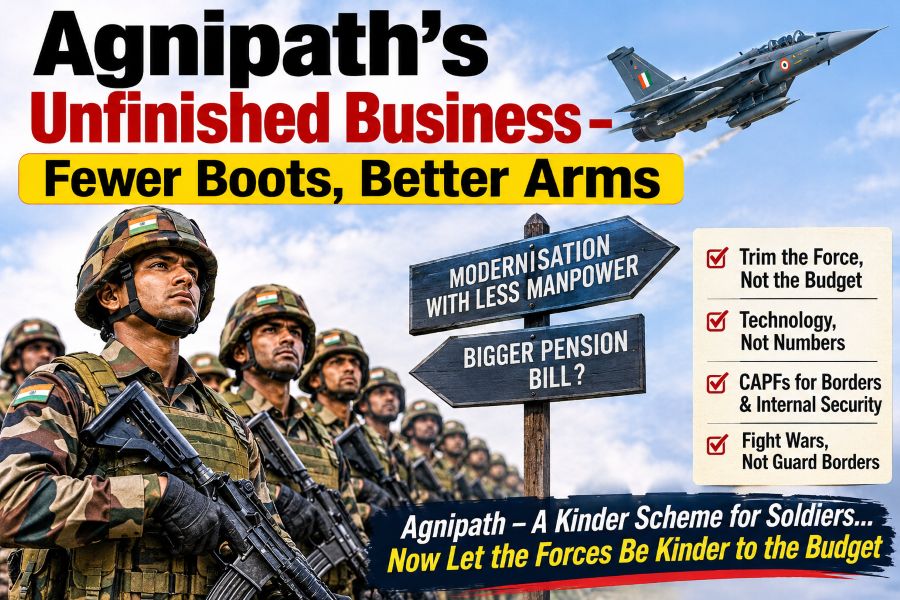
Agnipath’s Unfinished Business
By opening the path for every Agniveer to become a regular soldier, the government has fixed Agnipath’s human problem and quietly worsened its fiscal one. While this scheme witnessed massive protests across the heartland when it was introduced, many would probably perceive the terms now proposed by the government as a rollback or turnaround.
The circumstances that led to the introduction of the scheme, however, remain the same. The stated purpose was to “have a younger, fitter, diverse profile for facing future challenges” with the additional benefits of having trained manpower joining the society after their exit.
An underlying major factor, though not overtly stated, remained the burgeoning revenue budget. Pensions and salaries account for 44 per cent of the 2026-27 defence budget. Capital outlay, which pays for new weapons and modernisation, gets only 29 per cent.
The performance of the Agniveers to meet organisational requirements and achieve operational efficiency has been exceptional with most displaying high motivational levels, physical fitness and technological prowess. A major reason also for continuing to excel was to outdo the others to remain in the top 25 per cent for permanent retention.
While the individual would have the option to exit at the end of four or six years, the armed forces also have the opportunity to retain the best talent that meets their requirements. The revision partly undoes the scheme’s fiscal logic, with more regulars leading to a larger salary and pension bill.
Agnipath only ever trimmed manpower costs at the margins. The question governments and the services have avoided for two decades is the size of the force itself. India cannot build a modern military while keeping one of the world’s largest standing armies on a budget a fraction of China’s.
If Agnipath is to be softened, the army must become like all modern militaries. The argument that the Indian Army needs the numbers to guard active borders and handle internal security is both outdated and flawed. The primary task of any army is to fight and win wars.
The role of guarding the international border is that of the Central Armed Police Forces (CAPF) like Indo-Tibetan Border Police (ITBP), Border Security Force (BSF), and Sashastra Seema Bal (SSB). Internal security is a policing function carried out by both state and central police agencies. The argument that the CAPFs are ill-equipped and not trained sufficiently for the task may have been true in the past, but is no longer the case today. CAPFs, without the Indian Army’s involvement, have successfully eradicated Left Wing Extremism.
In addition, the CRPF declared zero operational fatalities in the last year, for the first time in 47 years, implying sound training and professionalism. The sanctioned strength of the CAPFs has also seen a consistent increase, with over a million personnel in active service. 63 battalions of Rashtriya Rifles (RR) were formed in the early nineties with personnel from the Indian Army on deputation for counter-insurgency roles.
The centre has already initiated replacing the RR with CAPF in some sectors. Reports, however, suggest that a significant number of RR troops will continue to stay in J&K. These numbers, however, need to be cut and replaced in their entirety by the CAPFs.
According to the latest SIPRI data, India remains the world’s second largest importer of weapons, even as imports have marginally reduced in the last five years. The huge costs of imports, coupled with a depreciating rupee, along with a large pension and salary bill, leave very little for any meaningful capability development. The result is an outdated military.
A recent article by Sudharshan Garg in Swarajya highlights how even basic things like body armour, night sights and communication are not available to every soldier. This plight is common across the services. The IAF flew the MiG-21 until September, 62 years since its induction. It is the only air force in the world that is still operating the Jaguar aircraft. Such alarming obsolescence is a result of a manpower-intensive military.
In addition, procurement delays and long-incubation indigenous programmes like aeroengines, fighter jets, submarines, tanks, etc. also add to it.
Arguments and the government’s efforts to cut down revenue expenditure are not new. The Kargil Review Committee had recommended something similar to Agnipath. It advised reduction of colour service with subsequent transfer of personnel to CAPFs after seven to ten years. Pay, perks, allowances and pension are factors that attract quality talent and cannot be compromised. What needs to be done is to embrace modern technology over manpower and reduce numbers.
According to a report published by the Centre for Strategic and International Studies (CSIS), the People’s Liberation Army has cut down its ground forces by 40 per cent, from 1.6 million in 2014 to 0.96 million in 2024, to drive modernisation and enable joint operations. While numbers do matter for the Indian Army, which faces a two-front threat with an active Line of Control (LoC) and Line of Actual Control (LAC), any hope that India, a five-times smaller economy with a nascent military-industrial complex, can modernise without cutting down its personnel is wishful thinking.
While the revised Agnipath scheme offers several benefits to the Indian Armed Forces in providing them with more capable, motivated and willing soldiers to fight future wars, the concomitant onus for reducing manpower also rests with the armed forces.
A candid and forthright assessment leading to future manning requirements in view of unmanned systems, artificial intelligence, network-centric warfare, etc., is the need of the hour. Agnipath has been made kinder to the soldier.
It is now the turn of the forces to be made kinder to the budget, or India will stay organised, trained and equipped to fight wars of yesteryear.
AVM Anil Golani (Retd) (Author is former Director General and Honorary Distinguished Fellow, Centre for Aerospace Power and Strategic Studies)