






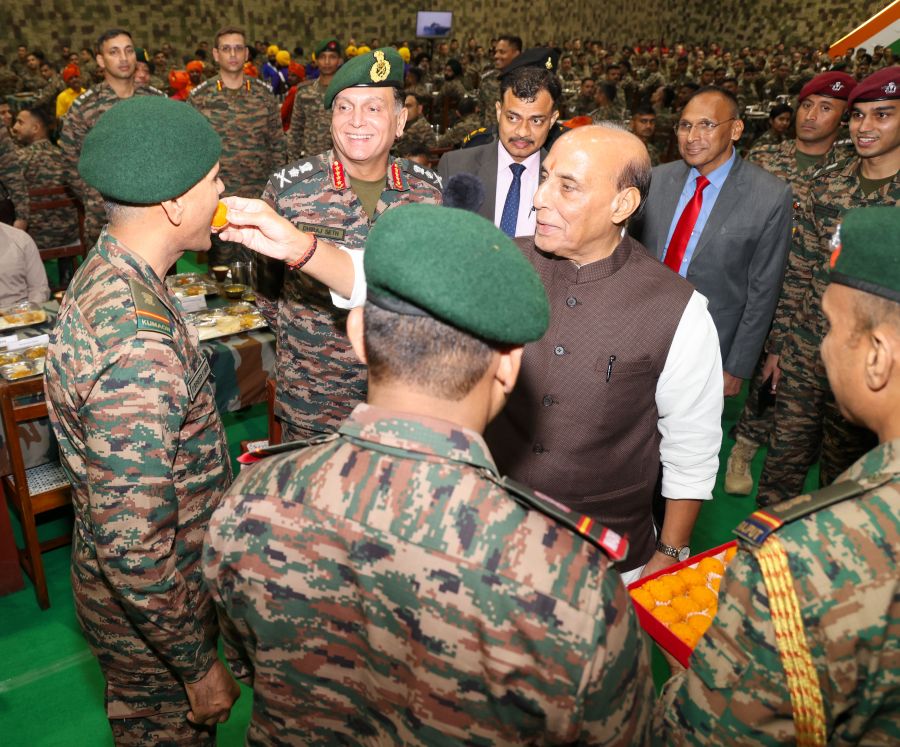
Defence Minister Rajnath Singh on Saturday reviewed the operational preparedness of Trishakti Corps at Sukna in West Bengal, taking stock of infrastructure development along the Line of Actual Control (LAC) and the deployment of advanced military equipment and emerging technologies to enhance combat effectiveness.
Singh expressed satisfaction with the Corps’ operational readiness and commended its contribution to nation-building through infrastructure development and community welfare initiatives in border areas, aimed at strengthening the Army’s engagement with local communities.
Chief of the Army Staff General Dhiraj Seth, Eastern Army Commander Lt Gen VMB Krishnan and Trishakti Corps Commander Lt Gen Man Raj Singh Mann were present during the visit, along with other senior Army officers.
Addressing soldiers during a Barakhana on the eve of Diwali, Singh lauded their courage, professionalism and commitment to safeguarding the nation’s frontiers under challenging operational conditions.
Underscoring the strategic importance of logistics in sustaining military operations, the Defence Minister described Sukna as a critical hub for the movement of supplies, weaponry, food, medical provisions and personnel to forward locations.
“Sukna is a vital link in the security architecture of Eastern India,” he said, adding that its geographical sensitivity demanded round-the-clock operational readiness. He said the Government was strengthening supply chains to ensure that troops deployed in forward areas received essential supplies without disruption.
Singh said budgetary allocations for roads, tunnels, border infrastructure and modern military equipment had been increased as part of efforts to strengthen national defence capabilities and advance Aatmanirbhar Bharat.
Highlighting the growing contribution of domestic industry, he said Indian start-ups and manufacturers were producing drones, anti-drone systems and other advanced military equipment. He noted that the Armed Forces were increasingly incorporating emerging technologies into their operational training, including drone operations and cybersecurity.
The Defence Minister cautioned that contemporary warfare had expanded beyond conventional battlefield engagements to include hybrid warfare, proxy conflicts, cyber-attacks, drone incursions and information warfare.
“Modern warfare extends beyond conventional battles to encompass hybrid warfare, proxy wars, cyber-attacks, drone incursions and information warfare. Defence Forces must remain vigilant,” he said.
He warned that adversaries were increasingly employing social media to spread misinformation, using drones to monitor sensitive locations and attempting to compromise military systems through cyber-attacks. He called upon personnel to remain alert and prepared to counter threats across multiple domains.
Describing the North-East as India’s “first edge” rather than its “last edge”, Singh emphasised the region’s strategic and cultural significance, highlighting its biodiversity, natural beauty, cultural diversity and traditions as integral to the country’s national identity.
He said the region represented the beginning of India’s geographical and cultural landscape, receiving the first rays of the morning sun, and underscored its importance in the country’s broader strategic outlook.
Team BharatShakti