





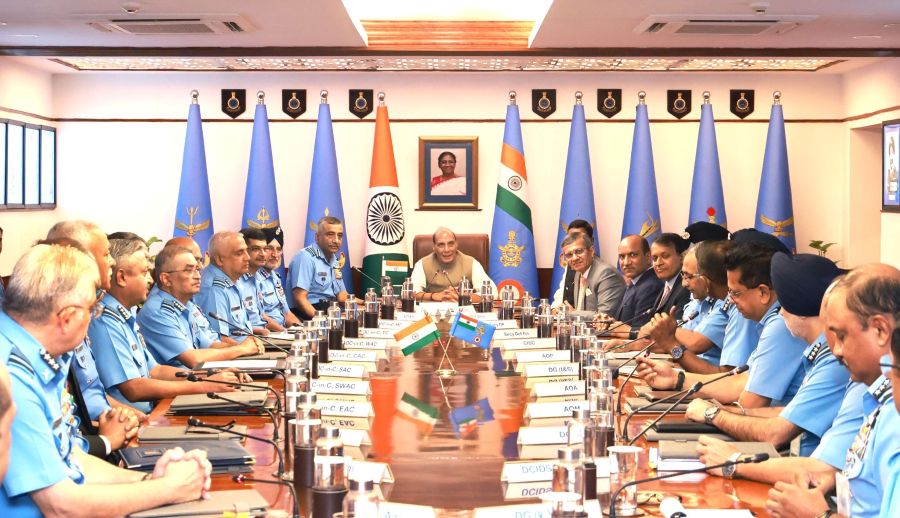
Defence Minister Rajnath Singh on Thursday called for strengthening the Indian Air Force’s offensive and defensive capabilities, with particular emphasis on the element of surprise, technological superiority and intelligence-driven operational preparedness to counter conventional and emerging threats.
Addressing the Air Force Commanders’ Conference in New Delhi on November 12, Singh stressed the need to enhance intelligence, surveillance and integration of systems to identify potential threats before they materialise. He said the ability to deny an adversary time to react, while ensuring that Indian forces are never caught off guard, would be crucial to maintaining operational readiness in an increasingly technology-driven battlespace.
“Victory in future conflicts would depend not merely on the number of aircraft, but also on technological sophistication, speed of response and precision of preparations,” the Defence Minister said, underlining the growing importance of electronic, cyber and space domains in modern warfare.
Referring to the Russia-Ukraine and Israel-Hamas conflicts, Singh noted that drones, missiles and air defence systems were reshaping warfare, with non-contact engagements increasingly extending beyond traditional battlefields. He urged the IAF to prepare for emerging challenges involving kamikaze drones, surveillance and counter-drone operations, while developing dedicated doctrines and operational architectures for electronic, cyber and space warfare.
The Minister commended the IAF for implementing its doctrines and operational methods during and after Operation Sindoor, praising the professionalism, restraint and judgement demonstrated by air warriors. He said operational lessons from the campaign were influencing the Service’s evolving procedures, particularly its emphasis on drones and air defence systems.
Highlighting the coordinated contribution of all three Services during Operation Sindoor, Singh called for sustaining jointness and integration in military planning and operational execution. He also urged the IAF to intensify training in emerging technologies and leverage the technical capabilities of young recruits to improve decision-making and organisational effectiveness.
On the Second Tour of Duty for Agniveers, Singh said the initiative had been introduced in response to feedback from the Services, reaffirming the Government’s commitment to incorporating military inputs into policy decisions.
IAF steps up AI-driven transformation
As part of the conference, Singh launched a suite of artificial intelligence applications developed in-house by the IAF’s AI Centre of Excellence under the Unit for Digitisation, Automation, Artificial Intelligence and Application Networking (UDAAN).
The applications, deployed on the IAF’s secure network, are designed to automate and accelerate processes across operations, administration and aerospace safety. The initiative marks another step in the Service’s technology-driven transformation and efforts to improve operational efficiency.
The conference, themed ‘The Year of Empowerment: Maximising Efficiency Through Decentralisation’, provides a platform for the IAF’s senior leadership to deliberate on operational, maintenance and administrative priorities.
The inaugural session was attended by Minister of State for Defence Sanjay Seth, Chief of the Air Staff Air Chief Marshal Ashutosh Dixit, Defence Secretary Rajesh Kumar Singh and other senior defence officials, besides Air Officers Commanding-in-Chief, Principal Staff Officers and Director Generals of the IAF.
Team BharatShakti