



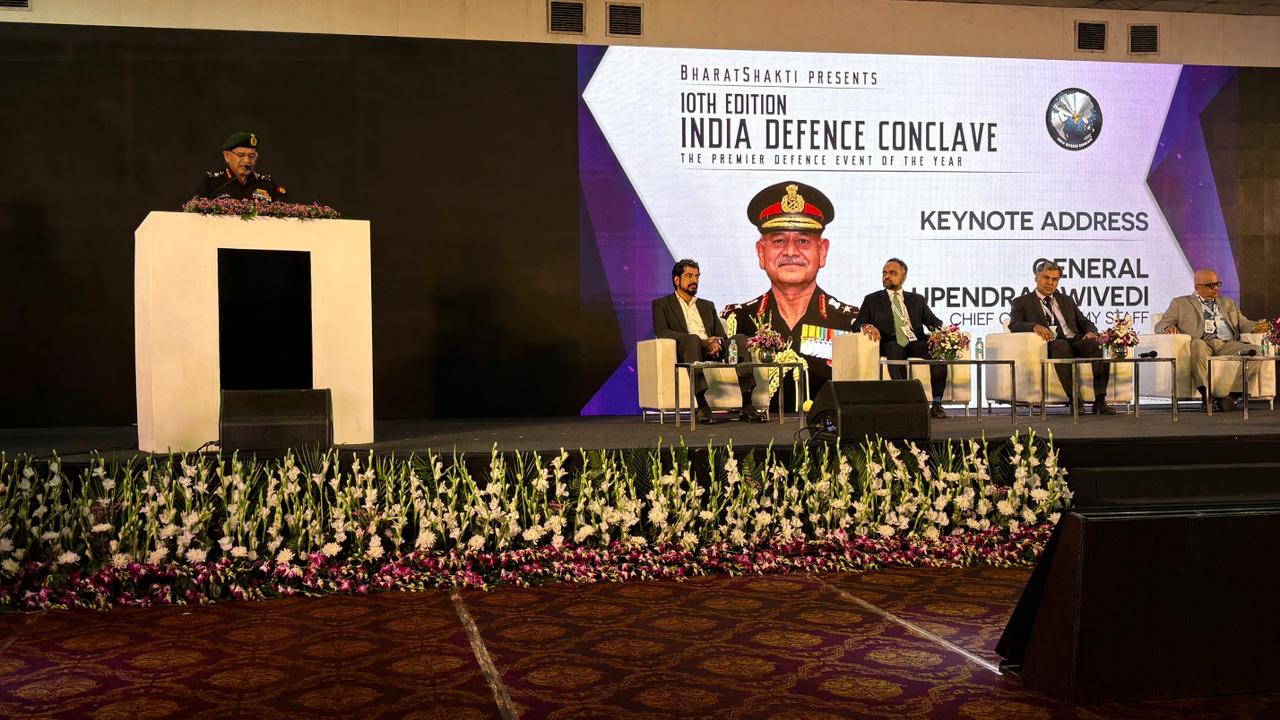
Underscoring that the future battlefield will be defined by rapid technological transformation, Chief of Army Staff General Upendra Dwivedi on Tuesday called for deeper collaboration between the armed forces, academia, and the private sector to build indigenous capabilities in drones, artificial intelligence, and multi-domain operations.
He said that strengthening this ecosystem is vital to advance India’s vision of self-reliance in defence and ensure the nation remains prepared for the evolving character of warfare.
Speaking at the 10th edition of India Defence Conclave in New Delhi, the army chief noted that India’s military transformation must focus on converting ideas into tangible capabilities through speed, innovation, and jointness. “The journey from dependence to self-reliance demands new partnerships,” he said. “Technology infusion must go hand in hand with efficiency and integration across all domains—land, air, sea, space, and cyber.”
He highlighted that the defence ecosystem is entering a decisive phase marked by experimentation, automation, and greater collaboration with industry and startups. He cited the creation of dedicated technology missions and innovation hubs within the Army as examples of efforts to accelerate the transition from concept to combat capability. “Our aim is to enhance efficiency through technology while ensuring that innovation becomes an institutional culture,” he added.
From Vision to Execution: Industry Leaders Respond
His call for transformation set the stage for an engaging panel discussion moderated by Chakra News Editor-in-Chief Sandeep Unnithan, featuring Ashok Atluri, Chairman and Managing Director of Zen Technologies; Ashish Kansal, Director and CEO of SMPP; and Sarjan Shah, Managing Director (India) of Shield AI.
Unnithan observed that the ongoing Russia–Ukraine and Israel–Hamas conflicts have shown how drones, precision-guided munitions, and AI-powered systems are redefining modern warfare. “We are witnessing the largest continuous conflicts of the 21st century, where unmanned systems, autonomous operations, and multi-domain coordination have become decisive factors,” he said, adding that India must now shift focus “from concepts to execution.”
Building India’s Drone and Anti-Drone Ecosystem
Ashok Atluri of Zen Technologies emphasized the urgent need to scale up India’s domestic drone manufacturing and anti-drone capabilities. “To become a genuine drone power, we must identify core companies with proven competence and support them through sustained orders and partnerships,” he said. “Defence manufacturing cannot depend on intermittent procurement, it needs continuity, trust, and volume.”
Atluri also highlighted the importance of developing a unified production framework, where multiple industries can collaborate on standardized designs, much like how global powers scaled their drone ecosystems for mass deployment.
Ashish Kansal of SMPP, whose firm recently received a large domestic orders for personal protection equipment, stressed that collaboration between the public and private sectors has significantly improved in recent years. “The rate of change in the last five years has been unprecedented,” Kansal said. “Private industry is now working shoulder to shoulder with DPSUs, accelerating timelines and boosting capability development.” He noted that co-production and technology-sharing are key to ensuring faster delivery and greater self-sufficiency.
AI, Autonomy, and the Next Leap in Warfare
Bringing a futuristic perspective, Sarjan Shah of Shield AI said that India stands on the brink of a software-driven revolution in warfare. “We have only seen the surface of AI integration,” Shah noted. “The real leap will come when autonomous systems can perceive, decide, and act independently across domains. India has the talent and opportunity to leapfrog generations in defence technology, just as we did in digital and mobile transformation.”
He added that future operations would rely on networked, intelligent systems that unify data and decision-making across services, stressing that India’s advantage lies in combining indigenous software innovation with affordable hardware production.
From BrahMos to the Next Generation
Panelists also pointed to India’s BrahMos missile programme as a model of successful collaboration between government and industry, an approach that could be replicated in emerging areas such as drones and counter-drone systems. Drawing parallels with global advancements like the Tomahawk missile, they noted that India’s next phase of growth would depend on creating scalable, interoperable, and export-ready defence products.
A Shared Vision for the Future
There was consensus that India’s defence transformation will hinge on clarity of requirements, sustained resourcing, and a culture of accountability that sees projects through from conception to deployment.
“The future of warfare will not be defined by a single weapon or platform,” Gen Dwivedi said. “It will be defined by how swiftly we transform ideas into enduring capabilities, and how confidently India leads that change.”


