



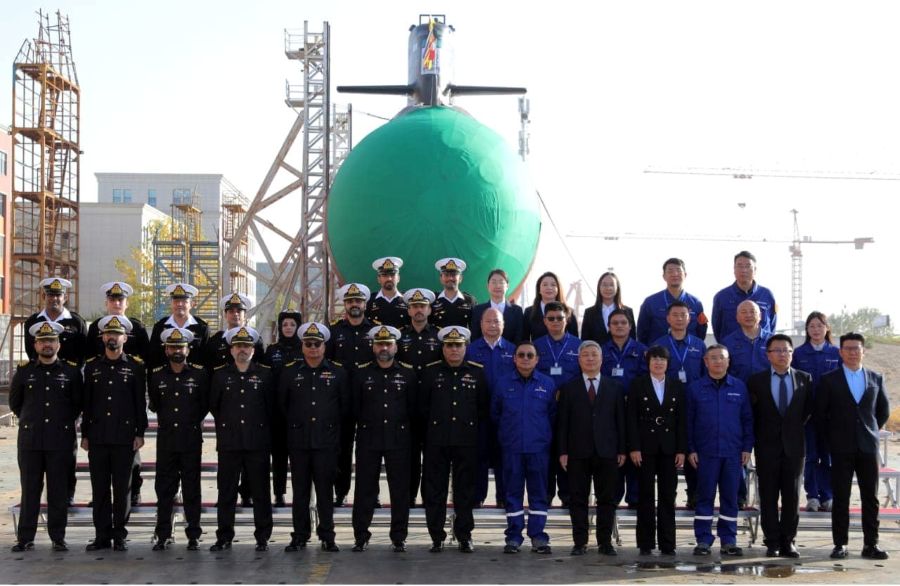
China has launched its fourth Hangor-class submarine, PNS Ghazi, for the Pakistan Navy, at the Shuangliu Base in Wuhan, China, marking a key milestone in Islamabad’s most ambitious naval modernisation programme to date. With this launch, all four Hangor-class submarines being constructed in China are now undergoing sea trials and have entered the final phase before induction, according to Pakistan’s military media wing, the Inter-Services Public Relations (ISPR).
The Hangor program originated from a 2015 agreement under which Pakistan contracted with China to supply eight diesel-electric attack submarines, marking the largest single defence export deal in Beijing’s naval sector. Of these, four are being built in China, while the remaining four will be constructed domestically at Karachi Shipyard and Engineering Works (KS&EW) under a transfer-of-technology (ToT) arrangement – an effort Pakistan projects as a step towards greater indigenous capacity in complex naval platforms.
Programme Slippage, but Strategic Momentum Intact
Initially, Pakistan planned to induct the first four submarines between 2022 and 2023, with the remaining four entering service by 2028. However, the programme has experienced delays. The first Hangor-class boat was launched only in 2024, followed by the second and third in 2025. The launch of Ghazi underscores that, while timelines have slipped, the project retains strategic momentum and strong political backing from both capitals.
The Hangor-class is widely assessed to be an export variant of the People’s Liberation Army Navy’s (PLAN) Type 039B Yuan-class submarines, based on the China Shipbuilding and Offshore International Company’s (CSOC) S26 design. While Pakistan has disclosed little about the submarines’ internal architecture, analysts believe they are equipped with advanced sensors, modern combat management systems, and standoff-capable weapons, designed to enhance Pakistan’s undersea strike and sea-denial capabilities.
Although Chinese Yuan-class submarines use Stirling air-independent propulsion (AIP) systems, Pakistani officials have not publicly confirmed whether the Hangor-class employs the same propulsion architecture. According to Pakistani defence outlet Quwa, the submarines are expected to be approximately 76 metres long with a submerged displacement of around 2,800 tonnes, making them slightly shorter but heavier than the baseline S26 design.
Transforming Pakistan’s Undersea Fleet
Once inducted, the Hangor-class submarines will significantly modernise Pakistan’s submarine fleet, which currently consists of three Agosta 90B AIP submarines and two ageing Agosta 70 diesel-electric boats acquired from France. The Agosta 90B fleet has been undergoing mid-life upgrades under a 2016 contract with Turkey’s STM, which involves replacing fire-control systems, sonar suites, electronic warfare systems, radars, and periscopes. The first upgraded submarine, PNS Hamza, was delivered in 2020.
The Hangor-class boats, however, represent a generational leap – bringing Pakistan closer to a more credible anti-access/area-denial (A2/AD) posture in the northern Arabian Sea, a maritime corridor vital to global energy flows and India’s western seaboard.
What China’s Submarine Deliveries Signal for India
Beyond Pakistan’s naval modernisation, the Hangor programme carries wider regional implications. The launch of Ghazi reinforces the deepening Sino-Pakistani defence-industrial partnership, while also signalling that China has likely overcome a longstanding bottleneck – its reliance on foreign suppliers, particularly German firms, for submarine propulsion technologies.
For India, the implications are twofold. First, Pakistan’s expanding undersea capabilities will make the Arabian Sea a more contested operational environment, complicating Indian Navy carrier deployments and surface task group operations. It will demand sustained investments in anti-submarine warfare (ASW) platforms, persistent maritime surveillance, and enhanced undersea domain awareness.
Second, China’s role as a reliable exporter of advanced submarines strengthens its strategic footprint in the Indian Ocean Region (IOR). By supplying, training, and supporting Pakistan’s submarine force, Beijing gains routine operational familiarity with waters critical to its energy security and to trade routes linking the Middle East and Africa.
While Pakistan lacks nuclear-powered submarines and continues to rely on conventional platforms, China’s backing compensates through numbers, modern sensors, and quieting technologies. India, by contrast, has commissioned two indigenously developed nuclear-powered ballistic missile submarines – INS Arihant and INS Arighaat – with another SSBN undergoing sea trials, giving New Delhi a decisive edge in strategic deterrence but not necessarily in conventional undersea density.
Also Read:China-Pakistan Tango at Sea: What Beijing’s Submarine Delivery in 2026 Means for India
Strategic Imperatives for New Delhi
China’s growing success in indigenising submarine technologies underscores the urgency for India to accelerate its own naval modernisation. Delays in Project 75(I), the absence of an operational indigenous AIP module, and slow progress on nuclear-powered attack submarines (SSNs) risk eroding India’s conventional undersea advantage over the next decade.
As Pakistan inducts modern submarines backed by Chinese logistics and training, India’s maritime strategy will need a sharper focus on ASW readiness, indigenous propulsion technologies, and networked sonar and surveillance systems. The launch of PNS Ghazi is thus not merely a routine naval event – it is a marker of shifting undersea balances in the northern Indian Ocean, with long-term consequences for regional maritime stability.
Ravi Shankar

Dr Ravi Shankar has over two decades of experience in communications, print journalism, electronic media, documentary film making and new media.
He makes regular appearances on national television news channels as a commentator and analyst on current and political affairs. Apart from being an acknowledged Journalist, he has been a passionate newsroom manager bringing a wide range of journalistic experience from past associations with India’s leading media conglomerates (Times of India group and India Today group) and had led global news-gathering operations at world’s biggest multimedia news agency- ANI-Reuters. He has covered Parliament extensively over the past several years. Widely traveled, he has covered several summits as part of media delegation accompanying the Indian President, Vice President, Prime Minister, External Affairs Minister and Finance Minister across Asia, Africa and Europe.


