



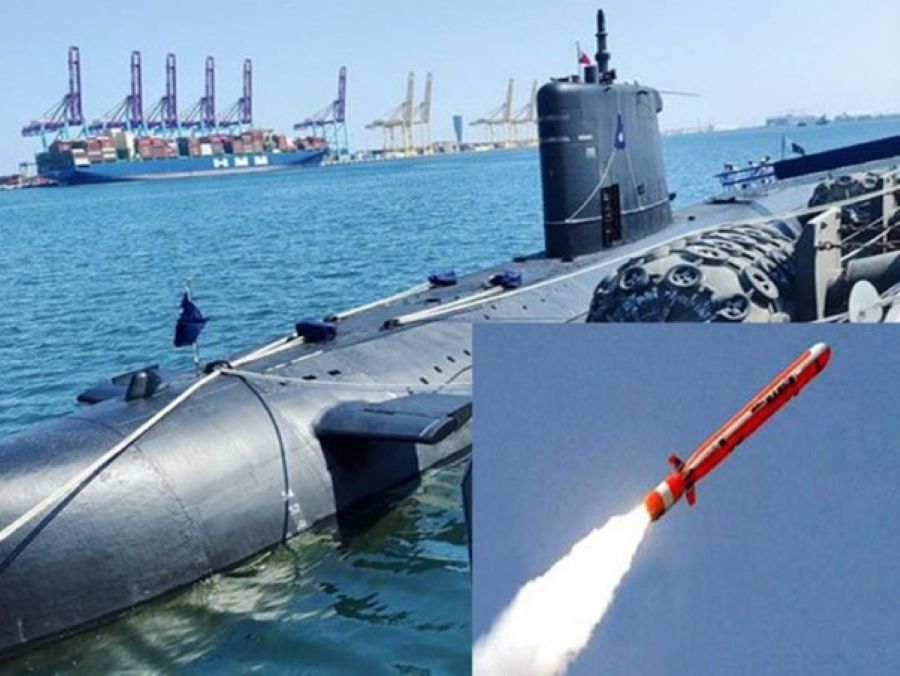
A recent confirmation from Pakistan’s Naval Chief that Chinese-built submarines will soon join the Pakistan Navy marks a major development in South Asia’s maritime balance. In an interview with China’s state-run media outlet Global Times, Admiral Naveed Ashraf revealed that the first batch of Hangor-class submarines, jointly built by China and Pakistan, is expected to enter service by 2026.
The announcement not only signals a shift in Pakistan’s undersea warfare capabilities but also suggests that China has surmounted a key technological hurdle, its long struggle to produce reliable submarine propulsion engines without relying on German suppliers. For India, the implications are twofold: a tightening China-Pakistan defence partnership in the Indian Ocean Region (IOR) and the emergence of Beijing as a fully self-reliant exporter of advanced naval platforms.
Ashraf described the Hangor-class project as progressing “smoothly” and highlighted its role in advancing Islamabad’s self-reliance through technology transfer and skill development. The programme, he said, epitomised “close Sino-Pakistani collaboration on naval equipment.” His remarks were clearly aimed at projecting a new degree of strategic confidence within Pakistan’s naval establishment, one bolstered by Chinese technology and backed by Beijing’s expanding maritime footprint across the Indo-Pacific.
Beijing Overcomes the Engine Hurdle
The Hangor-class submarines, based on China’s Type 039A Yuan-class, had faced extended delays due to Germany’s refusal to export MTU396 diesel engines following the EU’s 1989 arms embargo. This embargo hindered China’s ability to equip export variants of its submarines for partners such as Pakistan and Thailand.
Now, with the introduction of the Chinese-made CHD620 diesel engine, Beijing appears to have broken through this barrier. The CHD620, widely believed to be a reverse-engineered derivative of the German MTU design, signifies China’s growing ability to indigenise complex propulsion systems critical to underwater warfare.
If proven reliable, this development could mark a turning point, ending Beijing’s dependence on Western propulsion systems and giving China greater freedom in naval exports. For India, it signals not only the maturation of China’s defence industrial base but also its ability to sustain long-term technological cooperation with Pakistan in sensitive domains.
A Strategic Boost for Pakistan’s Undersea Arm
The eight Hangor-class submarines, part of a US$5 billion deal signed in 2015, will substantially bolster Pakistan’s undersea fleet. The first four submarines are being built in China, while the remaining four are under construction at Karachi Shipyard & Engineering Works under a technology transfer agreement.
These air-independent propulsion (AIP) capable submarines will be equipped with 533mm torpedo tubes, capable of firing both YJ-82 anti-ship missiles and the Babur-3 submarine-launched cruise missile, potentially giving Islamabad a nascent second-strike capability. The addition of these assets will strengthen Pakistan’s anti-access and area-denial (A2/AD) posture in the northern Arabian Sea, a vital maritime zone linking the Persian Gulf to India’s western seaboard.
For New Delhi, this translates into a more contested undersea battlespace. Indian carrier and surface group operations in the Arabian Sea could face heightened risks, necessitating sustained investments in anti-submarine warfare (ASW) capabilities, long-endurance surveillance, and undersea domain awareness.
India’s Undersea Edge: The Nuclear Factor
Unlike its regional rival India, Pakistan’s navy lacks a nuclear-powered submarine, instead fielding five conventional attack submarines imported from France. In contrast, India has in recent years commissioned two indigenously developed nuclear-powered ballistic missile submarines – the INS Arihant and INS Arighaat – with another undergoing sea trials.
Nuclear-powered submarines are deemed superior to conventional ones, as they can remain submerged for extended durations without refuelling, operate at higher sustained speeds, and offer longer operational ranges. It gives the Indian Navy a credible strategic deterrence and endurance advantage, which Pakistan’s upcoming Hangor-class fleet, despite its AIP capabilities, cannot match in terms of persistence or reach.
However, Pakistan’s induction of AIP-equipped submarines will narrow the tactical gap, especially in the northern Arabian Sea, by enhancing its stealth and endurance in coastal and near-sea operations, areas of key concern for India’s western seaboard defences.
The Expanding Chinese Footprint in the Indian Ocean
China’s role in arming Pakistan’s navy fits into a broader Indo-Pacific strategy. The People’s Liberation Army Navy (PLAN) already operates a logistics base in Djibouti, maintains a presence at Gwadar and Hambantota, and engages closely with Myanmar on naval cooperation.
By equipping Pakistan with modern submarines and providing continuous training and logistical support, Beijing secures routine operational familiarity in the northern Indian Ocean, an area critical for the safety of its energy and trade routes to the Middle East.
It not only tightens Sino-Pak defence interdependence but also allows China to project influence west of the Malacca Strait, effectively encircling India’s maritime sphere with dual-use port access and basing opportunities.
Reverse Engineering as Strategic Leverage
The CHD620 engine’s emergence illustrates China’s long-standing strategy of technological reverse engineering to overcome export barriers and strategic dependencies. Over the past decade, the Chinese industry has quietly replicated and improved upon key Western subsystems, ranging from jet engines to submarine propulsion units.
While the CHD620’s full operational performance remains untested, early indicators suggest acceptable acoustic signatures and integration compatibility. Even if not on par with Western propulsion systems, it provides a cost-effective and exportable alternative, allowing Beijing to expand its arms diplomacy footprint across Asia and Africa.
For India, this has two implications. First, China’s industrial self-sufficiency strengthens its position as a long-term defence partner for nations seeking alternatives to Western suppliers. Second, the proliferation of Chinese AIP-capable submarines, whether in Pakistan, Thailand, or potentially Bangladesh, will complicate India’s maritime surveillance and deterrence planning in the Indian Ocean Region (IOR).
Implications for India’s Maritime Strategy
India’s maritime posture has historically benefited from its technological and operational edge over Pakistan’s fleet. With Pakistan’s undersea capabilities now expanding, New Delhi must reassess its ASW readiness and submarine production timelines under Project 75(I) and future SSN plans.
Moreover, China’s demonstrated ability to indigenise advanced naval propulsion technology underlines the importance of accelerating India’s own defence R&D ecosystem, particularly in areas such as AIP modules, quiet propulsion systems, and integrated sonar networks.
Conclusion: A Shifting Undersea Balance
The Hangor-class induction in 2026 may not decisively tilt the maritime balance in Pakistan’s favour, but it undeniably narrows the technological gap and enhances Beijing’s strategic presence in India’s immediate maritime neighbourhood.
More than the submarines themselves, the real story lies in China’s quiet breakthrough in engine technology independence, a development that could redefine global arms dynamics and signal a new phase in the China-Pakistan defence tango with direct implications for India’s maritime strategy.
Ravi Shankar

Dr Ravi Shankar has over two decades of experience in communications, print journalism, electronic media, documentary film making and new media.
He makes regular appearances on national television news channels as a commentator and analyst on current and political affairs. Apart from being an acknowledged Journalist, he has been a passionate newsroom manager bringing a wide range of journalistic experience from past associations with India’s leading media conglomerates (Times of India group and India Today group) and had led global news-gathering operations at world’s biggest multimedia news agency- ANI-Reuters. He has covered Parliament extensively over the past several years. Widely traveled, he has covered several summits as part of media delegation accompanying the Indian President, Vice President, Prime Minister, External Affairs Minister and Finance Minister across Asia, Africa and Europe.


