



Editor’s Note
China’s rapid military modernisation is reshaping the security balance in Asia. For India, this is not a distant geopolitical development but a direct strategic concern along its contested borders and in the wider Indo-Pacific. Drawing on key findings from the U.S. Department of Defence’s 2025 report on China’s military trajectory, this analysis examines how Beijing’s evolving war-fighting capabilities and its preparation for high-intensity conflict with major powers carry profound implications for India’s defence posture and national security planning.
For India, China’s military rise is not an abstract great-power story unfolding somewhere in the Pacific. It is a reality that touches India’s borders, shapes its strategic choices, and constrains its room for manoeuvre.
The U.S. Department of Defence’s 2025 report on China’s military development offers one of the clearest external assessments yet of where Beijing is heading—and why New Delhi must pay close attention.
At the centre of the report is a blunt judgment: China is no longer preparing only for regional deterrence. It is building a military designed to fight and win high-intensity conflicts against powerful adversaries, including the United States. While Taiwan sits at the heart of that planning, the implications extend directly to India’s security environment.
According to the Pentagon, the People’s Liberation Army (PLA) is working toward concrete military goals by 2027. By then, China expects to be able to achieve what it calls “strategic decisive victory” in key contingencies, while deterring or constraining external intervention. U.S. analysts assess that this framework includes not only Taiwan, but also the ability to manage conflicts with other regional powers while avoiding escalation on unfavourable terms.
For India, this matters because China’s military strategy is not theatre-specific. The report emphasises that the PLA increasingly views conflict as a “whole-of-nation” effort, integrating military power with economic leverage, cyber operations, space capabilities, and political pressure. It is the same model India has experienced since 2020 along the Line of Actual Control (LAC): sustained pressure below the threshold of war, backed by the implicit threat of escalation.
The Pentagon notes that Beijing defines its territorial claims—including those over Arunachal Pradesh—as “core interests” tied directly to regime legitimacy. This framing leaves little room for compromise. While disengagement agreements along the LAC in late 2024 reduced immediate friction, the report assesses that China likely sees tactical calm as a way to stabilise relations without abandoning long-term leverage over India.
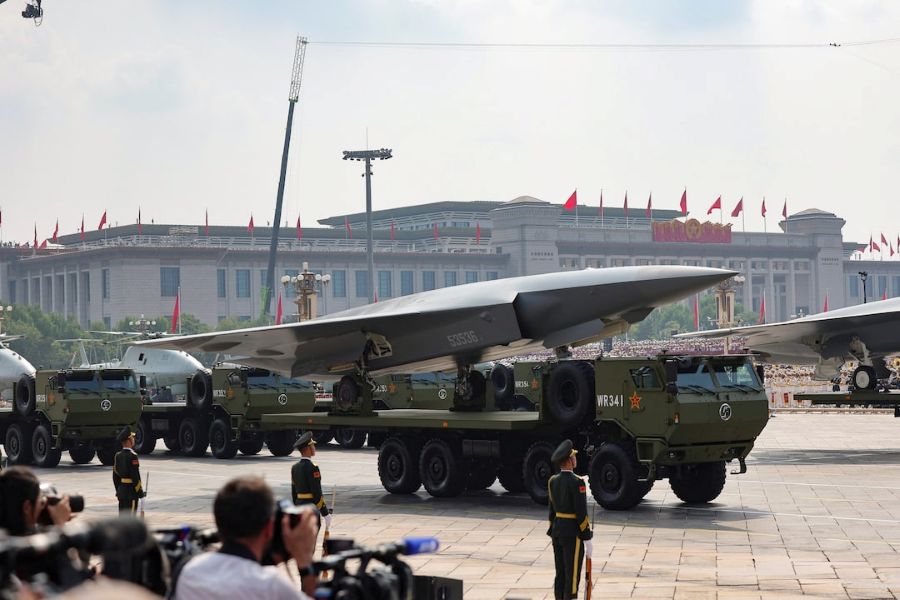
China’s military modernisation also alters the balance beyond the Himalayas. The report documents rapid advances in long-range strike capabilities, air power, and maritime forces. PLA conventional missiles, according to U.S. assessments, can already reach targets 1,500 to 2,000 nautical miles from the Chinese mainland. It expands China’s ability to threaten Indian interests in the Indian Ocean Region without relying solely on naval deployments.
Cyber and space developments are even more relevant to India. The Pentagon describes China as the most persistent cyber threat it faces, noting intrusions into critical infrastructure networks in 2024. These capabilities are not limited to the United States. India’s growing dependence on digital infrastructure, satellites, and networked military systems makes it vulnerable to the same tools, especially in a crisis short of open conflict.
Space is a particular area of concern. The report highlights China’s rapidly expanding satellite constellation, including hundreds of intelligence and surveillance platforms. For India, this means increased Chinese ability to monitor troop movements, logistics nodes, and naval activity across both continental and maritime theatres. China’s development of counter-space weapons—lasers, jammers, and anti-satellite systems—also threatens the space assets India increasingly relies on for communications and navigation.
China’s partnership with Russia further complicates India’s strategic environment. While the Pentagon stops short of describing a formal alliance, it assesses that Beijing has become a critical enabler of Russia’s war effort through diplomatic backing and dual-use technology. Joint bomber patrols and military exercises signal a shared interest in challenging U.S. power. For India, this triangular dynamic weakens the old assumption that Moscow can act as a neutral balancer in Asia.
At the same time, the report underlines Beijing’s discomfort with growing U.S.–India defence ties. U.S. analysts assess that China seeks to prevent deeper strategic alignment between New Delhi and Washington, viewing it as a constraint on Chinese freedom of action. It helps explain Beijing’s alternating pattern of military pressure and diplomatic engagement with India.
The larger takeaway for India is not that war is imminent, but that the strategic environment is hardening. China is building a military designed to impose costs, shape behaviour, and control escalation across multiple domains. India’s challenge is to respond without overreacting—strengthening deterrence, resilience, and partnerships while preserving strategic autonomy where possible.
The Pentagon report makes one thing clear: China’s military rise is no longer a distant concern focused solely on Taiwan. It is reshaping the security landscape across Asia, and India is already living with its consequences.
Ramananda Sengupta

In a career spanning three decades and counting, I’ve been the foreign editor of The Telegraph, Outlook Magazine and the New Indian Express. I helped set up rediff.com’s editorial operations in San Jose and New York, helmed sify.com, and was the founder editor of India.com. My work has featured in national and international publications like the Al Jazeera Centre for Studies, Global Times and Ashahi Shimbun. My one constant over all these years, however, has been the attempt to understand rising India’s place in the world.
I can rustle up a mean salad, my oil-less pepper chicken is to die for, and it just takes some beer and rhythm and blues to rock my soul.


