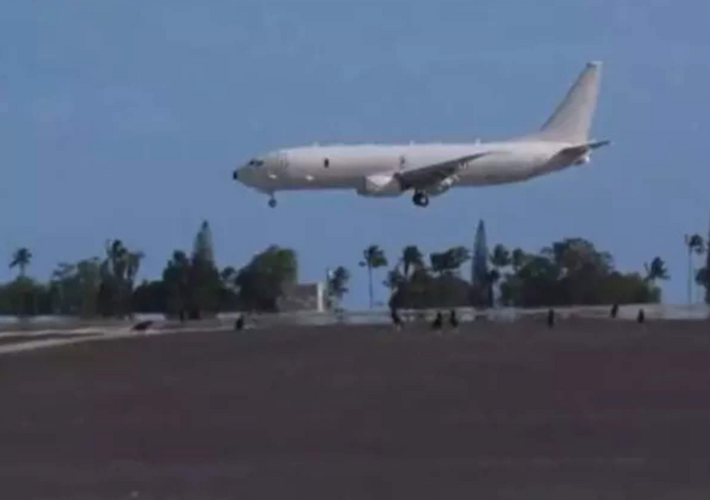
On February 6, Jay Tarriela, Spokesperson of the Philippine Coast Guard, disclosed that a routine maritime domain awareness flight over Scarborough Shoal was met with 28 separate radio challenges from a People’s Liberation Army Navy vessel, hull number 553.
Soon after, video footage surfaced of a Chinese military jet streaking across the same contested airspace.
It was not an isolated incident; China calibrated its signalling to assert its presence over a contested Reef in the disputed South China Sea. It was a message.
Scarborough Shoal, like many features in the South China Sea, has become a stage where Chinese military messaging crossed the limits of “Grey Zone Warfare.” The signalling is deliberate and calibrated enough to avoid a full-fledged war, yet forceful enough to assert dominance.
And this is where the story of China’s maritime strategy becomes far more intricate than traditional naval deployments.
When Fishing Boats Stop Fishing
In March 2021, more than 200 Chinese vessels anchored in a tight formation at Whitsun Reef in the Spratly Islands, well within the Philippines’ Exclusive Economic Zone (EEZ). Surprisingly, these vessels did not cast nets. They did not move with the rhythms of fishing fleets. They remained stationary for weeks, forming an intimidating presence.
The vessels’ presence was not about fish; it was about force. A silent armada forming an intimidating wall of hulls, projecting power without firing a single shot. It was grey-zone warfare in its most visible maritime form.
Mechanics of the Grey Zone
Grey-zone activities lie somewhere between diplomacy and armed conflict. They involve state-backed actions that deliberately remain ambiguous, too aggressive to ignore, too subtle to justify a conventional military response.
These tactics can include:
- Cyber operations
- Legal and economic pressure
- Military signalling
- Information campaigns
- Coercive maritime deployments
The goal is simple: change the facts on the ground or at sea without triggering a formal conflict.
For Beijing, the grey-zone strategy has become the preferred instrument for asserting its sweeping “nine-dash line” claims across the disputed South China Sea. Instead of open naval confrontation, China deploys research vessels, underwater drones, coast guard cutters, and maritime militia boats to map sea beds, survey submarine routes, and maintain a constant presence in disputed waters.
Let’s dissect how China weaponises the grey zone, adjusting tactics up or down, reshaping the fight based on exactly who it’s targeting.
The Philippines: Testing Limits at Sea
Few countries have felt the pressure more consistently than the Philippines.
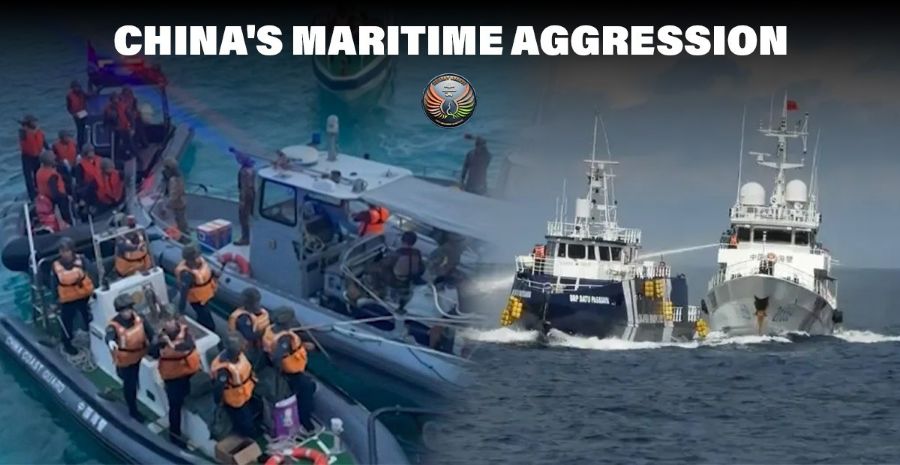
Chinese Coast Guard and maritime militia vessels have been documented conducting dangerous manoeuvres, ramming incidents, high-pressure water cannon attacks, and even using military-grade lasers against Filipino vessels in the West Philippine Sea.
In 2014, tensions escalated dramatically when China showed its ugliest side to the Philippines at Second Thomas Shoal. While Filipino personnel were attempting to resupply the BRP Sierra Madre, a Filipino warship stationed at the Second Thomas Shoal, Chinese Coast Guard personnel encircled the small inflatable boats carrying supplies.
What followed blurred the line between harassment and violence. Chinese personnel reportedly took out their small axes, attempting to puncture the Filipino boats. During the confrontation, a Filipino serviceman lost his thumb amid the physical assault by the Chinese. It was coercion, up close and personal.
Ironically, in August 2025, the tables turned when a China Coast Guard vessel collided with a PLA Navy warship (around 75,000 tonnes) while pursuing a Filipino patrol boat (approx. 321 tonnes) near Scarborough Shoal. Showing, even grey-zone choreography can stumble when aggression intensifies.
Taiwan: Expanding the Theatre of Grey-Zone Pressure
China’s grey-zone tactics are not confined to contested reefs of the South China Sea. Around Taiwan, the pressure campaign has taken on new dimensions.
In 2022, during then US House Speaker Nancy Pelosi’s visit to Taipei, the PLA Navy encircled Taiwan under the pretext of military drills. Again in 2025, Beijing launched a so-called military drill “Justice Mission 2025,” another large-scale encirclement exercise presented as routine operations.
Taiwan’s Ministry of National Defence regularly reports that PLA warships and aircraft have penetrated its Air Defence Identification Zone (ADIZ) and operated near its EEZ. On February 10th, 4 China Coast Guard vessels entered Taiwan’s restricted waters near Kinmen. This incursion lasted for 2 hours. The Taiwan Coast Guard said this is the 5th incursion in Kinmen in 2026.
Each incursion is framed as training. Each one chips away at the psychological buffer of sovereignty.
The maritime dimension has grown sharper.
In February 2025, Taiwan’s Coast Guard detained the vessel Hong Tai 58, crewed by eight Chinese nationals, for allegedly damaging an undersea cable linking Taiwan to the Penghu Islands. Undersea cables are not symbolic targets; they are lifelines for communications and economic stability.
Then came an episode where a Chinese social media influencer known as “Shandong KaiGe” filmed himself navigating a rubber dinghy across the Taiwan Strait and planting a Chinese flag on a Taiwanese beach. The act may have appeared theatrical, but its symbolism was unmistakable: normalisation of intrusion, one gesture at a time.
Grey-zone tactics had entered the realm of viral messaging.
Beyond Asia: The Ghost Fleet
Assuming China’s maritime grey zone is confined to East Asia would be a mistake.
Argentina, Peru, Sierra Leone, and other coastal nations have reported massive flotillas of Chinese distant-water fishing vessels operating near or within their waters. These fleets are frequently accused of engaging in Illegal, Unreported, and Unregulated (IUU) fishing.
Local fishermen watch as stocks decline, marine ecosystems suffer, and economic losses mount.
Even these vessels often switch off their Automated Identification Systems (AIS) just before sneaking into sensitive waters, transmitting deceptive signals, or disappearing from tracking systems altogether. Their shadowy presence has earned them the nickname “Ghost Fleet.”
Many of these vessels are part of China’s Maritime Militia, civilian fishing boats that covertly serve state objectives. Some are equipped with metal rods and sharp objects, which they use during confrontations with foreign coast guards.
Civil–Military Fusion at Sea
China’s maritime militia is not formally part of the PLA Navy, and that is precisely its strength.
State-funded, state-directed, and closely coordinated with both the PLA Navy and China Coast Guard, these vessels operate under the guise of civilian activity. They blur the line between commerce and coercion.
It is a civil–military fusion in maritime form.
The militia acts as a force multiplier, extending China’s reach without the political cost of overt naval aggression. Beijing is weaponising deniability, always ready with the perfect excuse: Oh, it’s just a civilian vessel.
But when hundreds of “fishing boats” anchor in formation.
When coast guard vessels use lasers and water cannons.
When warships encircle islands under the banner of “Military drills.”
The pattern becomes difficult to ignore.
Strategy Built on Ambiguity
China’s grey-zone strategy is flexible. It changes depending on the target. Pressure rises where resistance is weak and eases when confronted. It spreads to new areas when it sees an advantage.
The clever and dangerous part is the “uncertainty.” There’s no declared war, no official red line crossed. Just constant, small steps that slowly shift the balance.
By blurring the line between peace and conflict, Beijing has made denial a weapon. Its maritime militia is a perfect example of military forces hiding in plain sight.
Every radio challenge at Scarborough Shoal, every “fishing vessel“ anchored without nets, sends the same clear message: Presence is Power.
Akankasha Simlan