



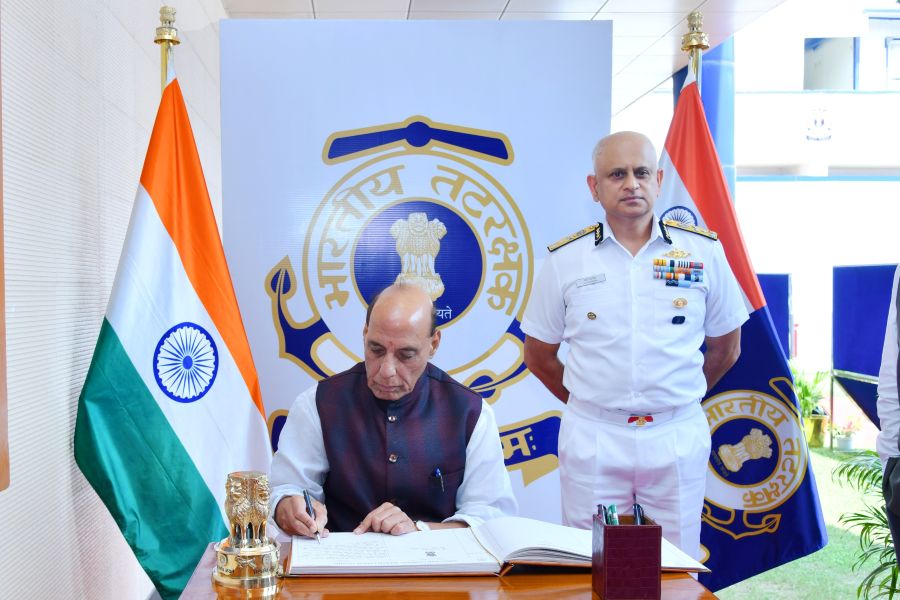
Defence Minister Rajnath Singh today set a bold and transformative vision for India’s maritime security, calling for enhanced technological vigilance, greater indigenisation, and a future-ready roadmap.
In his address at the 42nd Indian Coast Guard (ICG) Commanders’ Conference at the ICG Headquarters in New Delhi, Singh praised the ICG’s evolution from a modest coastal force into a formidable maritime guardian, now operating 152 ships and 78 aircraft. He highlighted the ICG’s expanding role as not just a security enforcer but a “true force multiplier” within India’s national security ecosystem.
Challenges in the Indian Ocean Region
With maritime threats growing increasingly complex and multi-dimensional, Singh warned that the nature of warfare has fundamentally changed. “Conflicts are now fought in hours and seconds, using satellites, sensors, and drones. Preparedness and adaptability must define the Coast Guard’s operational philosophy,” he asserted.
He stressed that India’s 7,500-km-long coastline, including its island chains in the Andaman & Nicobar and Lakshadweep regions, demands round-the-clock surveillance and technology-led monitoring to address challenges ranging from illegal fishing to drug trafficking and potential terror threats.
Technology, Cyber Warfare, and AI Integration
He emphasised the importance of integrating advanced technologies, such as artificial intelligence, machine learning, encrypted communications, and automated surveillance, into the maritime domain. “Traditional methods are no longer sufficient,” Singh said. “We must stay ahead of adversaries through smart surveillance systems, AI-driven threat detection, and cyber-resilient infrastructure.”
The minister warned of emerging threats such as GPS spoofing, remote-controlled vessels, and cyberattacks that could paralyse coastal operations without a single shot being fired. “A modern enemy may target us not with missiles, but with malware. The ICG must be equipped to fight both physical and digital threats simultaneously,” he cautioned.
The Complexity of Maritime Borders
Contrasting the predictability of land borders with the fluidity of maritime boundaries, Singh noted that the open seas are more vulnerable to covert threats. “A terrorist boat can masquerade as a fishing vessel. The ocean doesn’t come with fences,” he said. This fluidity, he emphasised, makes maritime security not just a matter of defence, but of persistent vigilance and multi-layered coordination.
Role in Multi-Agency Coordination and Humanitarian Response
The minister praised the ICG’s seamless integration with the Navy, state governments, and civil authorities, calling it “one of its greatest strengths.” He credited the force for maintaining real-time cooperation across agencies to deliver effective disaster response, counter-narcotics operations, and environmental protection.
From saving over 14,500 lives through search and rescue operations to seizing narcotics worth Rs 37,833 crore and apprehending 1,638 foreign vessels, the ICG has built a record of decisive action across a range of maritime challenges.
Empowering Women
He lauded the Coast Guard’s strides in gender inclusion. “Women are no longer confined to support roles — they are now pilots, air traffic controllers, law officers, and operators in frontline deployments. It reflects our vision of inclusive leadership and shared responsibility,” he said.
Indigenisation and Maritime Self-Reliance
Reaffirming the government’s commitment to ‘Aatmanirbhar Bharat,’ Singh revealed that nearly 90% of the Coast Guard’s capital budget now supports domestic platforms. “Every indigenously built ship or aircraft strengthens both our security and our economy,” he said. The Coast Guard’s growing reliance on Indian shipbuilding is now seen as a strategic national asset.
Geopolitical Vigilance in the Maritime Theatre
Highlighting instability in India’s maritime neighbourhood, including developments in Myanmar, Bangladesh, and beyond, Singh warned that regional turbulence often spills into Indian waters. “Illegal migration, piracy, smuggling — these are not just law enforcement issues. They are national security concerns,” he said, urging the ICG to maintain geopolitical situational awareness alongside maritime patrols.
Economic Security
Singh drew a direct connection between maritime protection and India’s economic lifelines. “Our ports, sea lanes, and offshore infrastructure are essential for trade, energy, and connectivity. A disruption at sea is a disruption to the nation’s progress,” he emphasised.
Vision 2047: A Future-Ready Force
Singh urged the ICG to chart a roadmap leading up to India’s centenary of independence in 2047. “The force must anticipate future conflicts, innovate with emerging technologies, and remain agile in strategy and response,” he said.
The three-day ICG Commanders’ Conference (September 28–30, 2025) is focused on shaping operational preparedness, enhancing maritime domain awareness, and aligning the Coast Guard’s capabilities with national maritime priorities. Senior leadership from the Ministry of Defence and Armed Forces, including Defence Secretary Rajesh Kumar Singh and Secretary (Defence Production) Sanjeev Kumar, are participating in strategic deliberations.
Director General Rakesh Pal inaugurated the conference with a review of the Coast Guard’s operational milestones, reaffirming its commitment to indigenous capacity-building and proactive maritime governance.
Team BharatShakti