


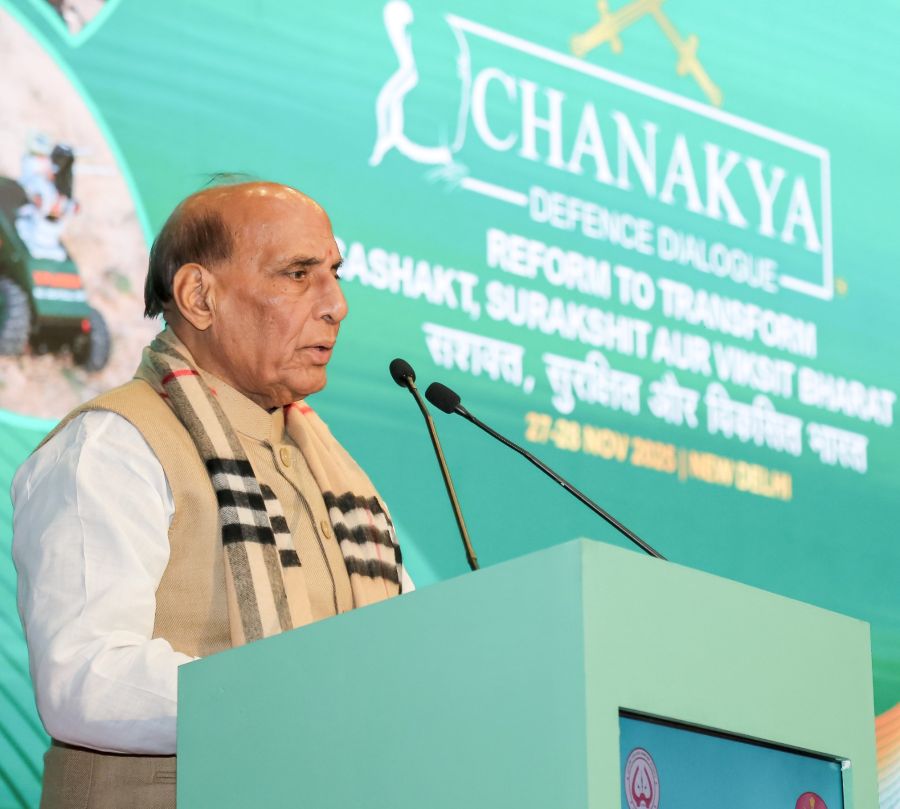
Defence Minister Rajnath Singh has asserted that defence reforms are no longer optional but a strategic necessity for India, given the rapid transformation in the character of warfare. Speaking on the final day of the Chanakya Defence Dialogue 2025 in the national capital, Singh said India cannot rely on “past structures to deal with future challenges,” emphasising the need for agile armed forces backed by institutional adaptability and technological superiority.
“The world is changing too fast, and threats are becoming more complex,” Singh noted in his special address titled “Resilient National Security @2047: The New Normal.” “Reforms extend the adaptability of our institutions, enhance the agility of our armed forces, and give the nation confidence to shape its destiny. They are not merely administrative exercises – they are drivers of national transformation.”
Reform Pathway for a Future-Ready Military
India is implementing significant structural and policy reforms to modernise its military, including the introduction of the Agniveer recruitment system to revamp its human resource model. Additionally, plans are underway to theaterise commands to enhance force integration and streamline operations, though progress has been relatively slow. The country is also accelerating the adoption of emerging technologies such as artificial intelligence, autonomous systems, and cyber capabilities to enhance its defence capabilities.
Singh underscored that warfare is no longer confined to conventional battlefields. The ongoing conflicts from Ukraine to the Middle East have demonstrated the decisive impact of economic dependencies, digital networks, and technological vulnerabilities.
“Economic interdependence, which once gave confidence to the world, now comes with vulnerabilities in supply chains and critical technologies,” he warned, stressing the need for resilience across defence, economy, and society.
Clear Message to Adversaries
Referring to India’s security environment, Singh said New Delhi remains alert to challenges in its neighbourhood.
“Terrorism, cross-border support to extremist elements, attempts to alter the status quo, maritime pressures, and information warfare are realities we must contend with. There will be no compromise on India’s sovereignty and security,” he declared.
Dialogue Highlights: Autonomy, Doctrine, and Technology
Organised by the Indian Army in partnership with the Centre for Land Warfare Studies (CLAWS), the two-day dialogue brought together diplomats, military leaders, and strategic thinkers.
Ambassador D.B. Venkatesh Verma, Member of the National Security Advisory Board, stressed that strategic autonomy is meaningful only when India has the will and capability to think, act, and fight independently. He called for higher defence spending, faster reforms, robust R&D, and reduced external dependencies to ensure a resilient military-industrial base.
Ambassador Pankaj Saran, former Deputy National Security Adviser and Member of the National Security Advisory Board, highlighted the increasing primacy of technology as the fulcrum of modern warfare. Citing the creation of a dedicated technology division in the NSCS in 2018 as a turning point, he urged India to adopt doctrinal shifts aligned with cutting-edge innovations.
Battlefield Equalisers and Future Warfighting
The concluding sessions explored disruptive technologies, AI, hypersonics, autonomous platforms, and cyber tools as critical battlefield equalisers. Experts also discussed jointness, island security, and cognitive warfare, identifying the transformation required to make India’s forces integrated, agile, and modern.
A Vision for 2047
As India positions itself for its centenary as an independent nation, the Chanakya Defence Dialogue reinforced a central message: national power in the 21st century will not rest on manpower and hardware alone but on institutions, innovation, and integrated defence preparedness.
Rajnath Singh’s message was unequivocal: India’s military transformation is not an aspiration but an imperative, essential for shaping a secure and confident nation ready to meet the challenges of the next two decades.
Ravi Shankar

Dr Ravi Shankar has over two decades of experience in communications, print journalism, electronic media, documentary film making and new media.
He makes regular appearances on national television news channels as a commentator and analyst on current and political affairs. Apart from being an acknowledged Journalist, he has been a passionate newsroom manager bringing a wide range of journalistic experience from past associations with India’s leading media conglomerates (Times of India group and India Today group) and had led global news-gathering operations at world’s biggest multimedia news agency- ANI-Reuters. He has covered Parliament extensively over the past several years. Widely traveled, he has covered several summits as part of media delegation accompanying the Indian President, Vice President, Prime Minister, External Affairs Minister and Finance Minister across Asia, Africa and Europe.