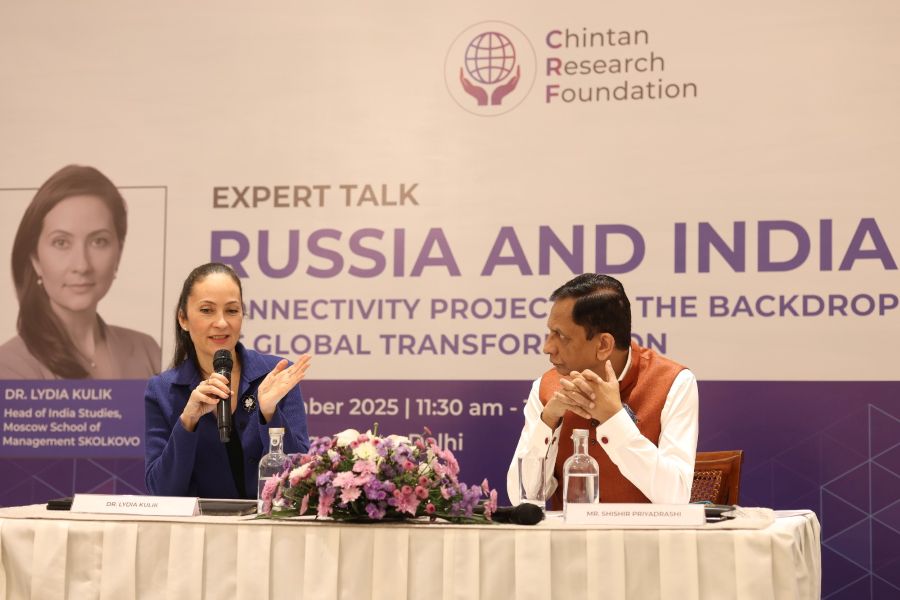
Russian analyst Dr Lydia Kulik placed defence and military cooperation at the centre of the India–Russia partnership, portraying it as the most durable pillar in a relationship otherwise adapting to global upheaval.
Her comments, delivered at an event organised by the Chintan Research Foundation just ahead of President Vladimir Putin’s state visit to India on December 4, reflected both continuity and the adjustments Moscow has made under sanctions pressure, demographic stress and shifting geopolitical alignments. The recurring theme throughout the discussion was trust—not invoked as rhetoric but as operational reality.
Dr Kulik, Head of India Studies at the Moscow School of Management SKOLKOVO and Senior Research Fellow at the Russian Academy of Sciences’ Institute of Oriental Studies, described the military relationship as one in which both sides have long been comfortable with each other’s presence, procedures, and platforms.
It, she suggested, explained why the reciprocal logistics support agreement, signed earlier in the year but publicised more prominently during the summit week, was “natural and logical.” The question, she argued, was not why such an agreement now exists but why it had taken so long to formalise, given the “connection and trust between the militaries.”
The logistics pact is significant because it codifies what had often been handled informally: access to each other’s facilities for refuelling, replenishment and repairs. The agreement is framed as reciprocal, and Kulik did not describe it in terms of specific theatres, but the discussion around it — including questions raised by the audience — framed it as an instrument that could ease India’s reach toward the Arctic and simplify Russian access to the Indian Ocean. Kulik did not elaborate on these interpretations; instead, she reiterated the structural point: routine military cooperation had matured to the point where such arrangements were a logical extension.
A major strategic concern raised during the interaction was whether Russia’s increasing defence and technological dependence on China, driven by Western sanctions, might disrupt India’s long-standing reliance on Russian platforms and components. Kulik rejected the premise firmly. She argued that over the past several years, Russia had undertaken an extensive effort to localise defence production, reducing its reliance on external suppliers.
Although she did not quantify the extent of localisation, she stated confidently that Russia’s shift toward China did not affect Russia–India defence ties, emphasising examples such as fifth-generation fighter aircraft projects and India’s acquisition of the S-400 system as evidence of Moscow’s continued willingness to share advanced technologies and localise production.
Her remarks underlined a larger point: Russia sees localisation not simply as a concession to India’s preferences but as a principle it has been forced to apply internally. She cited the example of Russia’s civilian aviation sector, which had previously depended on Western-sourced engines and components but, within a couple of years, had achieved full domestic localisation of platforms like the Superjet and MS-21.
Although this example sits outside the military domain, Kulik used it to illustrate the broader pattern of Russian adaptation — a pattern that reassures Moscow that it can sustain long-term defence obligations to India.
The discussion also highlighted another structural layer of defence cooperation: India’s dependence on Russian-origin military equipment across services, particularly the Navy, whose “Russian supply equipment goes a great deal,” as one questioner noted. Kulik acknowledged this history as part of the trust embedded in the relationship. She did not describe specific programmes, but her responses reflected the assumption that the two defence ecosystems remain deeply interlinked — through platforms, spare parts, training, and shared technological legacies.
Where she did devote attention was to the future-facing elements of defence cooperation — especially technology, underwater infrastructure, and emerging domains. Asked whether India and Russia could collaborate on submarine cables and seabed mining, she noted that many aspects of such cooperation would not be publicly visible, but said the “technological and scientific track” of the bilateral relationship needed far greater systematisation.
Existing frameworks, she observed, were fragmented and lacked the streamlined documents that govern India’s technology cooperation with other partners. Strengthening these frameworks, in her view, was already on the bilateral agenda and could feature in upcoming official discussions.
She also fielded questions on workforce mobility related to defence industry collaboration. While the main thrust of her mobility argument concerned Russia’s blue-collar shortages, she acknowledged that an expanding Indian workforce in Russia — including technically skilled managers and specialists — would naturally have implications for defence manufacturing and related industries.
The potential retention of Indian graduates from Russian universities, particularly in sectors linked to engineering and technology, was presented as a future area requiring deeper study.
Even broader geopolitical issues — whether concerning strategic stability, the erosion of arms-control frameworks, or the dynamics among the U.S., Europe, China and India — repeatedly circled back to defence cooperation. Kulik described Russia as one of the few actors still raising alarms about the collapse of global strategic stability agreements. She argued that meaningful progress in any peace process, including the Ukrainian context, would depend on dynamics between the U.S. and Europe.
None of these points were presented as predictions; instead, she framed them as realities shaping Russia’s security calculus, against which India–Russia defence ties remain a stabilising constant.
Ultimately, Kulik’s strategic framing positioned defence cooperation not as an isolated domain but as the backbone supporting other areas of bilateral engagement — from transport corridors and trade diversification to scientific collaboration and labour frameworks. Defence appears, in her account, as the domain least affected by global turbulence, largely because both countries possess long-standing habits of interoperability, confidentiality and institutional familiarity.
Her concluding argument applied equally to defence and to the broader partnership: India and Russia “are not alone in the world,” but the stability of their relationship is neither automatic nor self-generating. It must be maintained through steady technical cooperation, renewed frameworks and candid dialogue — the same qualities visible throughout her presentation.
Ramananda Sengupta

In a career spanning three decades and counting, I’ve been the foreign editor of The Telegraph, Outlook Magazine and the New Indian Express. I helped set up rediff.com’s editorial operations in San Jose and New York, helmed sify.com, and was the founder editor of India.com. My work has featured in national and international publications like the Al Jazeera Centre for Studies, Global Times and Ashahi Shimbun. My one constant over all these years, however, has been the attempt to understand rising India’s place in the world.
I can rustle up a mean salad, my oil-less pepper chicken is to die for, and it just takes some beer and rhythm and blues to rock my soul.