



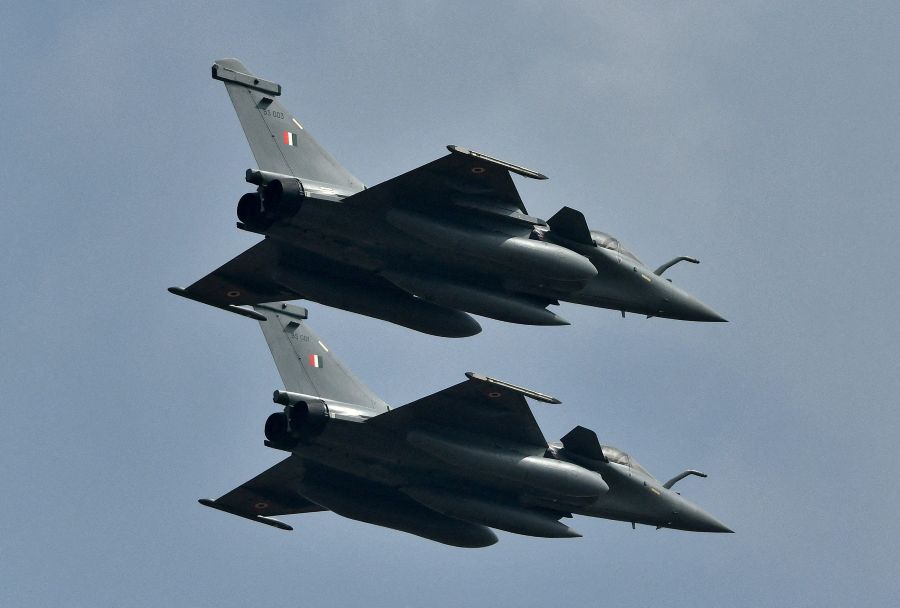
The Defence Ministry has received and begun examining the Indian Air Force’s (IAF) formal proposal to acquire 114 ‘Made in India’ Rafale fighter jets, marking a significant step forward in the long-stalled Multi-Role Fighter Aircraft (MRFA) programme.
BharatShakti had first broken the story in April – before Operation Sindoor – that the IAF was preparing to push for more Rafales to stem its acute fighter squadron depletion.
Also Read: Rafale Surge: IAF Eyes 40 More Jets as Navy Deal Nears Signing
Rafale Emerges as Frontrunner
Originally envisioned as a global tender, the MRFA project has seen no Request for Proposal (RFP) issued for years. Insiders say the IAF’s operational familiarity with the Rafale, combined with urgent combat readiness requirements, has made Dassault Aviation’s fighter the clear frontrunner – effectively bypassing the prolonged competitive process.
The project, estimated to be worth over Rs 2 lakh crore, will be anchored in India with over 60% indigenous content, bringing together Dassault and Indian aerospace firms. The Defence Procurement Board, chaired by the Defence Secretary, is expected to deliberate on the proposal in the coming weeks.
A Shrinking Force
The urgency is apparent. The IAF today operates only 31 squadrons against an authorised strength of 42.5. With two MiG-21 squadrons retiring this month, the force faces its sharpest shortfall in decades. Earlier this year, Air Chief Marshal A.P. Singh warned that India needs to induct 35–40 new fighters annually to offset the depletion of its existing fleet. HAL’s Tejas Mk-1A line, with 97 jets due by 2030, is promising but insufficient to plug the gap.
Interim Option: Two Squadrons of Rafales and Su-57
As a stopgap, the government is considering acquiring two additional Rafale squadrons via a government-to-government (G2G) deal with France. These fighters can be seamlessly integrated into existing infrastructure, reducing costs and providing a rapid boost to frontline strength.
At the same time, the IAF is also exploring the possibility of inducting the Russian 5th-generation Su-57 stealth fighters. Though still under development, sources suggest the jet could provide a potent capability boost in the interregnum. With its design philosophy closely aligned to the IAF’s Su-30MKI, pilot conversion and ground crew maintenance are expected to be relatively smoother if the Su-57 is chosen.
The Rafale purchase would also build on the ongoing Safran-led jet engine co-development in India, opening doors for deeper industrial synergies and new opportunities for Indian MSMEs in defence manufacturing.
Combat-Proven Edge
The Rafale’s appeal is not just industrial—it is battlefield-proven. During Operation Sindoor, Rafales decisively outmatched Pakistan’s PL-15 missile threat using their Spectra electronic warfare suite, reinforcing their credibility in South Asia’s contested skies.
Globally, the jet has seen action in Syria, Libya, and Mali, while in India, it has already proven its high-altitude performance in Ladakh. With advanced Meteor air-to-air missiles, SCALP stand-off weapons, and AESA radar, the Rafale represents a generational leap over legacy fleets like the MiG-21, MiG-29, and Jaguar.
A Joint Services Advantage
Adding to its case, the Rafale enjoys 95% commonality with the Navy’s Rafale-M, ensuring shared logistics, training, and maintenance efficiencies – an unusual convergence that strengthens the argument for standardisation across services.
Ravi Shankar

Dr Ravi Shankar has over two decades of experience in communications, print journalism, electronic media, documentary film making and new media.
He makes regular appearances on national television news channels as a commentator and analyst on current and political affairs. Apart from being an acknowledged Journalist, he has been a passionate newsroom manager bringing a wide range of journalistic experience from past associations with India’s leading media conglomerates (Times of India group and India Today group) and had led global news-gathering operations at world’s biggest multimedia news agency- ANI-Reuters. He has covered Parliament extensively over the past several years. Widely traveled, he has covered several summits as part of media delegation accompanying the Indian President, Vice President, Prime Minister, External Affairs Minister and Finance Minister across Asia, Africa and Europe.


