


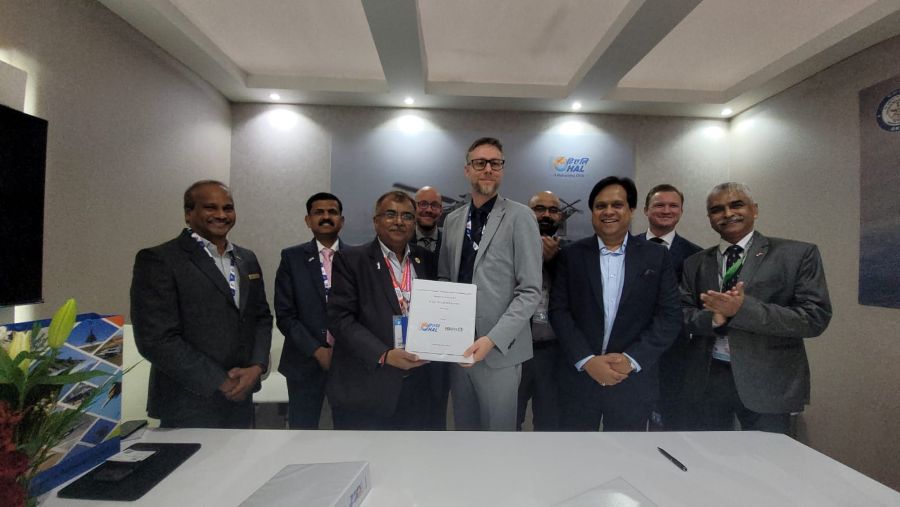
Hindustan Aeronautics Limited (HAL) and German defence electronics major Hensoldt have signed an agreement at the Dubai Airshow 2025 to jointly develop and indigenise a next-generation Obstacle Avoidance System (OAS) for Indian military helicopters. The system is designed to significantly reduce the risk of helicopter crashes during low-visibility and low-altitude operations. One such incident in December 2021 claimed the life of India’s first Chief of Defence Staff (CDS), General Bipin Rawat.
The agreement includes comprehensive transfer of technology (ToT), joint ownership of design and manufacturing intellectual property (IP), and full export rights for HAL, placing India among a select group of nations capable of fielding sovereign LiDAR-based helicopter safety systems. The pact follows an MoU signed in 2023 covering design and technology transfer for the system.
Helicopter operations in India routinely take place in some of the world’s most challenging environments, from the Himalayas and Northeast to densely populated urban landscapes, deserts and coastal belts. These conditions often involve poor visibility, unpredictable weather and confined landing spaces, making Controlled Flight Into Terrain (CFIT) a persistent operational threat.
“Obstacles in or near the flight path often pose a significant danger to helicopters, particularly cables, pylons and towers,” Hensoldt said. “Our system provides smart visual cues to reduce pilot workload and enhance mission safety, especially during adverse visual conditions.”
Where pilot visibility is insufficient, the OAS uses advanced software to collect and process real-time data from sensors and onboard databases, presenting the information in a visual interface that improves situational awareness.
LiDAR-Based Technology for Real-Time Terrain Awareness
Hensoldt’s solution combines its SferiSense fibre-scanner LiDAR, a high-speed Degraded Visual Environment (DVE) processor and synthetic-vision algorithms to produce a stabilised three-dimensional picture of the operating environment. The system can detect wires, ridgelines and other micro-obstacles more than one kilometre away, with sub-second reaction alerts, crucial for high-risk operations in fog, snow, sandstorms and night-time missions.
LiDAR technology provides a level of precision far exceeding traditional radar systems, including for threats that radars struggle with, such as cables approached parallel to the flight path. The system is also designed to be resistant to jamming and boasts strong angular-tracking performance.
The architecture is modular, scalable, and sensor-agnostic, complying with FACE and JCA standards and enabling integration into current and future Indian military helicopter platforms, both manned and unmanned.
Deep Technology Transfer and Sovereign Capability
Unlike traditional buyer-supplier arrangements, the HAL–Hensoldt agreement involves deep technology transfer, enabling HAL to manufacture, integrate and support the OAS domestically. Crucially, HAL retains export rights for OAS-equipped systems, helping India position its helicopter platforms more competitively in the international market.
The partnership reduces long-term reliance on foreign suppliers for critical safety systems, marks a structural shift toward sovereign capability in military avionics, and strengthens India’s aerospace research and manufacturing ecosystem.
Export Opportunity for India
The programme comes at a time of growing international demand for advanced helicopter safety suites due to harsher deployment environments, expanded military aviation activity and heightened focus on preventing CFIT incidents. The system is expected to boost India’s defence export ambitions, which aim to reach Rs 50,000 crore by 2029.
Once certified, the new OAS will be progressively integrated across India’s indigenous helicopter fleet. HAL engineers said the system’s flexible design will allow the inclusion of additional sensors, upgraded computing capability and evolving mission packages in future, keeping Indian helicopters aligned with global aviation safety expectations.
Huma Siddiqui