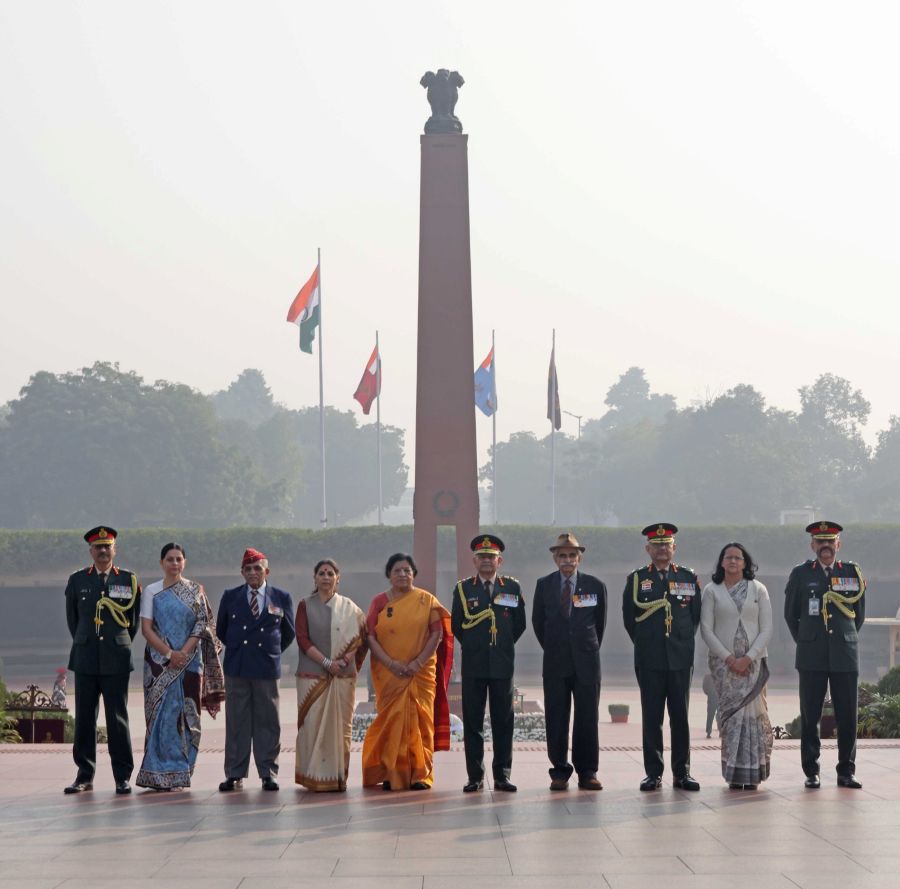
A silence that lasted nearly four decades was finally broken today at the National War Memorial, where the Indian Army held the first official commemoration for the soldiers of Operation Pawan, the Indian Peace Keeping Force’s (IPKF) mission in Sri Lanka. Led by Army Chief General Upendra Dwivedi, the ceremony marked the nation’s long-overdue acknowledgement of the 1,171 soldiers who died and more than 3,500 who were wounded during India’s first major overseas military deployment.
Wreaths were laid in memory of Major R. Parameshwaran, PVC, the lone Param Vir Chakra awardee of the operation, and every soldier who served between 1987 and 1990 in one of the most complex and politically fraught missions in India’s military history. Gen Dwivedi was accompanied by Vice Chief of Army Staff Lieutenant General Pushpendra Singh, himself an IPKF veteran who was critically injured as a young officer in 1989.
A First Step After Years of Silence
For years, Operation Pawan had existed in a painful vacuum. Even as Sri Lanka erected a memorial in Colombo honouring the IPKF, India offered no formal remembrance, no designated day, and no plaque at the National War Memorial acknowledging the operation. Veterans, widows, and families had been quietly gathering each year for what they called a “silent ceremony,” without bugles, without protocol, without institutional recognition.
Today’s ceremony ends that silence. For the first time, the country’s highest military leadership stood with the veterans, recognising the operation’s sacrifices and its role in shaping India’s strategic history.
“This is the acknowledgement we waited nearly four decades for,” said one veteran present at the ceremony. “For the first time, we feel seen.”
Why This Recognition Matters
Operation Pawan was unlike any mission India had undertaken before. Deployed under the Indo–Sri Lanka Accord, the IPKF was tasked with enforcing peace and disarming militant groups, including the LTTE. The mission tested the Indian Army in unfamiliar terrain, under shifting political pressures, and amid intense combat.
Yet for many years, its soldiers were caught in an uncomfortable silence, honoured individually through gallantry awards but collectively absent from the nation’s military narrative. The absence of recognition compounded the grief of families who had lost loved ones and left veterans feeling that their service had been relegated to the margins.
By officially commemorating OP Pawan today, the Army has begun correcting that historical omission. It is an important symbolic step, one that validates the courage of the fallen, the resilience of the wounded, and the service of all who participated in the operation.
The Unfinished Work: Closure Still Pending
Veterans and military historians agree that while today’s event marks a breakthrough, true closure has not yet been achieved.
What remains unresolved is formal, institutional recognition of OP Pawan as a key chapter in India’s military history, on the same footing as the 1971 Liberation War or the 1999 Kargil conflict.
Despite several years of deliberation within the Ministry of Defence, India still lacks: an officially designated OP Pawan Remembrance Day; a permanent memorial plaque at the National War Memorial; formal classification of Operation Pwawn as a major military operation; and Institutional acknowledgement in military records, museums, and public memory.
As Lt Col (Retd) Channan, IPKF veteran, observed, “Honour without formal recognition remains incomplete. The nation owes these veterans and their families not just gratitude, but closure.”
A Reminder of What Must Follow
Today’s ceremony, attended by veterans, widows, families, and senior commanders, was marked by solemnity and relief in equal measure. Bugles sounded for the first time for OP Pawan. The fallen were named. Their sacrifice was spoken aloud.
For many families, it was the emotional moment they had waited generations to witness.
Yet the event also underscored how much remains to be done. The recognition is historic, but it is only the beginning. The legacy of Operation Pawan cannot rest solely on a single ceremony; it must be preserved through enduring institutional remembrance.
The Road Ahead
With today’s commemoration, the Indian Army has taken a decisive step toward righting a decades-long oversight. The challenge now lies in ensuring that OP Pawan receives the enduring place it deserves in India’s military memory.
Huma Siddiqui