



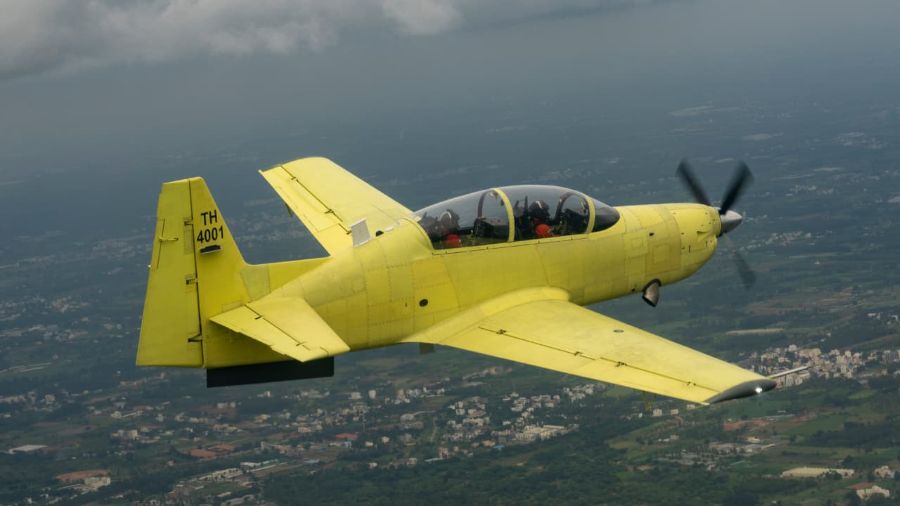
India’s indigenously developed Hindustan Turbo Trainer-40 (HTT-40) marked a major milestone today as the first series production aircraft (TH-4001) completed its maiden flight from the Hindustan Aeronautics Limited (HAL) facility in Bengaluru. The successful flight signifies a crucial step in modernising the Indian Air Force’s (IAF) basic trainer fleet. It underscores India’s advancing capabilities in indigenous aerospace design, manufacturing, and self-reliance under the ‘Atmanirbhar Bharat’ initiative.
The HTT-40 is a tandem-seat, fully aerobatic turboprop trainer designed to conduct Stage-I pilot training, including aerobatics, instrument flying, formation, and night operations. Developed entirely by HAL through internal funding, the aircraft fills the void left by the retirement of the HPT-32 Deepak trainer and represents a major leap in India’s indigenous design and production capability.
In March 2023, the IAF placed an order for 70 HTT-40 aircraft, which will operate alongside the Swiss-origin Pilatus PC-7 Mk-II trainers currently in service.
Production and Delivery Schedule
HAL is preparing to commence deliveries of the HTT-40 from February 2026, following a nearly six-month delay due to supply chain disruptions affecting the delivery of Honeywell TPE331-12B turboprop engines. The American manufacturer, which supplies the 1,100-shaft-horsepower engines for the aircraft, encountered logistical constraints that impacted the original 2025 delivery schedule.
According to sources, Honeywell has now assured regular deliveries of three engines per month starting in 2026, allowing a stable production ramp-up to meet the IAF’s training requirements.
The delay mirrors similar supply challenges faced by GE Aerospace, whose F404-IN20 engines for the Light Combat Aircraft (Tejas Mk-1A) have also been behind schedule. Despite these hurdles, HAL has revised its production plan to ensure that the first batch of three HTT-40 aircraft is handed over to the IAF by February 2026. Each aircraft will carry a serial number in the “TH-4000” series, with TH-4001 as the lead unit.
A Shift Toward Indigenous Manufacturing
The rollout of the HTT-40 marks a transformation at HAL’s Nashik division, which is long known for assembling Russian-origin fighters like the MiG and Su-30MKI, into a centre for fully indigenous aircraft production, including the Tejas Mk-1A and HTT-40.
The program underscores India’s expanding aerospace ecosystem. Over 38% of the HTT-40’s components are sourced from Indian suppliers, many from the MSME sector, including around 100 private firms that supply precision-machined parts, empennages, and subsystems. This distributed supply chain model not only promotes self-reliance but also strengthens India’s domestic defence industrial base.
Technical Highlights and Performance
The Hindustan Turbo Trainer-40 (HTT-40) is a two-seat turboprop trainer designed to deliver versatile, high-performance flight training. Its Honeywell TPE331-12B engine produces approximately 1,100 shaft horsepower, giving the aircraft a top speed of about 450 kilometres per hour and a range of 1,000 kilometres with external fuel tanks. It can sustain flight up to 20,000 feet and remain airborne for more than 3 hours, making it well-suited for intensive flight training missions.
The HTT-40 has a maximum take-off weight of around 2,800 kilograms and accommodates an instructor and trainee in a pressurised tandem-seat cockpit equipped with dual flight controls. Safety and comfort are ensured through ejection seats, G-suit compatibility, and a modern environmental control system designed for long-duration sorties.
Its glass cockpit integrates multi-function displays, a digital flight data recorder, and advanced communication systems, providing trainee pilots with an environment similar to that of frontline combat aircraft. A fully digital, triple-redundant flight control system ensures precise handling and stability throughout flight operations.
Beyond basic flight and navigation training, the aircraft is designed for instrument, formation, and night flying. Advanced variants can be configured for weapons familiarisation, with provisions for gun pods and practice bombs.
Its modular design, with line-replaceable units (LRUs), facilitates rapid maintenance and reduces operational downtime —an essential feature for high-frequency training schedules.
With its rugged design, fuel-efficient engine, and adaptable avionics, the HTT-40 is not only an ideal trainer for the IAF but also has fair export potential across Africa, Southeast Asia, and Latin America, where air forces seek cost-effective, dependable basic training solutions.
Certification and Export Readiness
HAL is working toward obtaining multiple certifications to bolster the HTT-40’s global standing. These include the Air Staff Qualitative Requirements (ASQR) clearance from the Indian Air Force and FAR-23 certification from the U.S. Federal Aviation Administration (FAA).
Huma Siddiqui


