


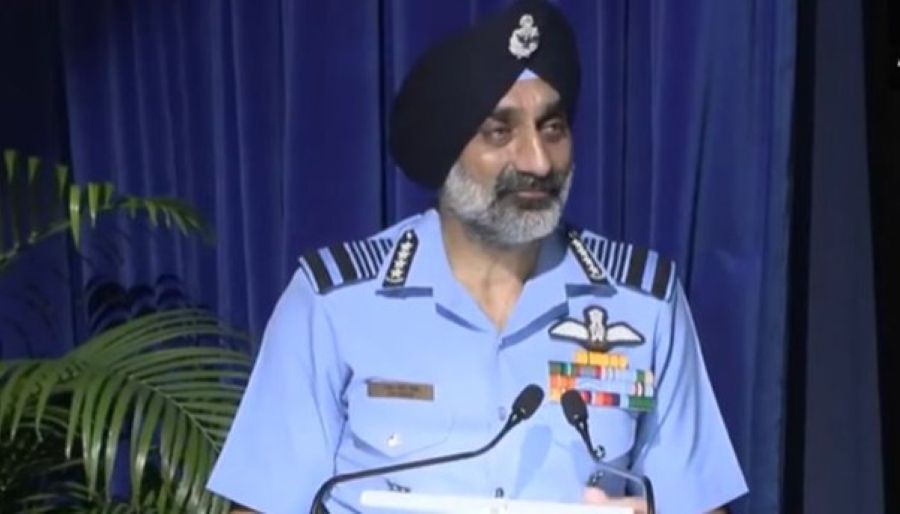
Air Chief Marshal AP Singh on Friday urged the armed forces to maintain a calibrated mix of manned platforms and unmanned systems, backed by long-range, heavy-calibre firepower, warning that wars cannot be won by drones alone and that political clarity on objectives matters as much as weaponry.
Speaking at the Air Force Association’s Annual General Meeting, the IAF Chief said Operation Sindoor demonstrated India’s ability to plan and execute joint operations with “full freedom” and clear objectives. He described the operation as a case study in effective jointness: all three services, the Chief of Defence Staff and national agencies, including the NSA, planned and acted together, he said.
“The operation showed the value of a happy mix of manned and unmanned systems,” he told the gathering. “Many drones operating together can saturate a system, but winning a war cannot rely solely on drones. We must retain and strengthen long-range capabilities, heavy-calibre weapons, and aircraft that can deliver long-range missiles.”
Singh singled out the S-400 and its associated long-range radars as a decisive element in Operation Sindoor, saying the system’s detection range exceeded the weapon release range of adversary aircraft, denying them freedom to operate and exposing them to counter-strike. “Their range was more than the range of their weapons, so they could never even come up to the weapon release range without being threatened, those who came had to face damage. So this was a game-changer,” he said.
He highlighted that many of the systems used in the operation were newly acquired and largely indigenous, either produced in India or integrated by Indian teams. “I hope this trend continues,” he added.
On the results of the campaign, Singh said Indian forces struck their assigned terrorist targets accurately and inflicted significant damage on Pakistan’s infrastructure, including radars, control and coordination centres, hangars and aircraft. But he was equally emphatic about why India chose to stop the fighting once its stated aim was achieved.
Addressing calls from some quarters for prolonged action, the Air Chief Marshal said those voices missed the point of the campaign. “We were given terrorist targets, and we struck them accurately. When our enemies refused to stop the war and attempted to attack us, we struck them hard. Many of their bases were damaged. A significant portion of their infrastructure suffered extensive damage,” he said. “But India terminated the conflict because it had met its main objective – anti-terrorism.”
Singh warned against mission creep and the political and strategic cost of open-ended fighting. “Continuing conflict will affect the progress of the country,” he argued, adding that India had set an example of how to start and terminate a conflict at the earliest possible opportunity. He cautioned that external observers who call for continued action often lack clarity about the original targets and objectives: “So, I think this is what the world is forgetting. They do not know what our target was when we started the war. Now their goalpost is shifting. Egos are coming in between.”
Taken together, his remarks stressed two linked themes: the technical need for balanced force modernisation, including manned platforms, unmanned systems, long-range missiles, and integrated air defence, and the strategic imperative of clearly defined, achievable political objectives. For Singh, the efficacy of modern systems must be matched by disciplined decision-making at the political level, so that military action remains purposeful, limited, and aligned with national interests.
Team BharatShakti