


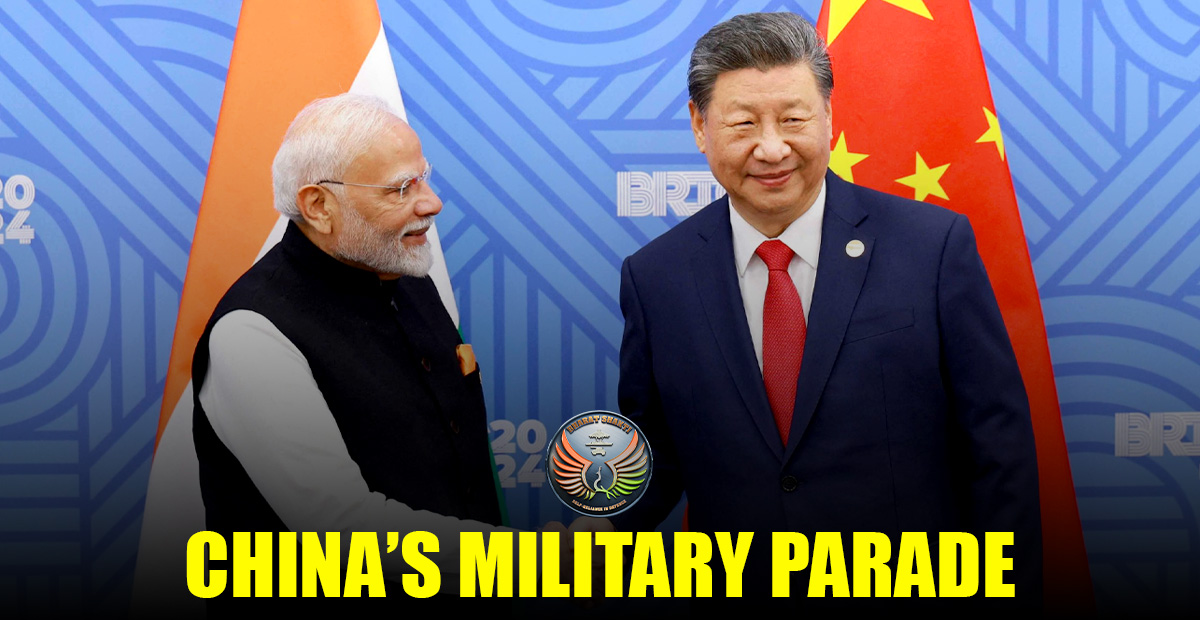
Prime Minister Narendra Modi’s potential participation in China’s Victory Day parade next month cannot be viewed in isolation. With U.S.–India ties strained by President Donald Trump’s steep tariff measures linked to New Delhi’s continued oil trade with Russia, India may find tactical value in signalling a limited thaw with Beijing. This perspective gains weight as the China–India border dispute is increasingly framed as a “political issue” that is “solvable.” In fact, from August 18 to 20, Chinese Foreign Minister Wang Yi, Beijing’s Special Representative on the boundary talks, will visit India to hold the 24th round of negotiations with his Indian counterpart, a move that suggests both sides are exploring pathways to stabilise ties.
Against this backdrop, Modi’s confirmed attendance at the Shanghai Cooperation Organisation (SCO) summit in Tianjin (August 31–September 1) places India in a pivotal position ahead of China’s military parade in Beijing on September 3, which will mark the 80th anniversary of the end of World War II. Whether Modi is invited to the parade itself remains unclear, but the possibility alone underscores New Delhi’s delicate role in Asia’s shifting strategic landscape.
The parade, to be held at Tiananmen Square, will be only the second of its kind since 2015. Chinese officials say it will feature cutting-edge military capabilities, including hypersonic systems, unmanned platforms, cyber warfare units and advanced naval assets, alongside traditional formations of the People’s Liberation Army (PLA). President Xi Jinping is expected to preside over the event and deliver a keynote speech positioning China as both a wartime victor and a modern guarantor of global order.
This year’s commemoration has drawn an unusually high-level turnout from Southeast Asia. Indonesian President Prabowo Subianto, Malaysian Prime Minister Anwar Ibrahim and Vietnamese President Luong Cuong are expected to be present. Leaders from Cambodia, Laos and Myanmar are also scheduled to attend, first taking part in the SCO summit (August 31–September 1) before heading to Beijing. Russia’s Vladimir Putin, along with the Serbian and Slovak leaders, has confirmed his presence, giving the event a broader international profile.
For India, the timing is sensitive. New Delhi remains a core member of the SCO and sees value in engaging with Eurasian multilateral structures. Yet its relations with Beijing continue to be strained after the 2020 border clashes in Ladakh, and trust on security issues remains limited. At the same time, India has deepened its strategic partnerships with the United States, Japan and Australia through the Quad framework, underscoring its effort to balance China’s growing influence.
Modi’s attendance at the SCO summit signals continuity in India’s commitment to dialogue and regional engagement. But extending that presence to Beijing’s military parade would carry symbolic implications far beyond the SCO platform. Beijing could read it as a diplomatic endorsement of its narrative of military resurgence, while Washington and Tokyo might interpret it as India leaning closer to China at a time of intensifying U.S.–China rivalry.
For Xi Jinping, securing Modi’s presence would be a diplomatic coup, reinforcing the message that Beijing’s regional leadership cannot be ignored even by rivals. For India, however, the calculus is more complex: it must balance participation in multilateral forums with the need to safeguard its strategic autonomy and avoid being drawn into China’s orchestrated display of power.
As Beijing seeks to project stability and military strength, New Delhi faces the task of demonstrating that its presence in such forums stems from a commitment to multilateralism, not alignment with China’s geopolitical ambitions. Whether Modi limits his role to the SCO summit or extends it to the military parade will therefore be closely scrutinised, both as a reflection of India’s immediate diplomatic choices and as an indicator of how it intends to navigate the sharpened fault lines of Asian geopolitics.
Ravi Shankar

Dr Ravi Shankar has over two decades of experience in communications, print journalism, electronic media, documentary film making and new media.
He makes regular appearances on national television news channels as a commentator and analyst on current and political affairs. Apart from being an acknowledged Journalist, he has been a passionate newsroom manager bringing a wide range of journalistic experience from past associations with India’s leading media conglomerates (Times of India group and India Today group) and had led global news-gathering operations at world’s biggest multimedia news agency- ANI-Reuters. He has covered Parliament extensively over the past several years. Widely traveled, he has covered several summits as part of media delegation accompanying the Indian President, Vice President, Prime Minister, External Affairs Minister and Finance Minister across Asia, Africa and Europe.


