


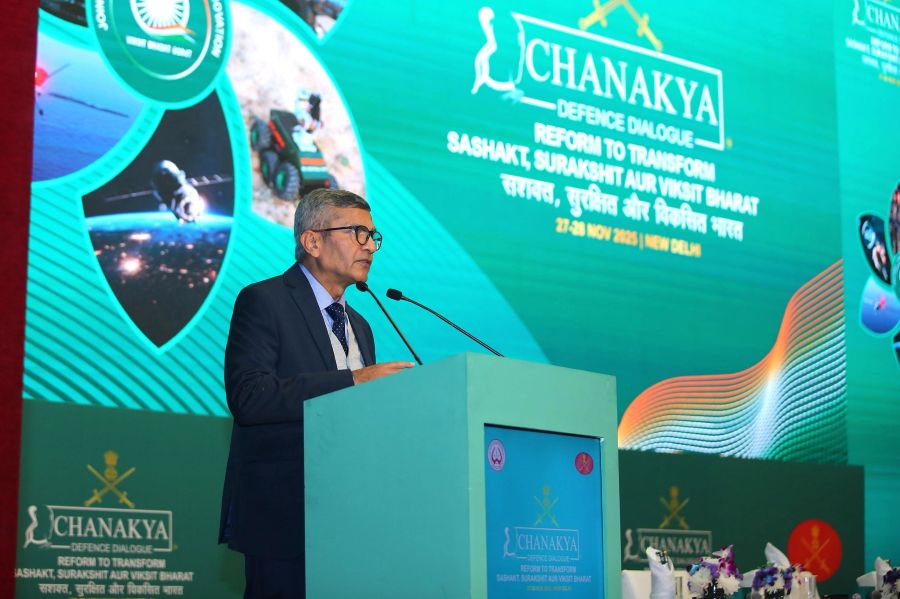
India must shed legacy silos, break structural inertia, and embrace a unified, market-responsive defence ecosystem if it is to emerge as a global defence industrial and technological powerhouse, Defence Secretary Rajesh Kumar Singh asserted on Thursday. Delivering a special address at the Chanakya Defence Dialogue 2025 on the theme “Re-imagining Defence Reforms for a Resilient National Security,” Singh outlined the government’s reform-heavy roadmap under Viksit Bharat 2047 and called for a fundamental transformation in how India conceptualises, builds and sustains military power.
Singh emphasised that resilience, jointness, and self-reliance form the bedrock of India’s future military preparedness. He urged the Armed Forces, industry, academia, startups and the innovation ecosystem to become “active architects of transformation” rather than passive participants in procurement-driven processes.
India’s Next Big Leap: A Hybrid Defence Industrial Complex
In his most striking remarks, the Defence Secretary argued that India must emulate the Chinese model of a hybrid defence industrial complex, seamlessly integrating public-sector capacity with private-sector agility and market discipline.
“We need to emulate admittedly successful adversaries like China, which have built a hybrid defence industrial machine able to blend central direction with market discipline, enforce dual-use R&D, and scale up complex systems very quickly,” Singh said.
He pointed out that India’s current trajectory, where Defence Public Sector Undertakings (DPSUs) increasingly partner with private firms on large platforms, including drone procurement programmes, is a promising start but is still far from the integrated vision required.
Singh proposed:
- Merging DPSUs and private firms into dual-production pipelines
- Mandating DPSUs to operate through focused subsidiaries with clear targets
- Creating a level playing field for private sector to ensure Indian companies hold Intellectual Property Rights (IPR) for critical systems
- Leveraging government buying power to expand the domestic industrial base and boost exports
A Defence Vision Anchored in Viksit Bharat 2047
The Defence Secretary’s agenda aligns with the government’s broader strategic goals to:
- Modernise the Armed Forces with disruptive technologies
- Deepen indigenisation and reduce import dependencies
- Secure access to critical minerals
- Strengthen defence exports and production economies of scale
- Reform human-resource systems and improve veteran welfare
He reiterated that defence expenditure should not be viewed as non-developmental spending, noting its multiplier effect on GDP, employment, skill growth, innovation, and dual-use technologies.
‘Might is Right’: The Global Strategic Reset
Singh sounded a cautionary note on deteriorating global geopolitics:
“We are getting back to a situation where might is right. The law of the jungle seems to be making a comeback.”
He cited the decline of multilateral institutions, increasing weaponisation of tariffs, and the rise of bilateral defence alliances as indicators of a world returning to hard power politics. Countries previously insulated from conflict, such as Indonesia, are now preparing to raise nearly 500 battalions and are rapidly rearming.
In such an environment, Singh stressed, technological and industrial superiority would be India’s decisive shield:
“If you become a technological and industrial powerhouse in defence, national security takes care of itself. With such an advantage, you can win conflicts – short or long.”
India’s defence transformation, Singh concluded, demands more than incremental improvement; it calls for structural reinvention. Moving from decades of public-sector dominance towards a genuine public–private industrial partnership, rooted in shared capability, indigenous technologies, and export competitiveness, is no longer aspirational but imperative.
The message from the Defence Secretary was clear:
India cannot secure its place as a global power unless it builds, like China, a defence ecosystem that innovates, produces, and scales with a unified national purpose.
Ravi Shankar

Dr Ravi Shankar has over two decades of experience in communications, print journalism, electronic media, documentary film making and new media.
He makes regular appearances on national television news channels as a commentator and analyst on current and political affairs. Apart from being an acknowledged Journalist, he has been a passionate newsroom manager bringing a wide range of journalistic experience from past associations with India’s leading media conglomerates (Times of India group and India Today group) and had led global news-gathering operations at world’s biggest multimedia news agency- ANI-Reuters. He has covered Parliament extensively over the past several years. Widely traveled, he has covered several summits as part of media delegation accompanying the Indian President, Vice President, Prime Minister, External Affairs Minister and Finance Minister across Asia, Africa and Europe.