



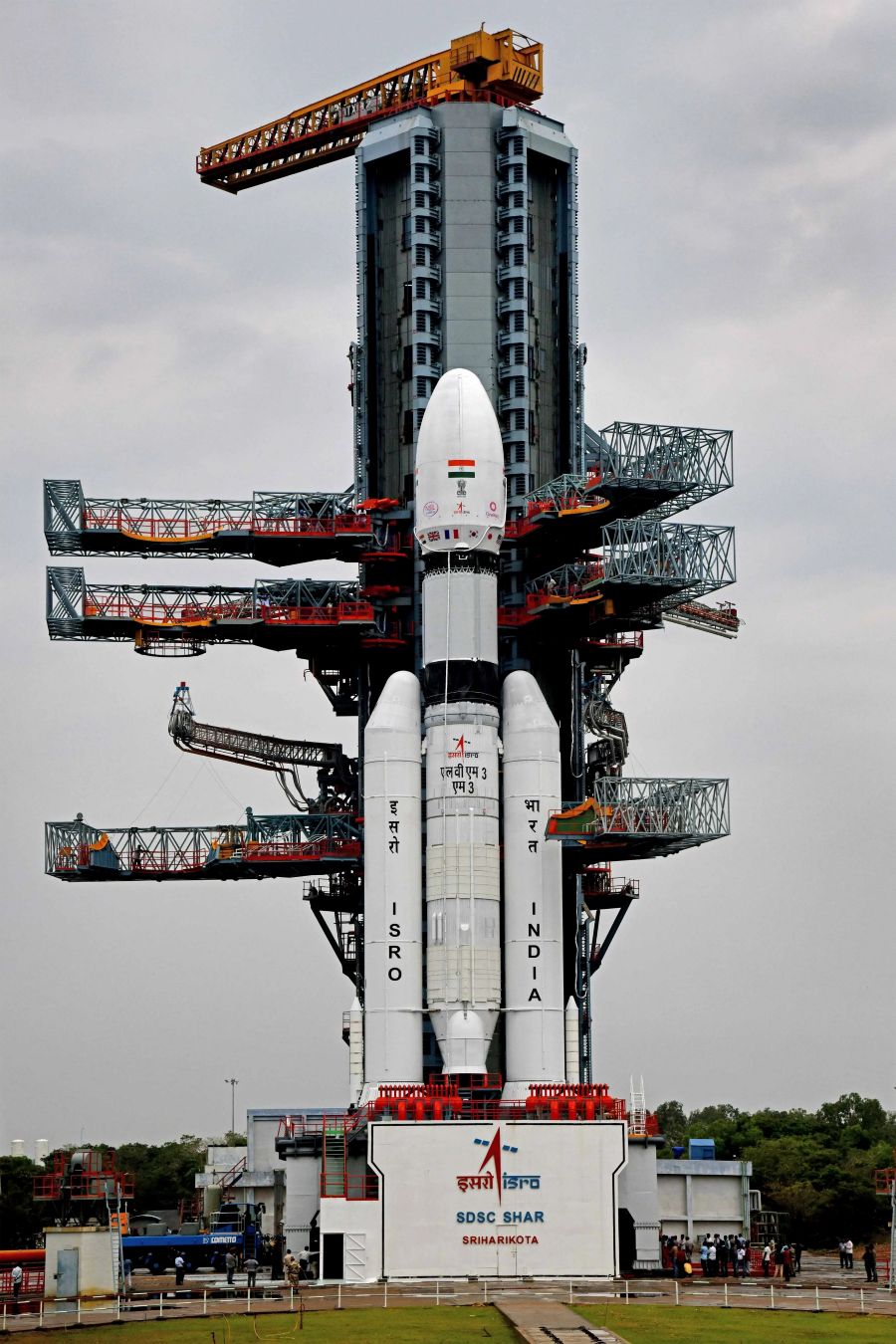
The Indian Space Research Organisation (ISRO) is poised to launch the CMS-03 military communication satellite, also designated as GSAT-7R, on November 2 from the Satish Dhawan Space Centre in Sriharikota. This mission marks an important augmentation to India’s maritime security infrastructure and highlights the nation’s growing leadership in advanced space technology amid a rapidly evolving global space economy.
About the Satellite
The CMS-03 satellite, weighing 2,650 kilograms, will be placed into geostationary orbit aboard ISRO’s heavy-lift LVM-3 (Launch Vehicle Mark-3) rocket during the LVM3-M5 mission.
Funded by the Ministry of Defence at an estimated cost of Rs 1,589 crores (approximately $225.5 million), the satellite is designed exclusively for the Indian Navy. It serves as the successor to GSAT-7 (Rukmini), which has been operational since 2013. ISRO Chairman V. Narayanan confirmed during a press briefing that the launch is scheduled for early November, while Vikram Sarabhai Space Centre Director A. Rajarajan specified November 2 as the target date.
The satellite will launch from the Second Launch Pad at Sriharikota, a facility specifically designed for GSLV and LVM-3 rockets and capable of supporting India’s most ambitious space missions, including the upcoming Gaganyaan human spaceflight program.
With a designed mission life of seven years, CMS-03 will provide advanced communication capabilities essential for securing India’s maritime borders. It will support surveillance, reconnaissance, navigation, and weather monitoring across the Indian Ocean Region, enabling voice, video, and data transmission among naval ships, submarines, and aircraft operating up to 2,000 kilometres from the Indian coastline. The satellite will utilise multiple frequency bands, including UHF, S, C, and Ku, to ensure robust and secure communications under all operational conditions.
The LVM-3, formerly known as the GSLV Mk III, represents India’s most powerful indigenous launch vehicle. Standing 43.5 meters tall with a lift-off mass of 640 tonnes, it features a three-stage configuration with two massive S200 solid strap-on boosters, a liquid L110 core stage with twin Vikas engines, and a cryogenic C25 upper stage powered by the CE20 engine.
With a perfect success record across seven missions, the LVM-3 can deliver 4,000 kilograms to geostationary transfer orbit and 10,000 kilograms to low Earth orbit. It has already proven its reliability in landmark missions such as Chandrayaan-2 and Chandrayaan-3 and is designated for the forthcoming Gaganyaan program.
Following the CMS-03 launch, ISRO plans another LVM-3 mission in early December to deploy BlueBird-6, a 6.5-tonne commercial communications satellite from a U.S. company, one of the heaviest commercial payloads ever launched from India. The satellite arrived in India on October 19, and its deployment will further demonstrate ISRO’s growing commercial capabilities.
CMS-03 will play a pivotal role in enhancing India’s naval communication architecture and enabling network-centric warfare capabilities. It will significantly expand secure multi-band communications for the Navy’s blue-water operations, ensuring seamless real-time coordination among warships, submarines, and aircraft. With upgraded payloads and enhanced coverage, GSAT-7R will strengthen India’s operational reach across critical maritime domains, supporting surveillance missions, tactical coordination, and continuous communication even in contested or remote areas. Space and Defence experts note that this satellite will reduce reliance on foreign communication services and bolster India’s autonomy in safeguarding its vast maritime interests.
ISRO Chairman V. Narayanan has stated that at least ten satellites continuously operate for strategic defence purposes, enhancing the safety and security of Indian citizens through advanced surveillance, navigation, and communication capabilities. Together, these satellites serve as critical force multipliers for the Army, Navy, and Air Force, integrating modern defence operations with cutting-edge space technology.
The CMS-03 launch comes at a time when the global space economy is expanding rapidly. The global military communication market is projected to grow from $34.28 billion in 2025 to $55.77 billion by 2032, while the military satellite market is expected to reach $30.02 billion by 2032. This growth reflects a worldwide demand for secure communication and intelligence systems, with major players such as Lockheed Martin, Northrop Grumman, Raytheon Technologies, and BAE Systems driving innovation. Meanwhile, nations like India, China, and Japan are accelerating indigenous satellite programs to strengthen defence capabilities and capture emerging market opportunities.
India currently holds less than 2% of the global commercial space market but aims to capture up to 10% in the next decade. ISRO has launched more than 430 satellites for 34 countries, generating over Rs 3,100 crores in revenue. The commercial launch market alone is projected to grow from $9.4 billion in 2025 to $36.7 billion by 2035, driven by increasing global demand for satellite-based services. The Asia-Pacific region, where India plays a pivotal role, is the fastest-growing market, expected to reach $169 billion by 2030.
Technological innovation is also reshaping the global space landscape. Low Earth Orbit (LEO) satellite constellations such as Starlink, Project Kuiper, and China’s Guowang are revolutionising global broadband connectivity. Artificial intelligence and machine learning are enabling satellites to perform autonomous decision-making and real-time data analysis, while quantum communication technology promises unbreakable secure communication channels, essential for defence and strategic operations.
Reusable launch systems and multi-orbit satellite networks are further reducing launch costs and enhancing connectivity across maritime, aviation, and government sectors. Meanwhile, space debris mitigation technologies are being developed to ensure sustainable space operations through controlled de-orbiting and debris removal missions.
India’s commitment to international cooperation has also strengthened its position as a leading spacefaring nation. The country has signed agreements with over 60 nations and joined the U.S.-led Artemis Accords in 2023, marking a major shift in its space diplomacy. Partnerships like the U.S.-India TRUST initiative and the successful launch of the NASA-ISRO Synthetic Aperture Radar (NISAR) satellite in 2025 highlight India’s role in global scientific and strategic collaborations.
The CMS-03 mission is part of ISRO’s broader roadmap, which includes the Gaganyaan human spaceflight mission in 2027, the development of India’s own space station by 2035, and ambitious interplanetary missions such as Chandrayaan-4 and Shukrayaan. ISRO plans to triple its current number of satellites within the next four years and increase launch frequency to meet growing national and global demands.
As India advances its strategic and commercial space ambitions, the launch of CMS-03 will mark a milestone in its journey toward becoming a comprehensive space power. It represents not just technological prowess but also strategic foresight, positioning India as a formidable player in global space exploration, defence, and innovation. The mission reflects the convergence of military strength, commercial opportunity, and scientific excellence, reaffirming India’s vision of a secure, self-reliant, and globally influential space future.
Huma Siddiqui


