


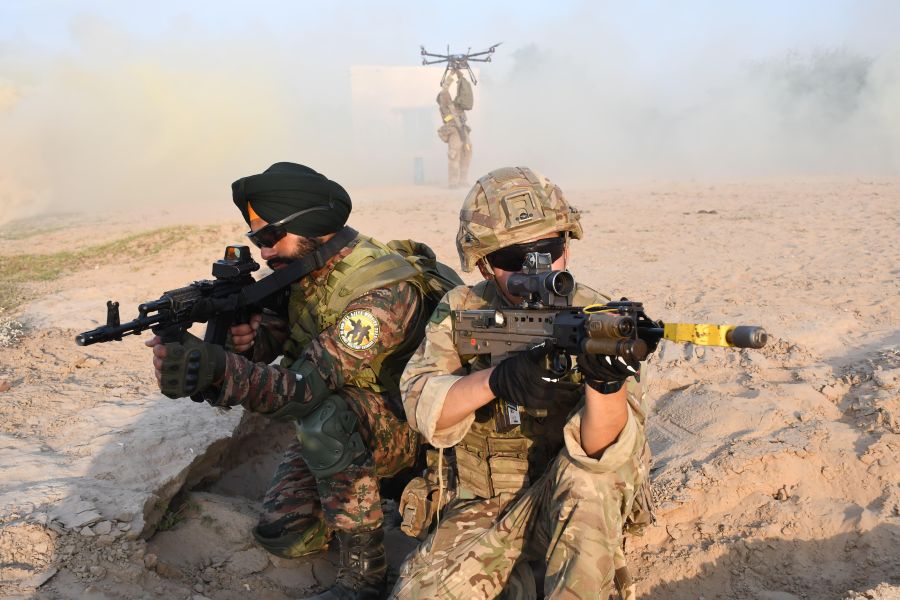
The latest edition of Ajeya Warrior, the flagship India–UK joint military exercise, is in full swing on the scorching sands of Rajasthan. This year’s drill, `Ajeya Warrior-25’, has entered a particularly high-intensity phase as both armies practice combat skills designed for today’s most volatile conflict zones.
With global terror networks adapting rapidly and UN peacekeeping missions confronting increasingly hybrid threats, military planners say the timing of this exercise could not be more critical.
Why the Exercise Matters Now
Defence officials from both countries point out three major reasons this year’s iteration has taken on heightened importance:
Evolving global terror threats: Modern extremist groups are shifting to dispersed, urbanised operations, requiring international forces to work together seamlessly in tight, high-risk environments.
Rising UN peacekeeping challenges: As both India and the UK remain active contributors to UN missions, the ability to coordinate under Chapter VII mandates, which authorise robust action, is essential for protecting civilians and stabilising crisis-hit regions.
Need for interoperable tactics in semi-urban conflict zones: Recent conflict trends show that peacekeepers often face ambushes, IEDs, and hybrid militant tactics in densely populated areas. Ajeya Warrior-25 directly trains troops for these realities.
Troops Engage in Realistic, High-Stress Scenarios
Around 240 soldiers, equally split between India’s Sikh Regiment and a high-readiness contingent from the UK Army, are undergoing drills that mirror the complexity of real operations.
The training includes:
- Intensive firing drills: reflex shooting, rocket-launcher engagements, sniper tasks and MMG operations.
- IED neutralisation sessions: sharing battle-tested procedures and case studies from recent global deployments.
- Urban and semi-urban combat modules: room-clearing, house intervention, convoy security, and road-opening patrols—skills increasingly critical in global peacekeeping missions.
- Heliborne insertion with ALH and Mi-17 helicopters: slithering and small-team airborne manoeuvres that enhance rapid response capability.
Each scenario is designed to replicate the stress, unpredictability and tactical fluidity of modern conflict.
Physical Conditioning and Team Cohesion at the Core
Beyond combat drills, daily regimens include: Yoga and conditioning routines; Five- and ten-mile endurance runs with full battle load; Battle obstacle courses; and Joint demonstrations of new-generation equipment.
These activities build shared discipline and resilience, key components for any future joint deployment.
Sports and Culture Strengthen Bonds
Troops have also taken time to build camaraderie off the field. Tug-of-war competitions, volleyball matches, and a lively Indo-UK cricket face-off have strengthened friendly ties. A cultural visit to Bikaner offered UK forces a glimpse of Rajasthan’s heritage and hospitality, reinforcing the human connection behind the military partnership.
Part of a Growing Strategic Convergence
Ajeya Warrior-25 reinforces a military partnership that has grown steadily over the past decade. The drill complements other India–UK engagements, such as Konkan (naval cooperation) and Indradhanush (air force engagement). It aligns with the broader Indo-Pacific security cooperation that both nations have been advancing.
The exercise comes shortly after major milestones, including Exercise Konkan-25 earlier this year and advanced subterranean training in the UK during the 2024 edition, reflecting the increasing sophistication of joint drills.
Preparing for the Battlefield of Tomorrow
Analysts say Ajeya Warrior-25 is more than an exercise; it is preparation for missions that demand fast decision-making, precision coordination, and resilience under pressure.
The focus on counter-terrorism, urban warfare, and UN-mandated operations positions both armies to handle High-risk peacekeeping deployments, hybrid and asymmetric threats, and crisis situations requiring rapid multinational response.
As the desert drills continue, officials stress that the objective remains unchanged: to ensure that Indian and British troops can operate together, effectively and decisively, in the world’s most challenging conflict zones.
Team BharatShakti